Editor's Note: Take a look at our featured best practice, Fiaccabrino Selection Process (44-slide PowerPoint presentation). The Fiaccabrino Selection Process is a powerful methodology for interviewing and screening the best people for your organization. The objective is to select those people who will be the highest performers with the lowest turnover.
(Whereas the methodology was originally developed for a sales [read more]
* * * *
 Mistakes are a part of life, but some mistakes carry severe penalties that could hurt your business and affect your personal life. Even with the over 15,000 tax rules that are constantly changing, the IRS won’t accept ignorance as an excuse. Since a small payroll mistake can cost your company thousands, avoid these common errors at all costs to avoid tax fees.
Mistake 1: Misclassifying Employees
Employees aren’t limited to the 9-5 variety; most businesses will hire semi-permanent temps or freelancers on a contract basis to fill out needed roles. When working with employees that require documentation beyond the W-2 payroll can become confusing. To know which employee needs additional documentation, research what is classified as a permanent or contract worker.
For example, a freelancer will need to fill out a 1099 form because they aren’t a permanent entity and won’t receive health insurance or tax breaks from your business. Some businesses will intentionally misclassify employees to avoid paying more taxes. However, if you do commit this payroll mistake, the business will be liable for paying their taxes anyway. Interest included.
Mistake 2: Filing the Correct Employee Form Incorrectly
Understanding the difference between a contract employee and a permanent worker won’t save you from a form that’s filled out with incorrect information. A mismatched name or a number missed on an employee’s social security number can cost you $100 per incorrect form. An employee may give you the wrong information by accident, but you can call 800-772-6270 to check up to 5 names or SSN. If the issue is more on the payrolls end, use FormPros to create multiple legally binding employee documents, including W-2 forms, to eliminate costly errors.
Mistake 3: Not Paying Non-Exempt Employees Overtime
W-2 and 1099 employees are further broken down into exempt and non-exempt employees in the eyes of the law. An exempt employee won’t receive overtime pay for any reason, while non-exempt workers are eligible as long as their shift exceeds 8 hours. The rules are complex, so it’s in your best interest to speak to a tax specialist before classifying employees.
In general, salary workers are exempt from overtime pay while hourly workers are almost always non-exempt employees, but most employers will avoid paying extra. Salary employees can be non-exempt if they exceed past the expected hours dictated in their contract.
Mistake 4: Missing Payroll Deadlines
Employees will start to resent you if you keep delaying payment they’re rightfully owed and will look for work elsewhere if you’re untrustworthy. You also run the risk of breaking compliance laws. The IRS requires deposits of withholding taxes, and small businesses are required to make quarterly estimates on their tax payments. If you miss important deadlines, the IRS will charge you fees, including a late penalty on each payroll tax deposit that isn’t paid in full.
Mistake 5: Poor Record Keeping and Withholding Errors
An error can present itself due to poor record-keeping, which becomes harder to correct as the tax year marches on. Following federal and state payroll record-keeping laws can keep you organized and save you from potential IRS troubles down the road. Retain payroll records for at least three to six years, depending on your business type or location.
Since small businesses make frequent tax calculation errors, it’s essential to backup all employee documentation. It’s possible to fill out a tax form incorrectly or forget to withhold certain taxes, which won’t be an issue if you catch these errors before filling.
Mistake 6: Miscalculating Wage Garnishments
When an employee receives a court order to pay back debt, it’s the employer’s responsibility to properly handle wage garnishments for the duration of their employment. The IRS will outline the percentage amount you must remove from their paycheck and send it to the bank or debt collector. Failure to properly handle garnishments, child support, or levies can make you liable for repayment. Don’t ever pocket this money as that’s considered a federal crime.
26-slide PowerPoint presentation
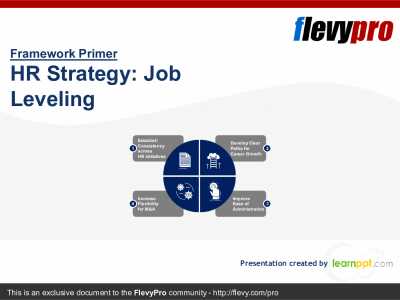
Job Leveling is a disciplined approach to gauge the value of work for individual positions across the organization. It entails ascertaining the nature of work done by each position, authority levels, and the effect of each job on business results.
Jobs that are configured inadequately bread
[read more]
Do You Want to Implement Business Best Practices?
You can download in-depth presentations on Human Resources and 100s of management topics from the FlevyPro Library. FlevyPro is trusted and utilized by 1000s of management consultants and corporate executives.
For even more best practices available on Flevy, have a look at our top 100 lists:
These best practices are of the same as those leveraged by top-tier management consulting firms, like McKinsey, BCG, Bain, and Accenture. Improve the growth and efficiency of your organization by utilizing these best practice frameworks, templates, and tools. Most were developed by seasoned executives and consultants with over 20+ years of experience.
Readers of This Article Are Interested in These Resources
17-slide PowerPoint presentation
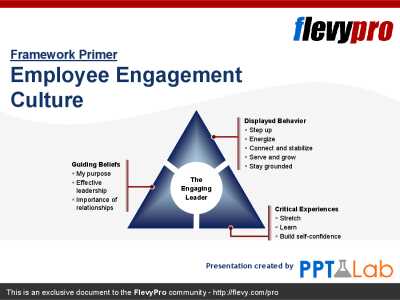
Improving Employee Engagement is a priority in most Talent and HR Strategies. This presentation provides a 5-step approach to building a culture of Employee Engagement. This processed was developed by Aon Hewitt based on the Aon Hewitt Top Companies for Leaders study.
Best practices from the
[read more]
18-slide PowerPoint presentation
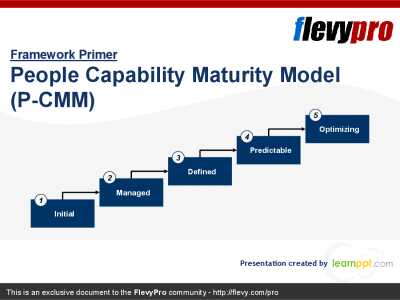
Following the success of Capability Maturity Model for Software, Carnegie Mellon University developed the People Capability Maturity Model (People CMM or P-CMM). The People CMM is based on best practices—in areas such as human resources, knowledge management, and organizational development—for
[read more]

27-slide PowerPoint presentation
Today's information-based, knowledge intensive, and service-driven economy has forced organizations to make substantial changes to the way they do business. With talented Human Capital now becoming the key strategic resource, the locus of the battle front has shifted. Managers not only have to
[read more]
19-slide PowerPoint presentation
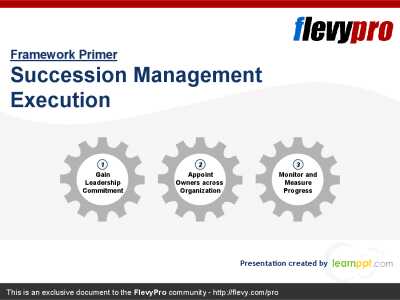
The changing business landscape calls for business to adopt a high-impact succession management system. Succession Management is not a mere listing of potential leaders. Succession Management both identifies and develops high-potential leaders capable of executing our company’s
[read more]