Editor's Note: Take a look at our featured best practice, Digital Transformation: Artificial Intelligence (AI) Strategy (27-slide PowerPoint presentation). The rise of the machines is becoming an impending reality. The Artificial Intelligence (AI) revolution is here. Most businesses are aware of this and see the tremendous potential of AI.
This presentation defines AI and explains the 3 basic forms of AI:
1. Assisted Intelligence
2. [read more]
* * * *
Where does a company’s AI money actually sit? A shrug is a fair answer from most CFOs. Five years back it was IT, no debate. The newest survey puts spending at 3.3 percent of revenue, close to double the earlier level, and the larger part skips the IT cost center entirely. Marketing took a piece. The service desks followed, then the warehouse, then finance.
Nobody drew that map. It seeped out through subscriptions, many signed by managers who wanted a Friday report to write itself. A few firms bring in outside help, like the AI strategy team at Innovecs, to pin all those pilots to three or four business goals before the budget freezes in November.
Why the Money Left the IT Department
Picture a sales director who needs a forecasting helper. A ticket used to mean three months of waiting. Today she pays 30 dollars a seat by card and her team logs in on Monday. Do that across forty managers and a dozen contracts overlap. A few belong to nobody.
Know-how pulls money as well. A returns desk lead can name the twelve minutes of every hour lost to copy and paste, and IT can’t. So she gets the budget, and IT gets security reviews and plumbing. Humbling, for a department that once approved every laptop. Now it blesses purchases it never made, sometimes three weeks after the card went through.
What a 3.3 Percent Budget Looks Like in Practice
Say a retailer books 400 million dollars a year. At 3.3 percent, that is 13.2 million for AI. Ten years ago, warehouses and servers ate nearly all of it. Now a fat slice buys chat and drafting tools that staff open at 8 a.m. Another chunk pays for courses on why customer records must never be pasted into a public chatbot, and those courses can cost several hundred thousand.
Below is a rough split I sketched myself. Finance teams describe nearly the same pattern.
Budget area
Illustrative share
Usual owner
Customer service tools
25 percent
Operations
Marketing and sales content
20 percent
Commercial teams
Data platforms and security
30 percent
IT
Planning and finance
15 percent
Finance
Staff training
10 percent
HR
IT still holds the largest slice, under a third. Marketing renews in January. Operations renews in July. HR buys training whenever a gap appears. Nobody sits in a meeting where all of it is visible, so a CFO asking for the total gets three spreadsheets and three numbers, none matching the card statements.
Anyone in procurement has seen the fallout.
Two departments each license a near identical writing tool.
Three pilots report wins, with three different yardsticks.
Data access rules change between floors of one building.
How to Keep Track of Scattered AI Spending
Skip fancy software at first. A spreadsheet works, with one row per tool and columns for owner, purpose and renewal date. Open it monthly, busy August included. Firms of a few thousand people often turn up 30 or 40 rows on day one, and a handful make their own approvers blink.
Every quarter after that, go through three steps.
Write down each live tool with its price, even a 15 dollar seat.
Attach one business number, say minutes per ticket.
Merge or drop any tool that changed nothing for two quarters.
Give Every Project a Number
“Improve efficiency” is a wish, nothing more. Targets look different. A claims team wants handling time down from 18 minutes to 14. A planner wants forecast error to drop five points.
Write the figure down before launch. Tape it above a desk. Come renewal, the talk lasts about thirty seconds. Number moved? Keep paying. Number stuck? Stop, and skip the argument about gut feelings.
Let IT Approve Fast, Not Approve Everything
Teams want it now. IT wants it safe. One thin gate, checking only security, data handling and integration, gives both sides most of their wish. Anything near customer records gets a hard look, often from legal too. One leaked support transcript can cost more than a year of licences. A writing helper that never touches internal files? Cleared by Wednesday, by lunch.
One firm posts an approved tool list and swears to always answer in ten working days. Staff stopped hunting for side doors. The deadline also made IT write a checklist rather than improvise.
What the Doubling Means for the Next Planning Round
Pilots seldom stay pilots. After six months in daily use, a tool is a running cost, and those are brutal to cut. Picture two firms at budget time. One holds a register and written targets, so it walks in with numbers. The other argues from memory and buys the same capability three times.
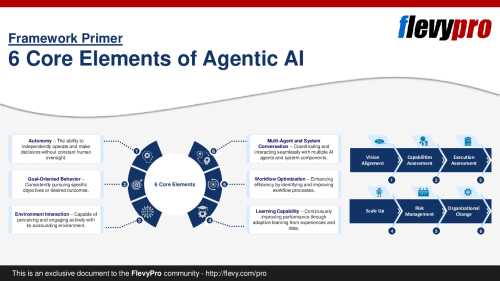
Agentic AI represents a shift toward autonomous, intelligent systems that can make decisions and take actions with minimal human intervention. Evolving from traditional machine learning, this technology enhances operations by automating complex workflows, optimizing decision-making, and enabling [read more]
Do You Want to Implement Business Best Practices?
You can download in-depth presentations on Artificial Intelligence and 100s of management topics from the FlevyPro Library. FlevyPro is trusted and utilized by 1000s of management consultants and corporate executives.
For even more best practices available on Flevy, have a look at our top 100 lists:
These best practices are of the same as those leveraged by top-tier management consulting firms, like McKinsey, BCG, Bain, and Accenture. Improve the growth and efficiency of your organization by utilizing these best practice frameworks, templates, and tools. Most were developed by seasoned executives and consultants with over 20+ years of experience.
Readers of This Article Are Interested in These Resources
Artificial Intelligence (AI) is no longer a future concept - it's a present-day business imperative. AI is transforming how organizations operate, compete, and create value. Yet, with its rapid evolution, many enterprises struggle to keep pace. The A.R.I.S.E. Framework is a proven, [read more]
Curated by McKinsey-trained Executives
How to Use AI Skills for Consulting - The Complete AI-Powered Consulting Framework Guide
Stop leaving millions in consulting value on the table.
Most consultants destroy competitive advantage not because they lack brilliant analytical minds or [read more]
Shift your perspective on artificial intelligence governance: transition from treating it as a restrictive regulatory hurdle to leveraging it as a dynamic engine for ethical product development and organizational trust. This extensive practitioner toolkit offers a structured, step-by-step roadmap [read more]
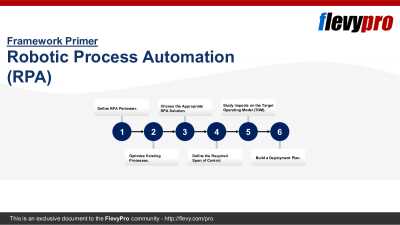
First, what is RPA?
Robotic Process Automation (RPA), also referred to as Robotic Transformation and Robotic Revolution, refers to the emerging form of process automation technology based on software robots and Artificial Intelligence (AI) workers.
In traditional automation, core activities [read more]
 Where does a company’s AI money actually sit? A shrug is a fair answer from most CFOs. Five years back it was IT, no debate. The newest survey puts spending at 3.3 percent of revenue, close to double the earlier level, and the larger part skips the IT cost center entirely. Marketing took a piece. The service desks followed, then the warehouse, then finance.