
 Click main image to view in full screen. Unlock all 32 preview images:
ISO/IEC 42001:2023 (AI Management System) Awareness Training – PowerPoint PPTX Template
PowerPoint (PPTX) 96 Slides


BENEFITS OF THIS DOWNLOADABLE POWERPOINT DOCUMENT
- Save Hundreds of Hours of Prep -- Skip writing slides from scratch; get a complete, beautifully designed, and facilitation-ready 89-slide professional masterclass instantly.
- Ensure Flawless Training Delivery -- Fully editable PPTX format allows you to add your company logo, customize AI policies, and seamlessly align the content with your organization's specific tech stack.
- Auditor-Grade Compliance Guidance -- Train your team using a toolkit built on years of real-world compliance experience at top global tech firms, giving you audit-ready confidence.
ARTIFICIAL INTELLIGENCE PPT TEMPLATE DESCRIPTION
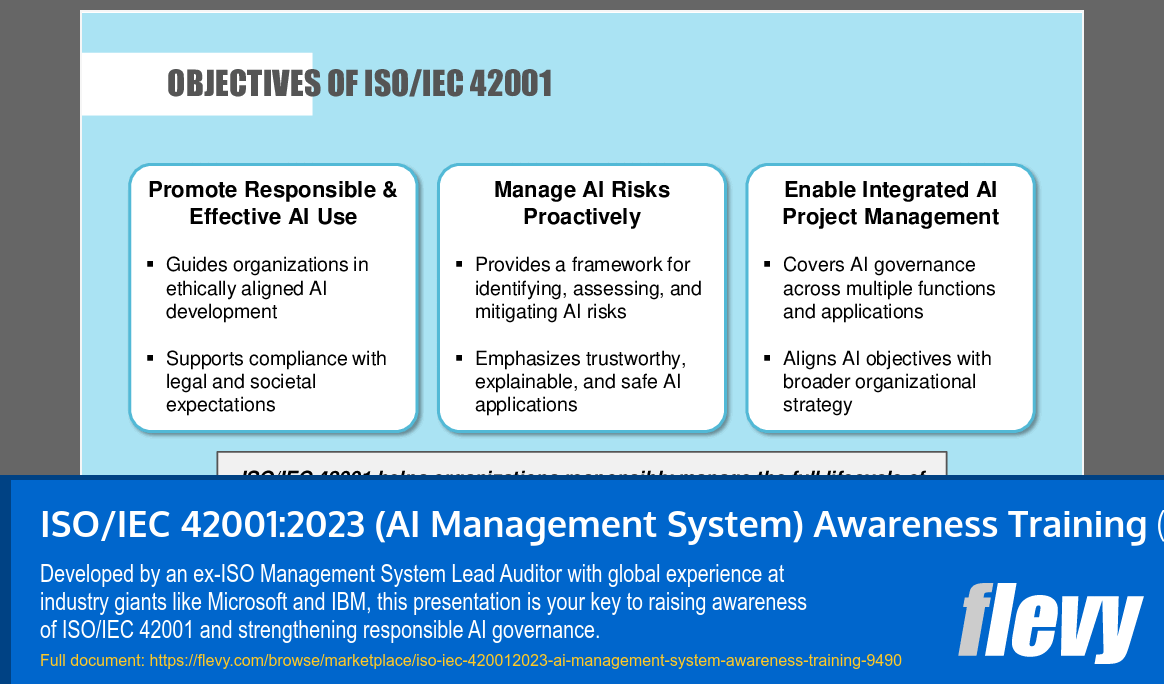
Shift your perspective on artificial intelligence governance: transition from treating it as a restrictive regulatory hurdle to leveraging it as a dynamic engine for ethical product development and organizational trust. This extensive practitioner toolkit offers a structured, step-by-step roadmap for mastering and deploying the ISO/IEC 42001:2023 framework. It equips your enterprise to implement AI solutions responsibly, mitigate technical and operational vulnerabilities, and achieve sustained operational excellence throughout the entire AI lifecycle.
EXECUTIVE SUMMARY
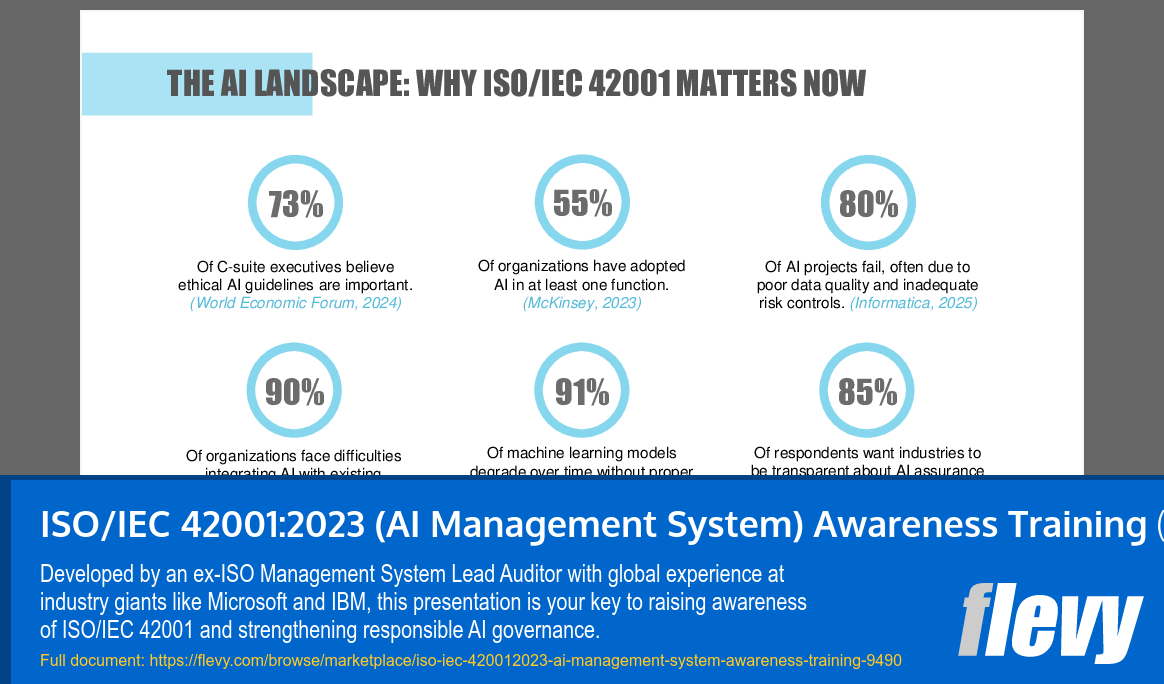
Organizations are integrating artificial intelligence into core operations, automated decisioning, and customer-facing products at a speed that often outpaces internal oversight frameworks—creating substantial commercial opportunities alongside significant risk exposure. As the first international standard dedicated to AI management systems, ISO/IEC 42001:2023 directly addresses the complex societal, ethical, operational, and legal exposure caused by rapid AI adoption.
This professional slide deck clarifies the ISO Harmonised Structure (HS) and explains the mandatory management system requirements alongside the 38 reference controls detailed in Annex A. Centered on Risk-Based Thinking and the classic Plan-Do-Check-Act (PDCA) continuous improvement cycle, this resource instructs teams on how to build systematic internal controls and maintain ongoing oversight of their enterprise AI deployment.
KEY BENEFITS
• Strengthen Regulatory Readiness: Construct verifiable governance documentation and audit trails aligned with major global regulatory frameworks, including automated decisioning expectations under the EU AI Act.
• Reduce Operational & Ethical Risk: Proactively detect and remediate algorithmic bias, model opacity, and data privacy vulnerabilities prior to deployment, safeguarding your enterprise against reputational damage.
• Gain Competitive Advantage: Stand out in commercial procurement processes and enterprise RFPs by proving third-party certification readiness to prospective clients who inspect AI safety and compliance.
TARGET AUDIENCE
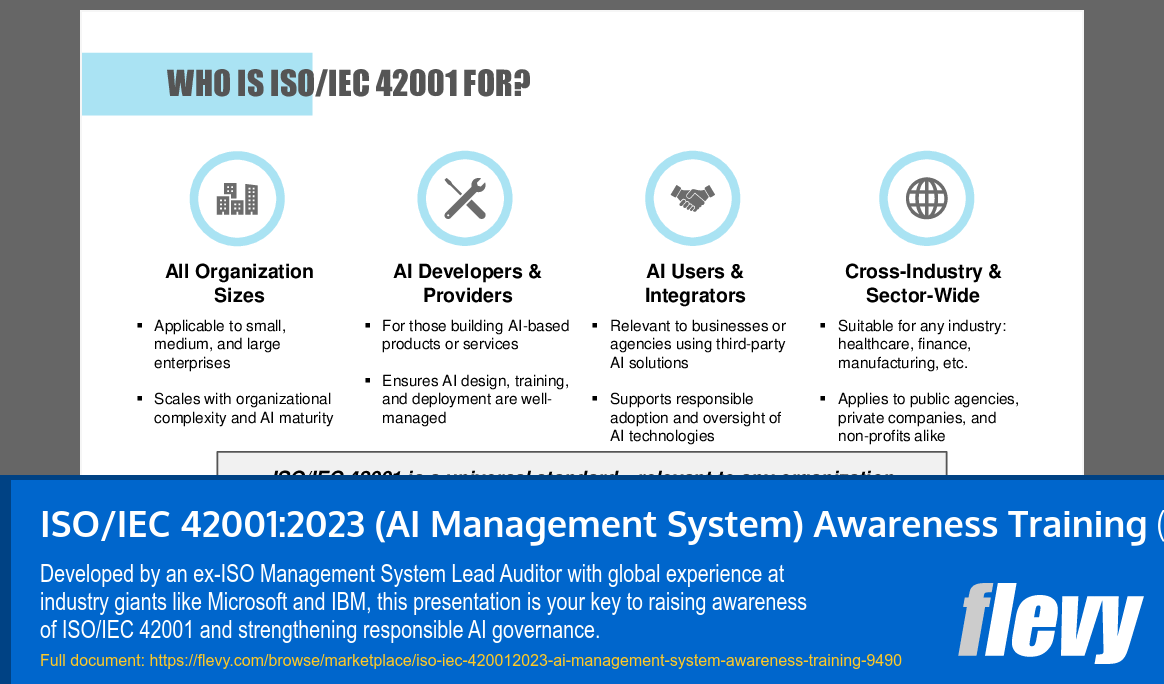
• AI Governance Owners & Compliance Teams: Designed to help establish an auditable, structured governance architecture and clear organizational risk thresholds.
• AI Practitioners, Developers & Data Stewards: Formulated to assist technical teams in deploying lifecycle controls, data quality benchmarks, and human-in-the-loop validation mechanisms.
• Top Management & Functional Leaders: Built for executives to display active governance leadership, assign strategic resources, and align the AIMS with core business objectives.
• Internal Audit Teams: Tailored to establish a thorough baseline understanding of mandatory standard clauses and streamline the preparation of the Statement of Applicability (SoA) ahead of external audits.
• All Employees: Created to foster an enterprise-wide culture centered on AI safety awareness, responsible usage standards, and routine incident reporting.
WHAT'S IN THE BOX?
• The Masterclass (90+ Slides): A thorough, detailed slide deck exploring the core concepts, evolutionary context, and mandatory clauses of the world's premier AI management standard.
• Visual Key Clauses Walkthrough: An applied, clause-by-clause review (Clauses 4 through 10) covering organizational context, leadership duties, operational controls, and performance evaluation.
• Annex A Controls Deep Dive: An exhaustive reference section examining the 38 control objectives across 9 domain categories, spanning AI policy, lifecycle protection, data integrity, and supplier governance.
• Audit & Certification Roadmap: Field-tested guidance designed to take your team through the formal certification process, highlighting specific preparations needed for Stage 1 and Stage 2 external assessments.
LEARNING OBJECTIVES
Upon finishing this ISO/IEC 42001:2023 AIMS Awareness course, participants will be equipped to:
• Interpret AIMS Fundamentals: Articulate why modern businesses require an organized, standardized framework for artificial intelligence governance.
• Differentiate AI Actor Roles: Distinguish between AI providers, producers, deployers, and partners, establishing clear boundaries for enterprise accountability.
• Navigate Clauses 4–10 & Annex A: Identify, select, and implement appropriate operational safeguards using formal risk and impact evaluations.
• Integrate AI Governance: Harmonize ISO/IEC 42001 operations with existing enterprise standards, such as ISO 9001 (Quality) and ISO/IEC 27001 (Information Security).
• Support Responsible AI Practice: Fulfill individual duties regarding incident escalation, data management standards, and active human oversight.
DETAILED TRAINING CONTENTS
This masterclass toolkit is structured across eight modules:
• Module 1: Introduction & ISO/IEC 42001 Essentials: Explores the economic driver for AI oversight, the definition of an AIMS, international adoption trends, and the standard's structural architecture.
• Module 2: Fundamentals of AI Management: Evaluates the AI technology ecosystem, analyzes unique AI risk profiles (algorithmic bias, opacity, performance drift, hallucinations), and establishes human oversight protocols.
• Module 3: Context of the Organisation & AI Roles: Maps internal and external interested parties (including AI subjects), establishes AIMS boundary scoping, and formalizes organizational roles.
• Module 4: Leadership, Planning & Risk: Covers executive leadership responsibilities, AI policy formulation, risk assessment methodologies, and the execution of the AI System Impact Assessment (AISIA).
• Module 5: Support & Operation: Details resource management, workforce competency planning, operational controls, data governance frameworks, and vendor management practices.
• Module 6: Annex A Controls Deep Dive: Presents a detailed evaluation of all 38 reference control objectives used to construct your organization's Statement of Applicability (SoA).
• Module 7: Performance Evaluation & Improvement: Outlines methods for tracking model performance drift, key process metrics, internal audit execution, and corrective action workflows.
• Module 8: Certification, Audits & Your Role: Explains the pathway from preliminary gap analysis to Stage 1 and Stage 2 certification audits, managing nonconformities, and maintaining operational habits.
PROPOSED 2-HOUR AWARENESS BRIEFING AGENDA
This slide deck is designed to support an efficient, high-impact 2-hour executive and staff awareness briefing:
• 00:00 – 00:20: Introduction to AIMS, the AI Landscape, and the Imperative for ISO/IEC 42001 Governance.
• 00:20 – 00:45: Analyzing AI-Specific Vulnerabilities, Model Performance Drift, and Human Oversight Mechanisms.
• 00:45 – 01:15: Defining AIMS Scope, Risk Treatment Protocols, and Executing the AI System Impact Assessment.
• 01:15 – 01:40: Deploying Operational Controls: Data Quality, Lifecycle Gates, and Vendor Oversight.
• 01:40 – 02:00: Navigating the Check-Act Continuous Improvement Loop, External Audit Preparation, and Q&A.
GLOSSARY OF KEY TERMS
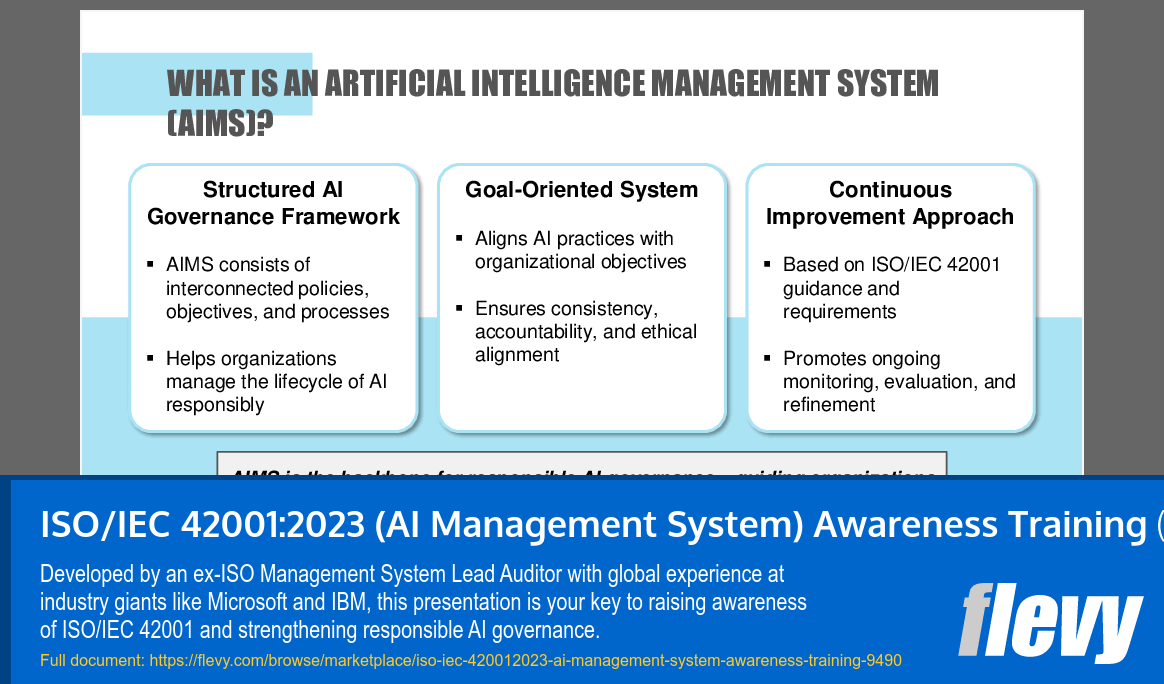
• AI Management System (AIMS): A structured set of policies, operational procedures, and technical controls used by an enterprise to design, deploy, or utilize AI applications while systematically managing associated risks.
• AI Actor Roles: The specific operational capacities an entity assumes within the AI value chain, such as AI Provider, AI Producer, AI Deployer/Customer, or AI Partner.
• Human Oversight: The operational ability given to human supervisors to monitor, comprehend, intervene in, or override an automated AI decision system when necessary.
• Model Performance Drift: The progressive decline in an AI model's output quality (affecting metrics like accuracy, precision, or recall) caused by shifts in real-world operational data over time.
• AI System Impact Assessment (AISIA): A structured evaluation focused on identifying and analyzing the consequences that an AI system's outputs may have on individuals, specific groups, and broader society.
• Annex A Controls: A standardized set of 38 reference controls categorized into 9 domains, used by organizations to address identified risks and formulate their Statement of Applicability (SoA).
• Harmonised Structure (HS): The standardized high-level clause design and common terminology utilized across modern ISO management standards to simplify multi-standard integration.
• Nonconformity: A failure to meet a specific AIMS requirement, categorized during formal external audits as either Major (a systemic failure of control) or Minor (a limited, isolated issue).
FREQUENTLY ASKED QUESTIONS (FAQs)
How does this deck support ISO/IEC 42001:2023 compliance? It delivers the core instructional material required to fulfill the mandatory employee awareness and competence provisions mandated under Clause 7.3 of the standard.
Is this training suitable for non-technical employees? Yes. The material is designed to bridge technical, operational, and legal domain concepts, making AI governance principles clear to non-technical operational staff and business leaders alike.
Can we add our corporate branding and logos to this deck? Yes. The presentation comes as a standard Microsoft PowerPoint (.pptx) file and is fully customizable for internal branding and contextual modification.
Are the Annex A reference controls covered in detail? Yes. Module 6 provides a visual, itemized breakdown of all 38 reference controls across the standard's 9 functional control domains.
How does ISO/IEC 42001 differ from traditional IT risk management? Conventional IT management focuses on predictable, hard-coded software behavior. AI applications evolve based on input data, introducing non-deterministic risks like performance drift and hallucinations that require continuous, specialized management.
Does this toolkit help prepare our organization for certification audits? Yes. Module 8 walks users through the requirements for Stage 1 and Stage 2 certification audits, highlights typical audit nonconformities, and explains ongoing surveillance audit cycles.
What types of AI models does this AIMS training apply to? The ISO framework is technology-agnostic. The content applies equally to predictive algorithms, large language models (Generative AI), automated decision-support applications, and autonomous agentic systems.
What software version is required to run the presentation? The deck is fully compatible with modern presentation software, including Microsoft PowerPoint (Office 365, PowerPoint 2019, PowerPoint 2021) and equivalent slide platforms.
Got a question about the product? Email us at support@flevy.com or ask the author directly by using the "Ask the Author a Question" form. If you cannot view the preview above this document description, go here to view the large preview instead.
PRESENTATION DEEP DIVE ANALYSIS
This deep-dive analysis was generated from the full 96-slide PowerPoint presentation.
Source: Best Practices in Artificial Intelligence, ISO 42001 PowerPoint Slides: ISO/IEC 42001:2023 (AI Management System) Awareness Training PowerPoint (PPTX) Presentation Slide Deck, Operational Excellence Consulting
ABOUT THE AUTHOR

Operational Excellence Consulting, founded in 2009 by Allan Ung, draws from extensive experience at Microsoft, IBM, and Underwriters Laboratories (UL). We specialize in strategy deployment, customer experience design, and operational excellence, applying Design Thinking, Lean, and Systems Thinking to maximize customer value and minimize waste.
Our
... [read more]
Ask the Author a Question
You must be logged in to contact the author.




























