Editor's Note: Take a look at our featured best practice, 6 Core Elements of Agentic AI (36-slide PowerPoint presentation). Agentic AI represents a shift toward autonomous, intelligent systems that can make decisions and take actions with minimal human intervention. Evolving from traditional machine learning, this technology enhances operations by automating complex workflows, optimizing decision-making, and enabling [read more]
* * * *
Conventional checkout assumes a person at the screen. They pick the product, choose how to pay, and confirm. Fraud tools, authentication steps, and even error messages are designed around that moment.
AI agents break the assumption. An agent can be asked to find a product within a budget, compare sellers, and in some cases complete the purchase. For now, this is a small and mostly experimental slice of online payments; conventional checkout is still how nearly all transactions happen. But card networks, large platforms, and payment providers have started building for it, which means payment teams can’t treat AI-initiated transactions as a purely theoretical problem.
Why AI-Initiated Transactions Create New Requirements
Six requirements stand out, and each one touches a different part of the stack.
A merchant sees a request from software. It needs a way to tell whether that software represents a real customer or is simply an automated script. In a browser session, device and behavioral signals help. With an agent, those signals are thin or absent.
Approval may be given in advance, within limits, rather than at the moment of purchase. The system needs to know what exactly was permitted: which merchant, what amount, what time window.
Customer consent. If a dispute arises, someone has to show that the customer actually agreed. That calls for a record that can be checked later, not an assumption.
Transaction context. A human buyer’s journey explains itself: they browsed, added to cart, paid. An agent’s request arrives without that trail, so context has to be supplied deliberately.
Fraud detection. Existing models were trained largely on human behavior. Agent traffic looks different even when it’s legitimate.
Credential management. The agent needs the ability to pay without becoming a new place where card data can leak.
Several industry efforts address parts of this. Visa’s Trusted Agent Protocol deals with agent identity, Google’s Agent Payments Protocol (AP2) with signed records of user intent, and OpenAI and Stripe’s Agentic Commerce Protocol with agent-led checkout. These are young, they overlap, and none can yet be called the standard.
Credentials and Tokenization Become Critical
The least defensible design is giving an agent a customer’s raw card number. A reusable PAN in an agent’s memory, logs, or third-party tools multiplies the places it can be exposed, and it can be used for anything, anywhere.
Tokenized approaches narrow that. A token can be limited to one merchant, a maximum amount, or a time window, and it can be revoked without canceling the customer’s card. Mastercard’s Agent Pay, for example, uses tokens that are tied to a particular agent and to rules the cardholder sets. OpenAI and Stripe’s protocol describes a single-use token tied to a specific merchant and amount.
For a payment team, the practical question is whether the stack can accept and process these credentials alongside ordinary card payments. That means checking how network tokens and cryptograms are handled today, who provisions them, and whether your systems can distinguish a scoped agent credential from a standard card-on-file payment.
Payment Provider Flexibility
No single provider or network will cover every agent channel. Different assistants, platforms, and card schemes are backing different approaches, and which ones gain traction is not yet clear. A merchant wired to one provider gets whatever that provider decides to support, on its timeline.
The same applies to payment methods. Agent-initiated purchases may arrive over card tokens, wallets, bank-based payments, or, in some experiments, stablecoins. A stack that handles only a narrow set of methods narrows what an agent can buy from you.
This is one reason infrastructure that sits across providers deserves attention. Teams that already use payment orchestration providers to connect several PSPs and acquirers have routing, credential handling, and reporting separated from any one vendor, which makes adding a new channel less of a rebuild. Support for agent-specific flows varies between vendors, so it should be verified rather than assumed.
Risk Controls Need More Context
Fraud systems often treat unusual automation as a warning sign: very fast sessions, no mouse movement, no history on the device. Those are reasonable signals when the goal is to block bots testing stolen cards. They are also a fair description of a legitimate agent buying something its owner requested.
Blocking all of it would turn away real customers. Allowing all of it would invite abuse. The workable approach is to evaluate agent traffic on its own terms:
Is the agent identified and verifiable, or anonymous?
Is there a record of the customer’s authorization, and does the purchase fall within it?
Does the transaction match the stated limits on merchant, amount, and timing?
Does the customer account behind it have a normal history?
This is where context supplied by networks and protocols may help, for instance, a verified agent identity or a signed mandate. Risk teams should plan to treat agent-originated payments as a distinct segment, with their own thresholds and reporting, so they can learn what normal looks like as volumes grow. Today those volumes are too small for confident benchmarks, so assumptions should be tested rather than copied from human checkout.
Designing a Payment Stack That Can Adapt
Nobody can say which standards will last. The sensible response is to build for change instead of picking a winner.
Use API-based integrations. Connections that can be extended through documented payment APIs are easier to adapt than hard-coded flows tied to a single checkout page.
Centralize payment logic. Routing rules, retries, and credential handling are easier to adjust when they live in one layer rather than scattered across provider-specific code.
Keep provider flexibility. Maintain the ability to add or replace providers without redesigning checkout. Some businesses extend this by building on white label payment gateway providers, which can shorten the work of adding connections, as long as the underlying design stays configurable.
Invest in observability. Tag and track agent-originated payments separately, including approval rates, declines, and disputes. Without that, there’s no way to know whether the stack is working for this traffic.
Standardize on tokenization. Treat scoped, revocable credentials as the default, and avoid storing or passing raw card data wherever tokens are available.
Make risk controls configurable. Rules should be adjustable by segment without a development cycle each time a pattern changes.
Aim for interoperability. Treat each protocol as an input to a common internal model for identity, consent, and credentials, rather than building a separate integration for every one.
Conclusion
AI-initiated transactions are early, and most payment teams don’t need a rebuild this quarter. They do need to know where their stack is rigid: credentials that can’t be scoped, risk rules that can’t be segmented, integrations that depend on one provider. Fixing those now is useful whether agent payments grow quickly, slowly, or take a form nobody has described yet.
Curated by McKinsey-trained Executives
Unlock the Future of Business with the Ultimate Agentic AI Playbook: The Only Resource You'll Ever Need to Dominate the AI Revolution
In today's fast-paced, tech-driven world, the companies that stay ahead of the curve are the ones that fully [read more]
Do You Want to Implement Business Best Practices?
You can download in-depth presentations on Agentic AI and 100s of management topics from the FlevyPro Library. FlevyPro is trusted and utilized by 1000s of management consultants and corporate executives.
For even more best practices available on Flevy, have a look at our top 100 lists:
These best practices are of the same as those leveraged by top-tier management consulting firms, like McKinsey, BCG, Bain, and Accenture. Improve the growth and efficiency of your organization by utilizing these best practice frameworks, templates, and tools. Most were developed by seasoned executives and consultants with over 20+ years of experience.
Readers of This Article Are Interested in These Resources
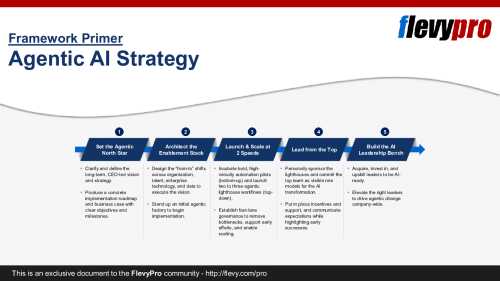
Most organizations have realized wins by developing AI and analytics capabilities. The challenge is scaling those wins so they are seen in operations, customer experience and financial results, however, tools alone rarely deliver that outcome.
An Agentic AI Strategy focuses on building the [read more]
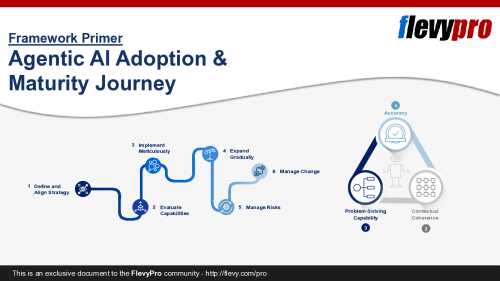
Agentic AI marks the shift from AI that analyzes and predicts to AI that acts. Autonomous agents now reason, plan, and execute multi-step workflows, collaborating with one another and with people to deliver outcomes. Executives know the stakes: 73% believe AI will fundamentally shift how their [read more]
Curated by McKinsey-trained Executives
🚀 McKinsey-Style Agentic AI Skills Toolkit
The Most Advanced Enterprise AI Operating System for Strategic Decision Intelligence
Stop using AI as a chatbot. Start deploying it as a multi-agent executive intelligence system.
This is not a prompt [read more]
 Conventional checkout assumes a person at the screen. They pick the product, choose how to pay, and confirm. Fraud tools, authentication steps, and even error messages are designed around that moment.