Editor's Note: Take a look at our featured best practice, Key Business Processes | Risk and Compliance (13-slide PowerPoint presentation). This document provides a thorough visual taxonomy of key business processes related to managing enterprise risk, compliance, remediation, and resiliency based on APQC's cross-industry process classification system (PCF), the most used process framework globally.
A process classification [read more]
* * * *
If you’re an HR leader, employment verification probably feels like one of the more straightforward items on your compliance checklist. Verify dates. Confirm job titles. Check the box. Move on.
Here’s the uncomfortable truth: that false sense of security is costing organizations millions.
While you’ve been treating employment verification as a routine administrative task, a web of intersecting federal, state, and local regulations has quietly turned it into one of the highest-risk activities in your hiring workflow.
Even sophisticated HR teams are discovering that their verification processes contain compliance gaps they never knew existed — gaps that class-action attorneys are increasingly eager to exploit.
This isn’t about failing to verify candidates. It’s about how you verify them. The distinction matters more than most executives realize. As one points out, systematic background checks protect organizations from hidden liabilities — but only when the checks themselves are conducted lawfully. When they aren’t, the very process designed to shield your company becomes the source of exposure.
In this article, we’ll walk through the four compliance gaps that put employers at greatest risk: FCRA notice failures, salary-history violations, inadequate lookback scoping, and manual data errors. Then we’ll give you a practical audit framework to close them — before someone else finds them first.
The Compliance Iceberg: What Most HR Teams Miss
On the surface, employment verification looks simple. You confirm a candidate worked where they said they worked, held the title they claimed, and left when their resume says they left. That’s the visible tip of the iceberg.
Beneath the waterline sits a regulatory structure that most teams never see — a tangle of federal statutes, state-specific restrictions, and local ordinances that intersect with the verification process in ways that aren’t obvious until something goes wrong. And things are going wrong more often than you’d think.
A HireRight survey of over 1,000 HR, risk, and talent acquisition professionals found that more than three-quarters of businesses globally uncovered candidate discrepancies during background screening in the last 12 months. That’s not a fluke — it’s the new normal.
The resume-fabrication numbers tell an even starker story. A 2025 StandOut-CV survey of over 2,100 U.S. adults found that 64.2% of Americans have lied on a resume at least once. The most commonly falsified items? Salary at previous jobs (32.8%), skills (30.8%), and previous work experience (30.5%).
When nearly two-thirds of candidates are misrepresenting something and three-quarters of employers are catching discrepancies, every verification becomes a potential compliance trigger. The question isn’t whether you’ll encounter a red flag — it’s whether your process for handling that flag exposes you to legal liability.
Here’s where the four biggest risks hide.
Gap 1: FCRA Notice and Consent Failures — The Standalone Document Problem
The Fair Credit Reporting Act (FCRA) isn’t new, but the way employers violate it hasn’t changed much either. The most common mistake? The disclosure form.
Under the FCRA, before you obtain a consumer report on a candidate — and yes, an employment verification qualifies — you must provide a written disclosure that the background check will be conducted. That disclosure must appear in a standalone document. No liability waivers tucked in. No at-will employment language. No policy acknowledgments. And absolutely no bundling it with the job application.
The Federal Trade Commission is unambiguous on this point. The disclosure is a standalone requirement, period.
Yet walk through most companies’ onboarding paperwork and you’ll find exactly the opposite: a single form that mixes the FCRA notice with liability releases, arbitration clauses, and application acknowledgments. Each of those extraneous elements can invalidate the disclosure entirely — and with it, the legal basis for the entire background check.
The courts have been clear. In Walker v. Fred Meyer, Inc., the Ninth Circuit found that language referencing other legal rights in a disclosure form violated the FCRA’s standalone requirement. One auto parts supplier learned this lesson the hard way, settling a similar case for $950,000 in 2023, according to a Cisive analysis of FCRA compliance trends. And that’s before we get to the class-action scale.
Here’s what’s at stake financially: Verified Credentials notes that FCRA violations carry statutory damages of $100 to $1,000 per violation for willful violations, plus punitive damages and attorney fees. In a class action spanning thousands of applicants, that math gets ugly fast.
The adverse action workflow is another trap. The FTC requires a specific three-step sequence: send a pre-adverse action notice with a copy of the report and a Summary of Rights, wait a reasonable period (widely accepted as at least five business days), then send a final adverse action notice naming the consumer reporting agency and informing the applicant of their right to dispute and obtain a free report within 60 days. Miss any step, and you’ve just handed a rejected candidate a potential claim.
And if you think these risks are limited to traditional background checks, consider what happened to Eightfold AI. A January 2026 lawsuit, covered by Employment Law Insights, alleges the company created “hidden credit reports” on job applicants without following FCRA notice requirements.
The case highlights a critical point that Cisive underscores: the FCRA applies whenever a third party compiles a consumer report for employment purposes, and even AI-powered applicant-scoring tools may qualify — triggering disclosure and consent obligations most employers don’t even realize apply.
If you’re using any third-party tool that scores, ranks, or filters applicants, ask yourself: have you provided FCRA-compliant disclosure for that tool? If the answer is “I don’t know,” you’re already behind.
Gap 2: Salary-History Violations — The Third-Party Liability Trap
Salary-history bans have spread rapidly across the United States, and they’ve created a liability trap that most employers don’t see coming — because the trap is sprung by their own background check provider.
As of 2026, at least 18 states plus Washington, D.C., have statewide salary history bans prohibiting employers from asking job applicants about past or current pay, according to FindLaw. Colorado’s fines range from $500 to $10,000 per violation. That’s per violation, not per case.
Here’s the part that catches organizations off guard: these bans don’t just apply to you. They extend to anyone acting on your behalf. FindLaw notes that employers in covered jurisdictions are prohibited from having recruitment firms, staffing agencies, or background check companies ask about salary history. If your third-party verification provider collects salary data in a banned jurisdiction, the liability flows back to you — not just to the provider.
This creates a genuine operational challenge. Many employment verification platforms, including Checkr, can include salary history where legally permitted. But as Checkr notes, salary history laws “may apply at the state or local level” and vary by jurisdiction. Oregon, for instance, prohibits asking about salary history as part of a background check entirely.
The gap here is subtle but dangerous: when you sign up with a verification provider, do you know what data fields they request by default? Have you configured jurisdiction-specific filters? Or is your provider cheerfully collecting salary data in Colorado, Oregon, and a dozen other banned jurisdictions — with your company’s name on the request?
For multi-state employers with remote hiring, the problem compounds. A candidate applying to a remote role in California triggers different rules than someone in Texas. If your verification protocol doesn’t adjust automatically based on the candidate’s location, you’re running a compliance roulette wheel with every hire.
Gap 3: Inadequate Lookback Scoping — The Seven-Year Rule and Its State-Level Tightening
Most HR professionals know the FCRA’s seven-year lookback rule. Few understand what it actually covers — and what it doesn’t.
The FCRA prohibits consumer reporting agencies from reporting civil suits, civil judgments, arrest records that didn’t lead to conviction, paid tax liens, and other adverse items older than seven years — but only for positions paying less than $75,000 annually. Bankruptcies can appear for up to ten years. Criminal convictions, at the federal level, face no time cap at all.
And critically: the FCRA’s seven-year rule does not restrict employment history or education verification. Those can be verified across a candidate’s entire career.
That’s the federal floor. Several states have built higher walls on top of it. California and Massachusetts cap criminal conviction reporting at seven years; New York caps at seven years for positions paying under $25,000; and these state-level restrictions can be stricter than the FCRA baseline. California prohibits reporting any arrest that didn’t lead to conviction, regardless of how recent it is.
And the landscape keeps shifting. Philadelphia amended its Fair Criminal Record Screening Standards effective January 6, 2026, reducing the misdemeanor lookback from seven years to four years, Cisive reports.
Meanwhile, a 2024 CFPB advisory opinion established that consumer reporting agencies should not report expunged or sealed records and must avoid duplicative entries — adding another layer of procedural obligation.
More than 37 states and 150-plus municipalities have enacted “fair chance” hiring laws that delay criminal history inquiries until after a conditional offer, fundamentally affecting when and how verification workflows should be designed.
The gap? Most employers set a single lookback window — often seven years for everything — and call it a day. They don’t calibrate to the most restrictive jurisdiction applicable to each role.
When a verification report includes time-barred information, it’s not just the CRA that faces exposure. The employer, who requested and received that report, may face claims for using information it wasn’t legally permitted to consider.
Gap 4: Manual Data Errors and Process Inconsistencies
This gap is less glamorous than federal lawsuits, but it’s just as dangerous — and far more common.
Every time someone manually types a date, transcribes an SSN, or matches a record by hand, you’re rolling the dice on accuracy. One mistyped digit can generate a report that contains false information about an applicant. Under the FCRA, that’s a problem — even if it was an honest mistake.
Manual errors also create an audit-trail problem. When compliance questions arise, can you show exactly what data was collected, when, by whom, and from which source? Or are you relying on spreadsheets, emails, and institutional memory?
The regulatory environment is tightening around data handling specifically. Effective April 18, 2026, New York’s S3072, reported by NFC Legal, prohibits employers from requesting or using consumer credit history for most employment decisions. When your verification process pulls credit data manually without jurisdiction filtering, a routine check can become a statutory violation.
Automation isn’t just about efficiency here — it’s about legal defensibility. Systems that integrate directly with your ATS, apply jurisdiction-specific rules automatically, and maintain a complete, timestamped record of every data point create a compliance trail that manual processes simply can’t match.
The Executive Audit Framework: How to Close These Gaps
None of these gaps requires a PhD in employment law to address. What they require is a structured audit — and a willingness to look under the hood of a process most organizations have taken for granted for years.
That principle applies directly here: the organizations that avoid these risks aren’t the ones with the best legal team on speed dial. They’re the ones whose verification workflows have compliance baked in at every step.
Here’s a four-part audit framework to get you there.
Step 1: Audit Your FCRA Disclosure and Authorization Package
Pull your current disclosure and authorization forms. Look at them with fresh eyes, or better, with legal counsel’s eyes. Is the FCRA disclosure truly standalone? Did someone sneak in a liability waiver, an at-will employment clause, or a policy reference?
Next, walk through your adverse action workflow from end to end. When you reject a candidate based on verification results, do both notices go out? Is the waiting period actually observed — and can you prove it?
Cisive recommends these audits be conducted at least annually with legal counsel, reviewing disclosure forms, adverse action workflows, and applicable state and local laws for all hiring locations.
Step 2: Map Salary-History Restrictions across Your Hiring Footprint
Create a list of every jurisdiction where you hire — including remote roles. Map the salary-history laws that apply in each one. Then audit your verification provider’s data request: are they collecting salary information in any of those banned jurisdictions?
If the answer is yes, add a jurisdiction-specific toggle to your verification ordering process. If your provider can’t support that toggle, it’s time to find one that can.
Step 3: Align Lookback Windows to the Strictest Applicable Standard
Stop using a single lookback window for all roles. For each position, determine the most restrictive jurisdiction among your hiring locations and configure the verification scope accordingly.
Review your provider’s lookback configuration capabilities — or lack thereof. As Checkr’s employment verification details, its package settings include a 1–10 year lookback window, the ability to verify 1 to unlimited employers, a 0–12-month date matching threshold, up to 3 aliases at no additional cost, and optional DOT questions for FMCSA-regulated roles — features that enable precisely this kind of jurisdiction-specific scoping.
Whatever provider you use, make sure it can adapt to your compliance map rather than forcing your compliance map to adapt to its defaults.
Step 4: Reduce Manual Touchpoints and Build an Audit Trail
Identify every manual data handoff in your current process. Each one is a potential failure point — for accuracy, for consistency, and for auditability.
Evaluate automation options that integrate with your ATS or HRIS. A platform like Checkr, which connects with over 200 ATS and HRIS systems, delivers most verifications in under three days, with 16% completed instantly through payroll integrations, AI-powered document review, and employer outreach. The speed is nice. The audit trail is essential.
Employers seem to agree on what matters most. HireRight’s 2025 Global Benchmark Report found that accuracy of results is a bigger priority now compared to prior years than cost and speed when choosing a screening provider. When accuracy becomes the primary metric, the case for automation over manual entry makes itself.
Caveats and Counterpoints: What This Framework Does Not Solve
This audit framework is a starting point, not a destination. It addresses process and configuration risks — the structural gaps that exist in how most organizations approach employment verification. It does not replace jurisdiction-specific legal review, and it certainly doesn’t eliminate the need to stay current as laws change.
Consider how fast the ground has shifted just in the last year: Philadelphia reduced its misdemeanor lookback to four years effective January 2026. New York’s credit check ban took effect in April 2026. Both represent significant changes that any organization hiring in those jurisdictions needs to reflect in its verification configuration immediately — not at the next annual review.
Automation brings its own questions, too. Tools that use AI to flag discrepancies or score risk are powerful, but as the Eightfold AI lawsuit demonstrates, any third-party system that evaluates applicants may fall under the FCRA’s definition of a consumer report.
You need to understand the methodology behind automated outputs — and ensure you’re meeting disclosure obligations for those tools just as you would for a traditional background check.
The global picture reinforces that verification rigor isn’t just a U.S. concern. In the EMEA region, People Management reported that 90% of businesses encountered discrepancies during pre-employment screening, with employment history (64%) and educational qualifications (47%) as the top categories.
Conclusion
Wherever you hire, the pattern holds: what candidates claim and what records show are increasingly divergent, and the verification process that bridges that gap carries more regulatory weight than ever.
Revisit this framework at least annually alongside legal counsel, and any time your organization expands hiring into a new jurisdiction. The compliance iceberg isn’t going anywhere, but if you know where the dangerous parts are, you can steer clear of them.
In an era of escalating regulatory scrutiny, complex global standards, and rising enforcement actions, organizations can no longer afford fragmented or reactive compliance approaches. This Best Practice Guide: Effective Compliance Management is a definitive, practitioner-driven blueprint designed [read more]
Do You Want to Implement Business Best Practices?
You can download in-depth presentations on Compliance and 100s of management topics from the FlevyPro Library. FlevyPro is trusted and utilized by 1000s of management consultants and corporate executives.
For even more best practices available on Flevy, have a look at our top 100 lists:
These best practices are of the same as those leveraged by top-tier management consulting firms, like McKinsey, BCG, Bain, and Accenture. Improve the growth and efficiency of your organization by utilizing these best practice frameworks, templates, and tools. Most were developed by seasoned executives and consultants with over 20+ years of experience.
Readers of This Article Are Interested in These Resources
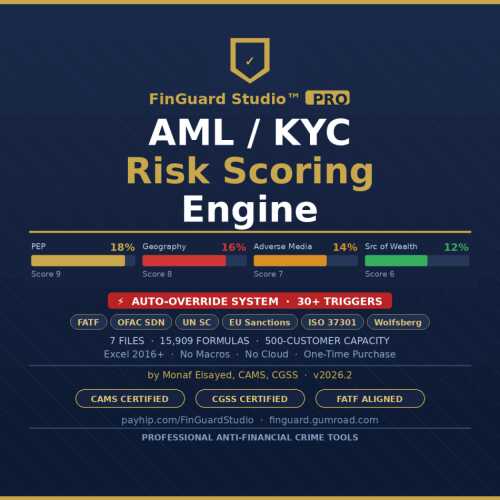
FinGuard Studio Pro is a professional-grade Excel-based AML/KYC customer risk scoring and onboarding logic engine built for compliance officers, MLROs, and AML analysts. Developed by a certified AML/KYC professional (CAMS, CGSS), every formula, weight, and trigger cites a regulatory source -- [read more]
The Only Complete Compliance and Risk Leadership System with Ready-to-Deploy Operational Tools
The Compliance leaders face unprecedented challenges: heightened organizations scrutiny, complex regulatory frameworks, resource constraints, and constant pressure to demonstrate accountability while [read more]
Curated by McKinsey-trained Executives
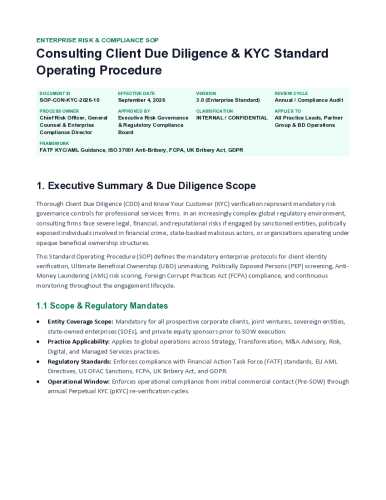
🚨 CONSULTING CLIENT DUE DILIGENCE & KYC STANDARD OPERATING PROCEDURE -- THE ENTERPRISE CLIENT RISK & COMPLIANCE STANDARD
⚡ STOP TREATING CLIENT DUE DILIGENCE LIKE A FORM-FILLING EXERCISE.
A consulting firm can win a major engagement, negotiate the [read more]
ISO 37301:2021 is an international standard designed and formulated to help organizations implement a robust Compliance Management System (CMS).
The standard specifies requirements and provides guidelines for establishing, developing, implementing, evaluating, maintaining and improving an [read more]
 If you’re an HR leader, employment verification probably feels like one of the more straightforward items on your compliance checklist. Verify dates. Confirm job titles. Check the box. Move on.