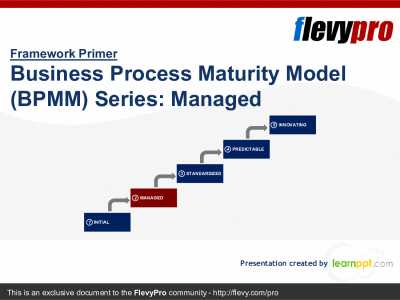
Editor's Note: Take a look at our featured best practice, Business Process Maturity Model (BPMM) Series: BPMM Primer (23-slide PowerPoint presentation). The Business Process Maturity Model (BPMM) captures a 5-level evolutionary improvement path that guides organizations as they move from immature, inconsistent business activities (level 1) to mature, disciplined processes (level 5). BPMM orders these stages so that improvements at each stage [read more]
* * * *
When corporate leaders buy new tools – CRM, marketing automation, lead distribution software, etc. – many assume that their purchases will deliver value, but it’s not always the case. One reason tech stack updates underwhelm is poor integration. It creates fragmented workflows and large data silos across business units, forcing team members to spend hours on manual, mundane tasks.
A lead capture automation tool can show how proper integration should work. On its own, it collects, verifies, and enriches leads. However, once integrated with lead distribution software, it creates a cohesive mechanism that not only captures leads but also monetizes or engages them in real time, while they’re still fresh. You can go even further and add a CRM to the equation. As a result, everything that happens to leads is automatically recorded, giving you a better view of performance without adding overhead.
Keep reading to explore the hidden costs of disconnected tools, the core pillars of integration, and other information to make digital transformation smooth.
The Hidden Costs of Disconnected Enterprise Software
An overloaded tech stack throttles work, creates technical debt, and frustrates team members. Enterprise leaders face this constantly. Teams add new tools without replacing or integrating the ones already in place. As a result, the underlying data flows never connect, and employees are stuck navigating cumbersome, often confusing workflows.
Here’s how it may look in practice: a prospect fills out a form after clicking a digital ad, and that record lands in a database with no connection to the sales workflow, so it just remains there. When a sales representative eventually finds it, they’ve already spent time tracking down customer information that should have been ready. Conversion rates drop. Customer trust suffers. Transferring data by hand slows customer acquisition even further.
You can’t achieve real digital transformation with software alone – integration is as important. That’s why, before you buy anything, it’s important to map your, say, customer acquisition process, every step from the first ad click to the signed deal. Once that map exists, touchpoints can flow smoothly across integrated business systems.
Three Core Pillars of Effective Process Integration
Data Centralization & CRM Integration
Centralize your data first – that’s how you break down silos across business units. Make CRM integration seamless enough that sales and marketing can share insights without delay and let system records update automatically across every channel. You’ll get a clear view of pipeline health and team performance, and your executive decisions will finally rest on reliable data instead of guesswork.
End-to-End Workflow Automation
Replacing manual tasks with business process automation speeds up work. It also cuts human error across daily operations. Companies should automate routine tasks using defined business rules. Teams that properly automate lead generation can capture buyer interest continuously, letting sales representatives spend more time selling and serving customers.
Automated Lead Routing & Lead Nurturing
Quick response is what wins new business in competitive markets. The moment a lead comes in, an automated lead distribution process checks the fresh data, buyer location, team size, and product needs, then routes the customer to an optimal endpoint. This combination enables one of the fastest follow-ups possible, minimizing intercepted deals.
Strategic Alignment: Connecting Marketing, Sales, & IT
Getting marketing, sales, and IT pulling in the same direction is a struggle for many companies. For example, IT protects system safety and uptime, while sales pushes for faster, easier-to-use tools to streamline processes. The only thing that closes that gap is teamwork.
Your marketing team can meet its quarterly lead volume objective and still fall short, since half those leads won’t convert when the objective isn’t tied to revenue. That’s the gap shared goals are meant to close. Sales representatives need to use the CRM daily to keep data clean, and executives need to connect goals to customer journey automation.
Smart automated business models let you scale operations without high costs. Give your representatives AI sales tools, and you get more targeted outreach while keeping data safe and organized.
Embedding Governance & Fraud Prevention into Automated Workflows
Here’s the problem with scaling process integration: automated workflows move customer information across cloud environments constantly. Security, data governance, and strict compliance controls – all of it has to be baked in from the start.
No fraud prevention and verification tools in your high-volume lead acquisition systems? Duplicates and bots may end up in your pipeline. Build compliance checks and verification protocols into your lead-routing infrastructure, and your sales productivity, regulatory standards, and data integrity stay intact.
Overcoming Culture & Change Resistance
What transforms enterprises is the people, not technology. Employees resist new software because of fear, or maybe because nobody trained them properly. That’s the reason why leadership must clearly communicate the vision behind process integration:
Communicate the “why” early: A team member who understands why a workflow is changing adapts faster than one just told to use new software. That’s why it is important to show them how process integration simplifies their daily tasks.
Provide practical training: An employee who receives hands-on training adopts a new tool much faster than one who is simply handed a manual. That’s why it is important to run hands-on workshops until employees feel confident using new automated workflows.
Show quick wins: Automate one small task this month, something that saves the team twenty minutes a week, and let people feel that win right away. Use that momentum before tackling anything bigger.
4 Phases Toward Integrated Transformation
Audit Your Current Systems First
Review your current tools and legacy software to map how data moves between them and identify manual steps that slow work down or cause errors.
Set Clear Objectives
What should you optimize for before buying a tool? Usually, it’s lower costs, faster lead distribution, and better work speed. It is crucial for every leader in the room to agree on those metrics from day one.
Use Phased Rollouts (Pilot to Enterprise)
Don’t try to roll out lead capture automation everywhere at once. Start with one team and gradually expand to as many professionals as needed.
Build Continuous Review Loops
What prevents digital transformation from deteriorating six months after its introduction? Ongoing review does. You have to work at digital transformation every day for it to hold up. Check performance metrics regularly. Use user feedback to adjust lead routing rules as you go. Ongoing tuning is what lets the company respond to changes more quickly.
Measuring ROI: Focus on Core Operational Metrics
The following operational metrics will help you measure how effective your tech stack upgrades and integrations are:
Speed-to-lead: How fast your lead capture automation tool routes a fresh prospect to a sales representative.
Workflow conversion time: How fast prospects move through each step of your sales funnel.
Data accuracy rate: The drop in duplicate records following deep CRM integration.
Resource hours saved: Time saved by automating data entry and lead distribution process tasks.
These metrics show whether digital transformation is paying off in revenue and lasting growth.
Transform Smarter Through Unified Integration
Software alone doesn’t transform a company, while people and processes do. Real competitive power comes from streamlined operations, requiring things like lead capture automation, lead distribution software, CRM, and AI sales tools working together as an ecosystem, not standalone solutions.
Processes come first. Team alignment comes second. Software comes third. Get this right, and digital transformation turns into results you can actually measure.
With our Business Process Management Toolkit, you can achieve greater control over your business operations and drive better results. Our toolkit provides you with a complete set of tools and resources to help you manage your business processes effectively, regardless of the size or complexity of [read more]
Do You Want to Implement Business Best Practices?
You can download in-depth presentations on BPM and 100s of management topics from the FlevyPro Library. FlevyPro is trusted and utilized by 1000s of management consultants and corporate executives.
For even more best practices available on Flevy, have a look at our top 100 lists:
These best practices are of the same as those leveraged by top-tier management consulting firms, like McKinsey, BCG, Bain, and Accenture. Improve the growth and efficiency of your organization by utilizing these best practice frameworks, templates, and tools. Most were developed by seasoned executives and consultants with over 20+ years of experience.
Readers of This Article Are Interested in These Resources
BPM has now considerably matured in terms of methods, tools and techniques, which has fortified its acceptance among organizations spanning industries. BPM related research today is predominantly activity-focused—reporting on procedural aspects of the practice of process management—and [read more]
Establishing a Business Process Management discipline drives strategy to execution with pace and certainty. Business Process Management-Lifecycle (BPM-L) establishes a value-driven Business Process Management capability driving business strategy to Information Technology (IT) and people-based [read more]
The Business Process Maturity Model (BPMM) captures a 5-level evolutionary improvement path that guides organizations as they move from immature, inconsistent business activities (level 1) to mature, disciplined processes (level 5). BPMM orders these stages so that improvements at each stage [read more]
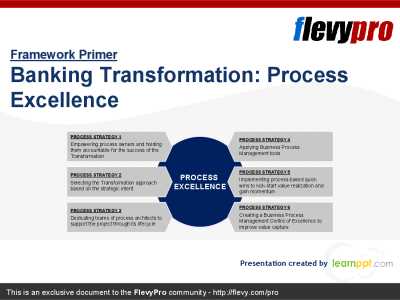
Seeking a return to pre-recession levels of profitability and growth, banks are embarking on a Transformation process which touches every corner of the operation--from providing new tools to its sales force to consolidating back-office operations. Research finds that Banking Transformation [read more]
 When corporate leaders buy new tools – CRM, marketing automation,