 Recency bias is the tendency to weight recent events more heavily than earlier ones when forming a judgment. Performance reviews are close to a laboratory case for it, because the evaluation window is twelve months and the recall window is however long a manager’s memory holds detail.
An employee who had a difficult January and a strong October can read as someone on the way up. Reverse the order and the same twelve months read as a decline.
The pragmatic solution is an evidence trail, meaning a record of what was said and agreed across the year that is available at the point the review is written. Most of that evidence is generated in 1:1 meetings and then lost when the meeting ends. A tool for 1:1 meeting insights captures the conversation, transcribes it, and pulls the substance into a record the manager can return to months later.
In this article, we look at how to build an evidence trail that can help tackle recency bias and give both employees and their managers a more accurate view of performance.
What a Defensible Evidence Trail Contains
When it comes to review time, four things need to be easily recoverable afterwards.
What feedback was given, and when. A review that says an employee has improved their stakeholder communication is only useful if it can point to the November conversation where the problem was raised and the March one where it was no longer an issue. Feedback without a date is an opinion.
What goals were set, and how they moved. Goals get adjusted mid-year, usually verbally, usually for good reasons. If only the original version is written down, the employee is assessed against a target that was quietly abandoned in May.
What concerns were raised. Workload, blockers, unclear ownership, friction with another team. These are the items an employee brings to a 1:1 and the ones most likely to disappear if nobody writes them down. They also matter in the other direction, because a manager who was told three times about an under-resourced project should not be describing missed deadlines as an individual failure.
Who said what. In a 1:1 the attribution question is simple, but it stops being simple in a skip-level, a project retro or a three-person check-in. A record that shows a commitment was made by the manager rather than the employee changes how a review reads.
Three Ways to Build the Trail
Doing it by hand is the default and it works, up to a point. A manager who writes a short summary into a shared document after each 1:1, tagging the feedback, the goal changes and the concerns, has everything the four categories require. The cost is discipline, and the failure mode is uneven adoption: some managers do it every week, some sporadically and others not all.
Buying an off-the-shelf notetaker removes the discipline problem. A meeting assistant joins the call, produces a transcript and a summary, and the manager reviews and files it. For a lot of organizations this is where the story ends, particularly if the notes only need to be readable by the two people in the meeting.
Building your own becomes the sensible option when the notes have to sit inside systems you already control, such as the HRIS, the review platform or an internal dashboard. Most of that build is your own logic: which fields update, what belongs in a summary for your organization, who can see it, and how long it is retained. Those decisions are specific to your policy and your compliance position, and they are the reason a generic tool often does not fit.
If you take the custom route, the recording underneath can be bought off the shelf. Recall.ai is an API that captures recordings, transcripts and metadata from all major meeting platforms as well as in-person meetings. The best value meeting recording API on the market, it is used by more than 3,000 companies and is priced at $0.50 per recording hour (scaling down with volume).
Consistency across Managers
An evidence trail that only some managers maintain creates a second problem on top of recency bias. Two employees doing comparable work are assessed against records of different quality, and the one with the more diligent manager gets the more specific review. In a calibration session, specificity tends to win arguments.
Automated capture removes most of that variance, because the record no longer depends on which manager remembers to write things down. What it does not remove is the judgment layer. Someone still has to decide what belongs in a review and what was a passing comment, and that decision should sit with the manager rather than with a summarization model. A workflow where the manager reviews and approves notes before anything attaches to a performance record keeps the accountability in the right place.
Using the Trail in the Review Itself
Having the evidence and using it are separate steps. Reviews written from a full-year record still drift toward recent months unless the writing process forces a wider look.
A simple structure helps here: work through the year in quarters rather than as a whole, pulling two or three specific items from each. Note where goals changed and why. Check whether any concern the employee raised more than once was resolved. Then write the assessment.
Instead of “communication has improved”, the resulting review says what was raised in Q1, what changed by Q3, and what the manager saw that led to that conclusion. An employee can disagree with a specific claim, which is a healthier conversation than disagreeing with a general impression.
Judgment about performance stays a judgment, and no amount of documentation makes a review objective. An assessment built on twelve months of recorded conversation is still defensible in a way that an assessment built on six weeks of memory is not, and the employee on the receiving end can tell the difference.
Do You Want to Implement Business Best Practices?
You can download in-depth presentations on Performance Measurement and 100s of management topics from the FlevyPro Library. FlevyPro is trusted and utilized by 1000s of management consultants and corporate executives.
For even more best practices available on Flevy, have a look at our top 100 lists:
These best practices are of the same as those leveraged by top-tier management consulting firms, like McKinsey, BCG, Bain, and Accenture. Improve the growth and efficiency of your organization by utilizing these best practice frameworks, templates, and tools. Most were developed by seasoned executives and consultants with over 20+ years of experience.
Readers of This Article Are Interested in These Resources
106-slide PowerPoint presentation
Corporate performance evaluation has evolved from the 1960s focus on ROE to the current variations of economic profit that measure impact on shareholder value. Both ROE and EP are business metrics, tools used to measure the performance of the business. Focusing on EP instead of ROE decreases the
[read more]
854-slide PowerPoint presentation
Curated by former McKinsey Consultants
Unleash the Power of Data-Driven Decision-Making: Elevate Your Business with the Ultimate 850+ Slides PowerPoint Deck of Performance Metrics and KPIs!
Learning Objectives:
Master the Art of Performance Measurement: The first step towards achieving
[read more]
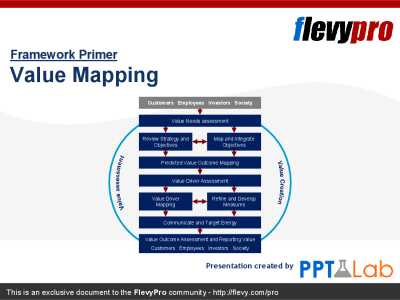
19-slide PowerPoint presentation
Value Mapping is a Performance Measurement and Performance Management framework developed by Andrew Jack to overcome management and employee dissatisfaction with existing Performance Measurement and Management frameworks.
Whereas traditional frameworks (e.g. Balanced Scorecard, EFQM Excellence
[read more]
21-page PDF document
Productivity, efficiency, unit costs. So many business performance variables - yet they're ALL directly related to each other, & they're ALL measurable... from the top of an organization, down to the person, process & penny. Learn the secrets of an effective performance framework, and how it can
[read more]