Editor's Note: Take a look at our featured best practice, 8D Problem Solving Process & Tools (206-slide PowerPoint presentation). The 8D Problem Solving Process has become a standard in many industries as problem solving or improvement process, as internal Corrective Action Request (CAR) Process or as Supplier Corrective Action Request (SCAR) Process.
The 8D Problem Solving Process Training Module includes:
1. [read more]
* * * *
Perfection is not attainable, but if we chase perfection we can catch excellence. – Vince Lombardi
In “The Discipline of Market Leaders – Choose your Customers, Narrow your Focus, Dominate your Market,” Michael Treacy and Fred Wiersema describe three distinct value propositions or disciplines an organization can choose to compete in their market or industry–Operational Excellence, Product Leadership, and Customer Intimacy.
Market leaders choose to excel in delivering extraordinary levels of one of these three value propositions, while maintaining competitive standards in the other disciplines.
Based on Treacy’s and Wiersema’s findings, market leaders will not pursue a diffused business strategy across two or even all three disciplines, but will continually focus on their organizational design, processes, technology, and competencies to improve the one particular value discipline that they want to provide to their Customers better than anyone else.
Organizations pursuing an Operational Excellence differentiation strategy are able to deliver a combination of quality, price, and ease of purchase and service that no other organization in their market or industry can match.
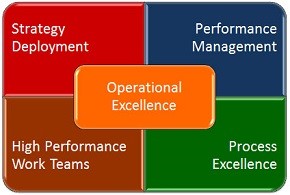
First, Operational Excellence organizations follow a well defined Strategy and Operational Planning & Deployment Process that ensures collaboration and alignment among the different parts of the organization and effectively links strategic and operational objectives, initiatives and execution. Strategy Mapping and Hoshin Planning provide this systematic and collaborative planning, execution, and review process.
Second, Operational Excellence organizations are able to translate strategic or operational objectives and initiatives into measurable success indicators and ensure alignment among the different levels and parts of the organization.
The Balanced Scorecard Methodology provides a Performance Management framework to ensure alignment of an organization towards common objectives and goals.
Third, Operational Excellence organizations are process-centered organizations that have well designed, efficient, and effective management, value chain, and support processes to deliver best-in-class products and services consistently.
Process Excellence concepts, methods and tools, including Six Sigma Methodology, Lean Management Methodology, 8D Problem Solving Process, and Business Process Improvement, are core competences and utilized at all levels of the organization.
Fourth, Operational Excellence can only be achieved and sustained with the right attitude, the right mindset, and the right competencies. Operational Excellence organizations continuously strive to increase the engagement and empowerment of their employees through strong values, guiding principles, leadership development, coaching, and continuous competence development.
The Gemba Walk Slide Deck is a comprehensive and professionally designed resource that equips leaders and teams with the tools and knowledge to drive meaningful improvements through effective Gemba Walks. Built around proven Lean principles, this slide deck guides you step-by-step from [read more]
Do You Want to Implement Business Best Practices?
You can download in-depth presentations on Lean and 100s of management topics from the FlevyPro Library. FlevyPro is trusted and utilized by 1000s of management consultants and corporate executives.
For even more best practices available on Flevy, have a look at our top 100 lists:
These best practices are of the same as those leveraged by top-tier management consulting firms, like McKinsey, BCG, Bain, and Accenture. Improve the growth and efficiency of your organization by utilizing these best practice frameworks, templates, and tools. Most were developed by seasoned executives and consultants with over 20+ years of experience.
Readers of This Article Are Interested in These Resources
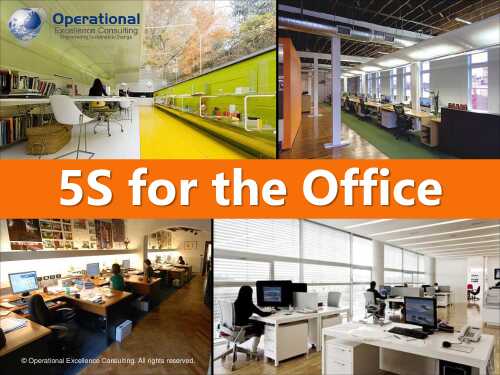
The office, by any name, is a paperwork factory. To become a Lean enterprise, office activities must fully support shop-floor manufacturing operations to eliminate waste. The adoption of 5S throughout all office functions is the first step to increase efficiency. 5S principles are dedicated to [read more]
Value Stream Mapping (VSM) is a lean management technique used to analyze the flow of materials and information currently required to bring a product or service to a Customer. The goal of value stream mapping is to reduce the end-to-end lead time of a process by highlighting and eliminating [read more]
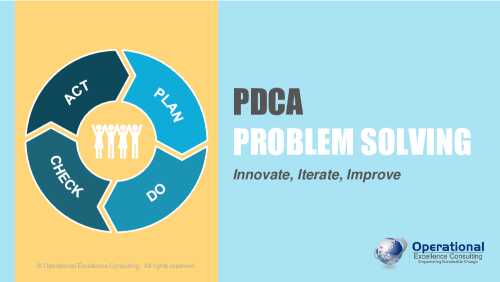
The PDCA cycle, also known as the Deming Cycle or the Shewhart cycle, is a four-step continuous improvement process that is widely used in quality management, business improvement, and project management.
The PDCA cycle is an iterative process, meaning that it is repeated continuously in order [read more]
Visual management is a powerful tool for conveying important information in a simple and easy-to-understand format. This practice involves displaying information in a visual format through various tools such as charts, graphs, diagrams, or photographs. By doing so, visual management reduces [read more]
 Perfection is not attainable, but if we chase perfection we can catch excellence. – Vince Lombardi