Editor's Note: Take a look at our featured best practice, Core Competencies Analysis (17-slide PowerPoint presentation). Core Competencies Analysis is a powerful 5-phase business framework used to determine company-specific skills that enable differentiated value delivery. In other words, using Core Competencies Analysis, we can determine true competitive advantages of our company.
This offers invaluable [read more]
* * * *
Marketers have long been fascinated by why certain products capture the public’s interest, becoming integral to daily routines, while others quietly disappear from the view.
This intrigue is not only limited to consumer goods, but also extends to how some organizations achieve and maintain a competitive advantage.
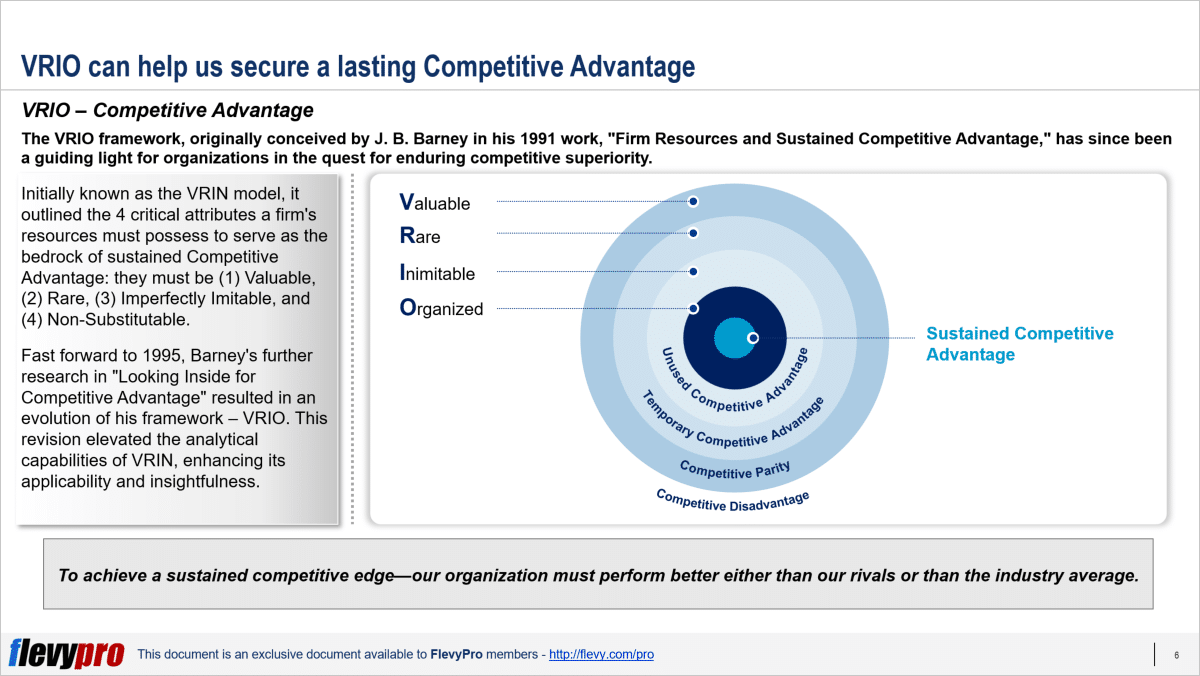
To make sense of this phenomenon, Jay Barney introduced the VRIO framework. The VRIO which stands for Value, Rarity, Imitability, and Organization offers a structured way to understand this phenomenon and to provide a strategic approach in the evaluation whether an organization’s resources can sustain a competitive advantage. The VRIO framework serves as a guide for leaders in strategically evaluating and leveraging their internal strengths to achieve long-term success.
Understanding VRIO begins with breaking down its components—Value, Rarity, Imitability, and Organization, with each element posing a crucial question:
Value. Does the resource or capability allow the organization to exploit opportunities or defend against threats?
Rarity. Is the resource scarce, possessed by few competitors?
Imitability. How difficult and costly is it for others to replicate this resource?
The importance of the VRIO framework lies in its dual ability to identify and sustain organizational competitive advantages. It offers a clear pathway for organizations to not only discover but also effectively utilize their unique capabilities, ensuring long-term success and market leadership.
The first 2 components of VRIO—Value and Rarity—are particularly crucial in determining whether an organization’s resources can provide a solid foundation for a Competitive Advantage.
Value
Value focuses on the significance of a resource in enabling the organization to meet threats or opportunities. A valuable resource must make a significant impact on an organization’s effectiveness or efficiency. For example, a patented technology could allow an organization to produce goods at a lower cost than competitors.
Rarity
Meanwhile, Rarity deals with the scarcity of the resource. If a resource is common, it is less likely to be a source of competitive advantage. An example could be a unique business model that is difficult for others to replicate due to cultural, historical, or geographical factors.
Both Value and Rarity are critical as they directly influence an organization’s ability to outperform its competitors. Without these characteristics, resources are less likely to sustain long-term advantages, making it easier for competitors to catch up or surpass the organization’s performance. Thus, focusing on developing resources that are both valuable and rare is essential for maintaining a strong position in the market and ensuring ongoing success.
Phase 1. In the Identify phase, organizations conduct a deep dive into their tangible and intangible assets, assessing each for value, rarity, and imitability. This phase is crucial as it sets the stage for all strategic actions that follow, grounding decisions in solid, evaluative research.
Phase 2. Moving to the Organize phase, the focus shifts to structuring the organization to leverage these resources effectively. This involves setting up formal structures and control systems that align resource management with overarching strategic goals, ensuring that resources are not just present but are actively driving competitive superiority.
You can download in-depth presentations on this and hundreds of similar business frameworks from the FlevyPro Library. FlevyPro is trusted and utilized by 1000s of management consultants and corporate executives.
For even more best practices available on Flevy, have a look at our top 100 lists:
>>> IMPORTANT NOTE: This guide is included in the discount pack offered by Dr. Stephen Sweid with the title: - THE PENTACLE OF BREAKTHROUGH STRATEGY: DISCOUNT PACK -. This is a comprehensive pack for breakthrough strategy with 5 specialized guides produced by the same author on [read more]
Readers of This Article Are Interested in These Resources
Today, companies face shrinking margins in many of their products due to fierce competition in the marketplace. Service offering becomes not only a major growth and profit contributor, but also a key competitive advantage.
This toolkit provides an approach and tools that can help your [read more]
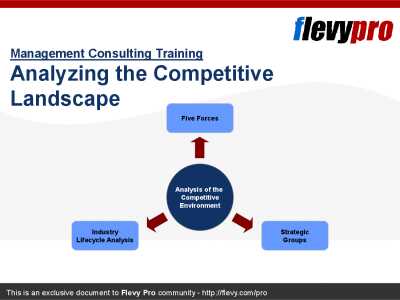
It goes without saying that understanding the competitive landscape is crucial to succeeding in the market.
This presentation discusses several frameworks to understand and analyze the competitive environment--and ultimately develop a sustainable competitive advantage.
This presentation will [read more]
In today's business environment, learning and knowledge have become key success factors and intangible resources are of vital importance. The struggle between competing organizations have moved from tangible resources to intangible resources where knowledge and the ability to use knowledge have [read more]
This presentation introduces a systematic method to conduct a value chain analysis. Value chain analysis is a systematic method for dis-aggregating a firm or industry into its major discrete activities to understand sources of competitive advantage. Value chain analysis can be used to identify [read more]
 Marketers have long been fascinated by why certain products capture the public’s interest, becoming integral to daily routines, while others quietly disappear from the view.