Editor's Note: Take a look at our featured best practice, Digital Transformation: Artificial Intelligence (AI) Strategy (27-slide PowerPoint presentation). The rise of the machines is becoming an impending reality. The Artificial Intelligence (AI) revolution is here. Most businesses are aware of this and see the tremendous potential of AI.
This presentation defines AI and explains the 3 basic forms of AI:
1. Assisted Intelligence
2. [read more]
* * * *
Artificial Intelligence has moved from an experimental capability into the foundation of most new products being built today. According to Deloitte’s 2026 State of AI in the Enterprise, which surveyed 3,235 leaders across 24 countries, 88% of organizations use AI in at least one business function, and the number of companies with 40% or more AI projects in production is expected to double within six months. For startups, this shift redefines what a Minimum Viable Product actually is. An MVP no longer means the smallest version of a 7working product. It increasingly means the smallest version of a working AI-enabled product, handling real data, real users, and real consequences from the moment it ships.
This is the point at which Responsible AI stops being a topic reserved for large enterprises and be7comes a Product Strategy issue for founders. The gap between the pace of AI adoption and the maturity of AI governance is now measurable. Economist Impact research finds that only 8% of organizations globally maintain a comprehensive AI governance framework, dropping to 2% among small firms. Startups that ignore this gap at the MVP stage inherit risk they will later struggle to remediate.
Why Responsible AI Matters at the MVP Stage
The assumption that governance can wait until scale is no longer defensible. Three trends make Responsible AI a Day 1 concern for founders.
AI incidents are rising faster than adoption. The AI Incident Database recorded 362 AI-related incidents in 2025, up from 233 in 2024, a 55% year-over-year increase. These incidents include biased outputs, hallucinated content acted on as fact, unsafe automated decisions, and data leakage. Startups building on foundation models inherit many of these risks by default.
Trust in AI is declining. Global trust in AI companies fell from 61% to 53% between 2023 and 2024, according to the Edelman Trust Barometer. Only 25% of US adults trust AI to provide accurate information, and 77% of Americans do not trust businesses to use AI responsibly. For a startup dependent on early user adoption, this is a Go-to-Market issue as much as an ethics issue.
Regulation is now enforceable. The EU AI Act (Regulation (EU) 2024/1689) entered into force on 1 August 2024. Prohibited AI practices have been banned since 2 February 2025. Obligations for General-Purpose AI (GPAI) model providers applied from 2 August 2025, and high-risk system requirements become mandatory on 2 August 2026. Penalties reach €35 million or 7% of global annual turnover for prohibited practices, and up to €15 million or 3% of turnover for high-risk non-compliance.
Waiting until Series A to address these issues typically means retrofitting governance onto architecture that was never designed for it, an outcome that consumes runway at exactly the wrong stage.
Core Principles of Responsible AI for Early-Stage Product Teams
Responsible AI is often framed as a set of ethical principles. For a startup, it is more useful to treat it as a set of design decisions embedded into the earliest version of the product. The NIST AI Risk Management Framework (AI RMF 1.0), released by the National Institute of Standards and Technology in January 2023, organizes these decisions around four functions: Govern, Map, Measure, and Manage. The framework is voluntary but has become the reference standard cited in US federal guidance and echoed across enterprise procurement questionnaires.
For an MVP, five principles translate the framework into practice:
Validity and Reliability. The model does what it claims to do, consistently, on the data it is likely to encounter in production. Performance is measured, not assumed.
Safety. The system does not cause foreseeable harm to users, third parties, or the business itself. Failure modes are identified in advance.
Fairness and Bias Management. Outputs do not systematically disadvantage protected groups. Training data is inspected for representativeness.
Transparency and Explainability. Users are informed when they interact with an AI system, and decisions can be explained at a level appropriate to the audience.
Accountability and Data Governance. Roles are defined. Data flows are documented. Model behavior is logged.
Founders who lack in-house AI or compliance capability increasingly integrate these principles through their build partners rather than through early internal hiring. Engaging experiencedmvp development services for startups is one path to embedding governance decisions such as data handling, model selection, human-in-the-loop design, and logging architecture into the initial build, rather than layering them on later. The distinction is material. Research cited in 2025 industry analyses found that 47% of enterprise AI users made at least one major decision based on hallucinated content in 2024, and 76% of enterprises have since introduced human-in-the-loop processes to catch errors before deployment. Retrofitting that pattern into a product designed without it is significantly more expensive than including it from the beginning.
A Practical Framework for Building Responsible AI into an MVP
The following sequence establishes a Responsible AI baseline before an MVP goes live. It is deliberately scoped for teams operating under early-stage constraints.
Classify the AI use case by risk. Map the intended AI functionality against the EU AI Act’s four risk tiers: unacceptable, high, limited, and minimal. A survey of 113 EU AI startups found that 33% believed their systems would be classified as high-risk, compared with the European Commission’s own estimate of 5–15%. Misclassification runs in both directions and drives significant cost differences.
Document data provenance. Record where training and inference data originates, how consent was obtained, and what retention rules apply. This is a prerequisite for any future enterprise sales cycle, procurement review, or investor due diligence.
Define human oversight explicitly. Determine which decisions the AI will make autonomously, which it will recommend for human approval, and which humans will make with AI serving only as reference. Deloitte reports that only 21% of organizations planning agentic AI adoption have a mature governance model in place, an execution gap easier to avoid than to close.
Build minimum-viable logging. Log inputs, outputs, model version, and confidence scores for every AI-driven decision that affects a user. Without this, incident investigation, model drift detection, and regulatory response become impractical.
Test for bias and failure modes before launch. Establish a small set of evaluation datasets that exercise edge cases and demographic variation. This does not require enterprise-scale MLOps. It requires deliberate design of what acceptable performance actually means.
Publish a plain-language AI disclosure. For any MVP with limited-risk features under the EU AI Act (including chatbots and generative content), users must be informed they are interacting with an AI system. A short in-product disclosure meets this requirement and reduces trust friction.
None of these steps require enterprise infrastructure. They require decisions to be made deliberately at the point where product architecture is still fluid.
The Regulatory Landscape Startups Cannot Ignore
Regulation is now the fastest-moving variable in AI product development. Three frameworks shape most Responsible AI decisions for startups today.
The EU AI Act is the world’s first comprehensive AI regulation. Its extraterritorial scope means non-EU startups whose AI systems affect EU users are subject to its provisions. High-risk classifications are triggered by application domain such as recruitment, credit scoring, education, healthcare, and critical infrastructure, rather than by model complexity alone.
The NIST AI Risk Management Framework is voluntary in the United States but is increasingly referenced in federal procurement, state legislation, and enterprise vendor questionnaires. Its four core functions and roughly 72 subcategories give startups a defensible structure when asked how they manage AI risk. NIST also published a Generative AI Profile (NIST AI 600-1) in July 2024 addressing hallucination, prompt injection, and training data privacy.
National regimes are emerging in parallel. Italy’s Artificial Intelligence Law (Law No. 132/2025) entered into force on 10 October 2025. Similar national laws are progressing across G7 markets. Startups selling into multiple jurisdictions will increasingly need a governance approach that satisfies the strictest applicable regime.
For most early-stage products, the operative question is not whether to comply with every framework but whether the product’s data handling, transparency, and oversight design would withstand scrutiny under any of them. That test is easier to pass by design than by remediation.
Common Missteps at the MVP Stage
Certain patterns recur across startups that later face governance problems. Founders can avoid most of them by naming them explicitly during MVP planning.
Assuming the product does not really use AI. Recruitment screeners, chatbots, content generators, and recommendation engines are all AI systems under most regulatory definitions. The inventory question is where governance begins.
Underestimating risk classification. Systems that touch employment, credit, health, education, or identity are far more likely to be high-risk than founders initially assume.
Delegating governance to the model provider. Using a foundation model does not transfer accountability. The startup deploying the model is the party responsible under the EU AI Act and under most enterprise procurement contracts.
Treating transparency as a marketing decision. AI disclosure is a product requirement, not a copy exercise. It affects UI design, consent flows, and data collection.
Skipping the incident response plan. Writer research found that 35% of organizations admit they could not shut down a rogue AI agent if one emerged. A one-page runbook covering rollback, disclosure, and communication is a low-cost, high-value investment.
Responsible AI as a Product Strategy Advantage
The frame that treats Responsible AI as a compliance burden misreads the current market. PwC’s 2025 US Responsible AI Survey of 310 US business leaders found that organizations at the strategic stage of Responsible AI maturity are 1.5 to 2 times more likely to describe their governance capabilities as effective compared with those still at the training stage. Effective governance correlates with faster enterprise sales cycles, cleaner due diligence, and reduced incident cost.
For a startup, three takeaways follow:
Responsible AI is a Product Strategy decision made at the MVP stage, not a compliance project deferred to Series B.
The cost of building governance into initial architecture is materially lower than the cost of retrofitting it after product-market fit.
In a market where trust in AI companies has fallen to 53%, demonstrable responsibility is a differentiator, not a tax.
The startups that treat Responsible AI as part of Product Strategy from Day 1 will not only avoid the €35 million penalty exposure and the 55% growth in AI incidents. They will build products that enterprise buyers, regulators, and users can actually trust, which remains the shortest path to durable growth in a market defined by AI adoption running ahead of AI governance.
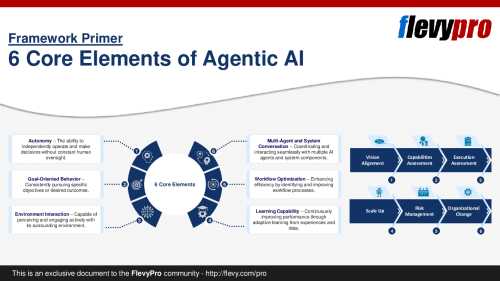
Agentic AI represents a shift toward autonomous, intelligent systems that can make decisions and take actions with minimal human intervention. Evolving from traditional machine learning, this technology enhances operations by automating complex workflows, optimizing decision-making, and enabling [read more]
Do You Want to Implement Business Best Practices?
You can download in-depth presentations on Artificial Intelligence and 100s of management topics from the FlevyPro Library. FlevyPro is trusted and utilized by 1000s of management consultants and corporate executives.
For even more best practices available on Flevy, have a look at our top 100 lists:
These best practices are of the same as those leveraged by top-tier management consulting firms, like McKinsey, BCG, Bain, and Accenture. Improve the growth and efficiency of your organization by utilizing these best practice frameworks, templates, and tools. Most were developed by seasoned executives and consultants with over 20+ years of experience.
Readers of This Article Are Interested in These Resources
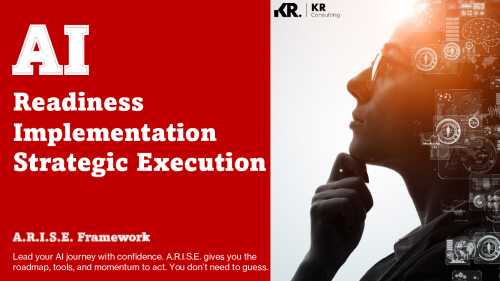
Artificial Intelligence (AI) is no longer a future concept - it's a present-day business imperative. AI is transforming how organizations operate, compete, and create value. Yet, with its rapid evolution, many enterprises struggle to keep pace. The A.R.I.S.E. Framework is a proven, [read more]
Curated by McKinsey-trained Executives
How to Use AI Skills for Consulting - The Complete AI-Powered Consulting Framework Guide
Stop leaving millions in consulting value on the table.
Most consultants destroy competitive advantage not because they lack brilliant analytical minds or [read more]
Shift your perspective on artificial intelligence governance: transition from treating it as a restrictive regulatory hurdle to leveraging it as a dynamic engine for ethical product development and organizational trust. This extensive practitioner toolkit offers a structured, step-by-step roadmap [read more]
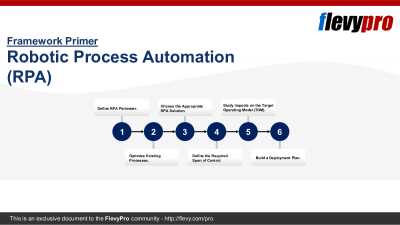
First, what is RPA?
Robotic Process Automation (RPA), also referred to as Robotic Transformation and Robotic Revolution, refers to the emerging form of process automation technology based on software robots and Artificial Intelligence (AI) workers.
In traditional automation, core activities [read more]
 Artificial Intelligence has moved from an experimental capability into the foundation of most new products being built today. According to Deloitte’s 2026 State of AI in the Enterprise, which surveyed 3,235 leaders across 24 countries, 88% of organizations use AI in at least one business function, and the number of companies with 40% or more AI projects in production is expected to double within six months. For startups, this shift redefines what a Minimum Viable Product actually is. An MVP no longer means the smallest version of a 7working product. It increasingly means the smallest version of a working AI-enabled product, handling real data, real users, and real consequences from the moment it ships.