Editor's Note: Take a look at our featured best practice, Balanced Scorecard (34-slide PowerPoint presentation). What is the Balanced Scorecard (BSC)?
The Balanced Scorecard is a strategy performance management tool--a semi-standard structured report, supported by proven design methods and automation tools, that can be used by managers to keep track of the execution of activities by the staff within their [read more]
* * * *
It’s (relatively) easy to come up with a corporate vision, with a mission statement, with a set of strategies. But, when it comes to the execution of that vision and strategy, things become much more challenging. This difficulty increases as the size of the organization increases. For proper strategic performance management, a number of methodologies and tools exist. The best strategic management framework is still the Balanced Scorecard (BSC).
First, let’s define strategic management. Wikipedia states strategic management analyzes the major initiatives taken by a company’s top management on behalf of owners, involving resources and performance in external environments. It entails specifying the organization’s mission, vision and objectives, developing policies and plans, often in terms of projects and programs, which are designed to achieve these objectives, and then allocating resources to implement the policies and plans, projects and programs. It is a level of management activities below setting goals and above tactics.
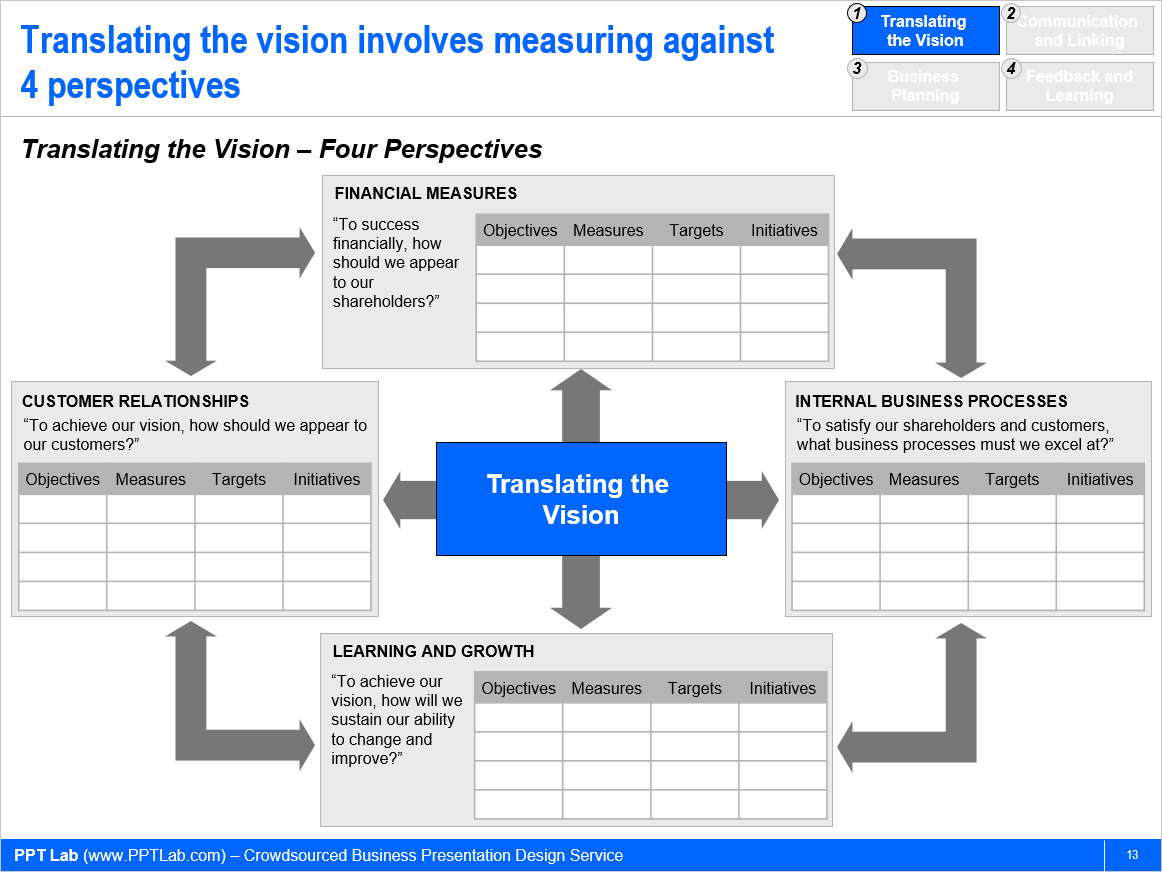
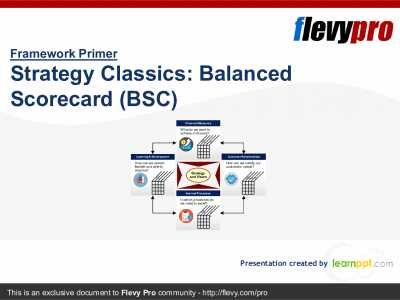
The goal of every business is to make a profit. As such, corporate goals, initiatives, and investments all typically are tied to financial metrics. How will it impact sales? What is the ROI? How long is the payback? Resultantly, most strategic management systems focus on Financial Measures. The Balanced Scorecard differs in that it takes a “balanced” approach by supplementing traditional financial measures with three important non-financial categories:
Customer Relationships
Internal Business Processes
Learning and Growth
This balanced approach allows organizations to track financial results, while simultaneously monitoring progress in building the capabilities and acquiring the intangible assets they need for continued, sustainable growth.
The foundation of the strategic management approach should be based on BSC. With the scorecard and metrics in place, the organization should adopt a continuous, iterative approach to managing its strategy and BSC. Though this process, companies can achieve the following:
Clarify and update the overall corporate strategy;
Communicate the strategy throughout the organization;
Align departmental and individual goals with the strategy;
Link strategic objectives to long-term targets and annual budgets;
Identify and align strategies initiatives; and
Conduct periodic performance reviews to learn about and improve strategy.
Note that the Balanced Scorecard approach can also be implemented independently at a lower level, e.g. at a departmental or project initiative level. For reasons started above, it is the preferred scorecarding methodology for many organizations and consulting firms. You can learn more about the Balanced Scorecard here.
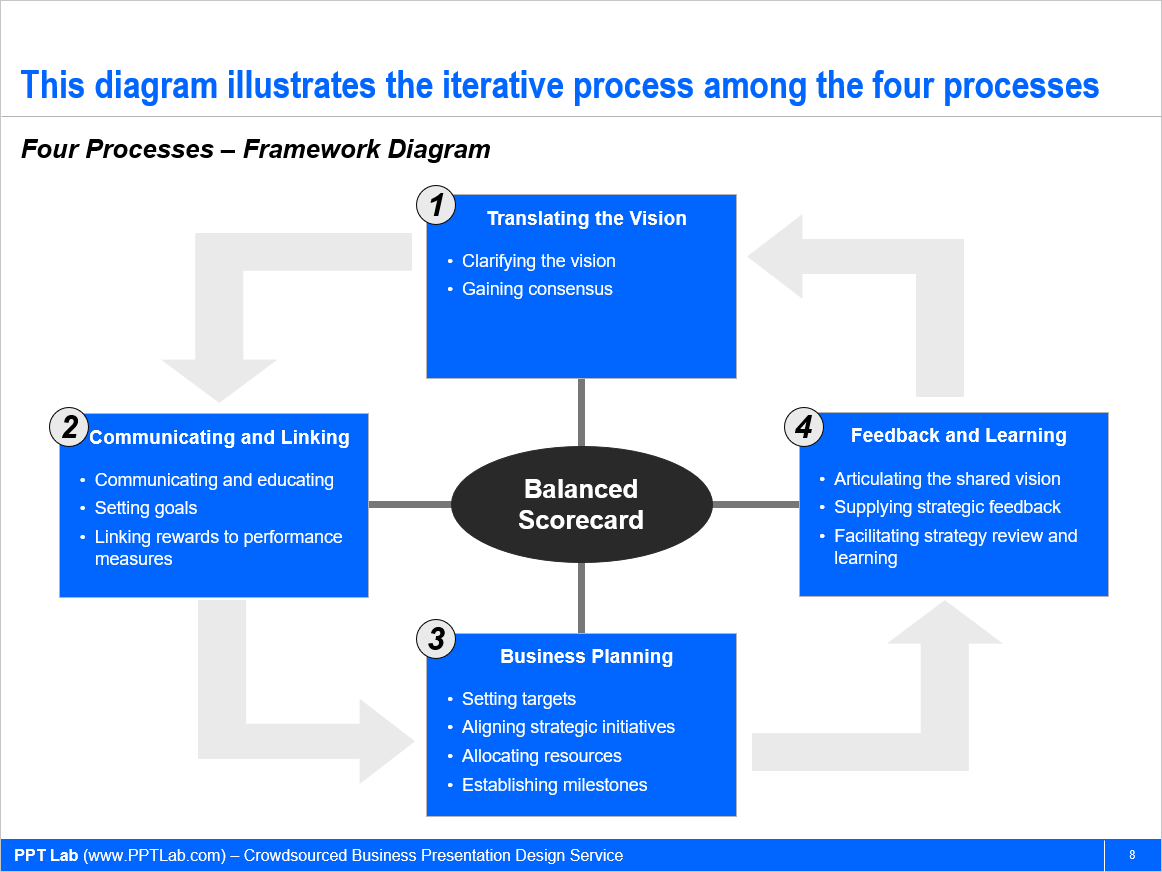
Properly implementing BSC requires an iterative set of four processes.
Process 1. Translating the Vision
The first process is to translate the vision. This involves converting the vision statement into operational terms. The process also ensures that, at the management level, we gain consensus and its true essence. Whereas gaining consensus may seem an easy and self-evident task, it often is not. Vision statements are often vague and easily interpreted differently by different people. In other words, even though everyone may agree to a vision statement, each person may have formed a different interpretation of what that statement actually refers to in operational terms.
Process 2. Communication and Linking
The second involves communicating the translated vision down through the organization and educating people on what it means. It also involves setting objectives and linking rewards to performance metrics.
Process 3. Business Planning
Business planning must then be performed in accordance to the work done in the previous two processes. Business planning activities include setting targets, aligning strategic initiatives, and allocation resources. In most companies, strategic planning and budgeting are two separate processes. BSC forces your organization to integrate the two processes.
Process 4. Feedback and Learning
This fourth process provides a mechanism for strategic feedback and review. It allows for continuous strategic refinements. Info that can be tracked with the scorecard for this include feedback on products, new learnings about internal processes, and technological discoveries.
As the diagram above illustrates, Feedback and Learning feeds back into Translating the Vision.
Of course, the approach to strategic management can be driven by the size of the organization. A global organization may employ a more structured strategic management model. This is due to its size, scope of operations, and need to encompass stakeholder views and requirements.
A small or mid-sized business may adopt an entrepreneurial approach. This is due to its comparatively smaller size and scope of operations, as well as possessing fewer resources. In such cases, the CEO may simply outline a mission, and pursue all activities under that mission.
The Balanced Scorecard approach becomes more useful and necessary as the size of the organization increases.
For a deeper discussion, check out these resources:
Performance Management Stream – Flevy’s most comprehensive offering on Performance Management, a bundle of 25+ frameworks (e.g. BSC, OKR, KPIs, Value Mapping, Benchmarking, etc.).
Elevate your team's performance and strategy execution to new heights with the Performance Scorecard Framework, crafted by former strategy consultants from elite firms such as BCG and EY. This unique tool combines the strengths of the Balanced Scorecard with an exclusive proprietary [read more]
Do You Want to Implement Business Best Practices?
You can download in-depth presentations on Balanced Scorecard and 100s of management topics from the FlevyPro Library. FlevyPro is trusted and utilized by 1000s of management consultants and corporate executives.
For even more best practices available on Flevy, have a look at our top 100 lists:
These best practices are of the same as those leveraged by top-tier management consulting firms, like McKinsey, BCG, Bain, and Accenture. Improve the growth and efficiency of your organization by utilizing these best practice frameworks, templates, and tools. Most were developed by seasoned executives and consultants with over 20+ years of experience.
Readers of This Article Are Interested in These Resources
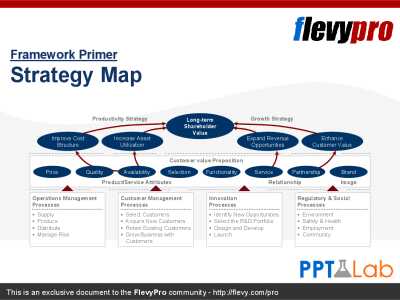
A Strategy Map is a diagram that conveys the primary strategic goals being pursued by an organization. It is a strategic part of the Balanced Scorecard (BSC) framework to describe strategies for value creation. More specifically, a Strategy Map describes how our organization creates value by [read more]
The Balanced Scorecard is a strategic performance management system that is used extensively in business, government, and nonprofit organizations to align business activities to the vision and strategy of the organization.
The Balanced Scorecard (BSC) Deployment Process Module includes: [read more]
Effectively developing and communicating high-level business strategy is essential for organizations looking to achieve market leadership. Additionally, creating a results-oriented culture requires a comprehensive management system. You can use this Balanced Scorecard Strategy Map tool as a basis [read more]
The Balanced Scorecard (BSC), developed by Robert Kaplan and David Norton, is a Strategic Performance Management System. It is a semi-standard structured report, supported by proven design methods and automation tools, that can be used by managers to keep track of the execution of activities by the [read more]