Editor's Note: Take a look at our featured best practice, Digital Transformation Strategy (145-slide PowerPoint presentation). Digital Transformation is being embraced by organizations across most industries, as the role of technology shifts from being a business enabler to a business driver. This has only been accelerated by the COVID-19 global pandemic. Thus, to remain competitive and outcompete in today's fast paced, [read more]
* * * *
 Cyber threats have become harder to detect, jeopardizing public data with every online session. Public Wi-Fi hotspots, phishing schemes, and large-scale breaches all undermine digital privacy.
A virtual private network (VPN) counters these risks by encrypting internet traffic and concealing browsing activity. However, hundreds of providers compete for attention, and not all of them deliver genuine protection. This guide highlights what separates trustworthy VPN service providers from those that only look secure on paper.
Why Security Should Drive the Decision
It is tempting to grab the cheapest option or a free plan without reading the fine print. A provider with poor encryption or data-handling practices can actually broaden risks instead of shrinking them.
Price comparisons and server counts matter, but only after confirming security. Putting protection first keeps all your sensitive information behind a reliable shield.
Before comparing subscription tiers, measure each provider against defined security benchmarks. The criteria below spell out what those benchmarks should cover.
1. Encryption Standards and Protocols
Solid encryption is the foundation every other feature rests on. AES-256 remains the top choice among cybersecurity professionals, and for good reason. Government agencies and major financial institutions rely on the same to protect classified information.
The tunneling protocol, paired with that encryption, matters just as much. IKEv2 holds its own on mobile devices, where connections jump between cellular towers and Wi-Fi access points. Providers still leaning on PPTP deserve a hard pass, since it has well-documented security flaws.
2. No-Log Policies and Independent Audits
A genuine no-log policy is critical. It means the provider doesn’t log browsing history, connection timestamps, or user IP addresses. Even perfectly encrypted traffic becomes a liability if detailed activity logs sit on a company’s servers waiting to be subpoenaed or stolen.
How to Verify Claims
Nearly every provider advertises zero logging, so the promise alone carries little weight. Credible companies back up that claim by hiring independent cybersecurity firms to audit their infrastructure. These third-party examiners inspect server configurations and internal data-handling processes and publish their findings. A recent audit report offers far stronger assurance than any self-written privacy statement.
3. Kill Switch and Leak Protection
A kill switch severs internet access whenever an encrypted tunnel drops. Without it, a brief connection hiccup can expose a real IP address and send unprotected data across the open network, often without any visible warning on screen.
DNS and IPv6 leak protection deserve the same scrutiny. A DNS leak reveals the sites a user visits, even while the tunnel is active. Reputable providers have in-built leak guards rather than expecting users to configure them manually. Running a quick leak test after installation confirms if those safeguards really work. Use any of the free browser-based tools available to do this.
4. Server Network and Jurisdiction
A provider’s location shapes its responses to government data requests. Companies in privacy-conscious jurisdictions, such as Panama or Switzerland, sit outside the reach of prominent intelligence-sharing agreements.
Geographic diversity in the server fleet is also beneficial. A broad spread of locations reduces overcrowding on individual servers. This further lowers the odds of slowdowns that tempt users to turn protection off.
RAM-only servers raise the bar further. They wipe all stored data on every reboot, and long-term retention becomes physically impossible.
5. Additional Features Worth Considering
Some supplementary tools can strengthen the VPN’s offerings. Here are some to consider:
- Multi-hop routing pushes traffic through two separate servers, layering an extra round of encryption on top.
- Built-in threat filters block malicious domains and trackers before a page even loads.
- Split tunneling lets users route only sensitive apps through the encrypted connection. Routine traffic flows normally, while unnecessary bandwidth use remains low.
Device compatibility is also key. A provider that supports routers, smart TVs, and mobile platforms delivers consistent coverage under a single subscription.
Summing Up
Picking the right provider comes down to checking real protections. Strong encryption, an independently audited no-log policy, a reliable kill switch, and a privacy-respecting legal home make a sound choice. Spending a little time comparing these factors up front prevents regret later and safeguards sensitive data. A well-vetted provider runs quietly in the background, offering steady reassurance whenever a device goes online.
23-slide PowerPoint presentation
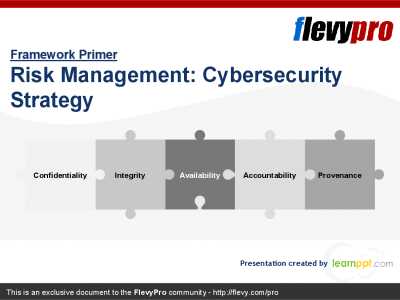
Cybersecurity is a growing threat and should be at the forefront in any IT Risk Management Strategy. As role of
The PPT outlines the critical elements of a robust cybersecurity strategy, emphasizing the importance of integrity, availability, accountability, and provenance of information. It
[read more]
Do You Want to Implement Business Best Practices?
You can download in-depth presentations on Cyber Security and 100s of management topics from the FlevyPro Library. FlevyPro is trusted and utilized by 1000s of management consultants and corporate executives.
For even more best practices available on Flevy, have a look at our top 100 lists:
These best practices are of the same as those leveraged by top-tier management consulting firms, like McKinsey, BCG, Bain, and Accenture. Improve the growth and efficiency of your organization by utilizing these best practice frameworks, templates, and tools. Most were developed by seasoned executives and consultants with over 20+ years of experience.
Readers of This Article Are Interested in These Resources
18-page Word document
This Word Document provides a template for an IT Security & Governance Policy and is easily customisable. Areas cover are: Security, Data Back-Up, Virus Protection, Internet & Email usage, Remote & 3rd Party Network Access, User-Account Management, Procurement, Asset Management and IS Service
[read more]
Excel workbook
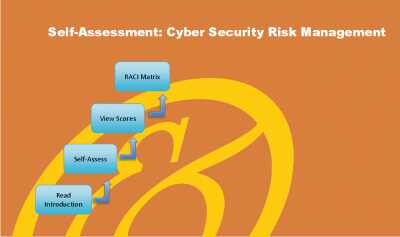
National Institute of Standards and Technology (NIST) U.S. Department of Commerce Cyber Security Framework Aligned.
Governments, sectors, and organizations around the world are increasingly recognizing the NIST Cyber Security Framework (CSF) as a recommended cyber security baseline to
[read more]

53-slide PowerPoint presentation
Cybersecurity awareness is the understanding and knowledge of potential threats to information systems and the measures individuals and organizations can take to protect themselves from these threats. It involves being conscious of the risks associated with using technology and being proactive in
[read more]
16-slide PowerPoint presentation
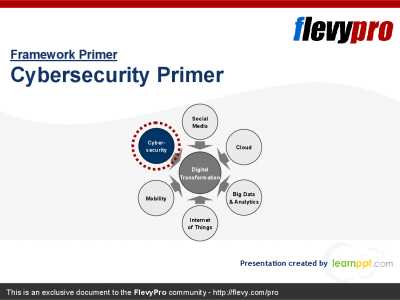
Cybersecurity is the protection of information systems from theft or damage to the hardware, the software, and to the information on them. The more we depend on the Internet and related technologies, the more we depend on their security.
As such, there can be no Digital Transformation without
[read more]