 A company seeking a managed IT partner may now start with ChatGPT rather than a referral or search engine. In G2’s 2026 AI Search Insight Report, 51% of surveyed B2B software buyers said they start research with an AI chatbot more often than Google. The finding concerns self-reported software research, not managed service provider (MSP) contracts, so it provides context rather than direct evidence of how buyers select IT service firms.
AI-generated vendor recommendations can shape an early shortlist before a provider receives an inquiry. The problem may be that prospective buyers cannot discover or verify an IT firm’s expertise. AI search visibility is therefore an emerging competitive consideration.
How AI Search Is Reshaping B2B IT Vendor Selection
IT procurement traditionally involved referrals, directories, search results, and vendor websites before direct contact. Those channels remain important, but AI can compress early research.
A procurement director might ask for cybersecurity partners experienced in healthcare compliance, compare cloud migration providers for a regional manufacturer, or request MSPs serving businesses with offices in several states. ChatGPT, Perplexity, and Google’s AI search experiences can help assemble possibilities, summarize differences, and suggest questions for a request for proposal.
Answers can omit capable firms or contain outdated information. Nevertheless, they may influence which companies receive closer examination. Buyers may validate the names through reference checks or security questionnaires, but firms missing from the initial list may have fewer opportunities to demonstrate their strengths.
That creates a visibility gap: an MSP can rank for conventional search terms yet remain absent from relevant AI-generated shortlists. Commercial teams must examine both pathways.
What Helps Buyers and AI Search Systems Evaluate IT Service Providers
No universal formula governs recommendations across AI platforms. Their models, sources, and retrieval methods differ. Providers can nevertheless improve information quality.
Relevance to Buyer Questions
A generic claim to offer “complete IT solutions” says little about a buyer’s particular problem. Specific descriptions of managed detection and response, cloud environments, geographic coverage, or experience with regulated industries make a firm’s fit easier to assess. Healthcare buyers need different evidence from retailers seeking nationwide help-desk coverage.
Crawlability and Accessible Information
Service details need accessible pages, navigation, and consistent information. Google’s Search Central guidance says standard SEO foundations remain relevant to AI Overviews and AI Mode. To qualify as a supporting link, a page must be indexed and eligible to appear in Google Search with a snippet. No separate AI-specific technical optimization is required, and eligibility does not guarantee inclusion.
Third-Party Credibility
Independent directory listings, substantive customer reviews, certifications, and documented client outcomes help buyers corroborate claims. Accuracy matters more than mention volume. An expired certification or unsupported compliance promise can weaken a provider’s case when prospects investigate further.
Content and Credibility That Support IT Provider Discovery
Many IT firms describe services without specifying their customers, coverage, or substantiated outcomes. Such specifics help buyers compare vendors, particularly when competing providers appear similar on the surface but differ in delivery capabilities.
Service pages should separate offerings such as co-managed IT, cloud infrastructure, disaster recovery, compliance support, and managed cybersecurity. Specify scope, client environments, onboarding, service boundaries, and credentials. Industry pages need genuine evidence, not recycled sales copy.
Evidence is equally important. A client-approved case study might explain the starting problem, the deployment approach, and measurable results, with client details anonymized where confidentiality requires it. Named technical leaders, accurate professional certifications, and documented partnerships give procurement teams additional material to check.
Credible external coverage reinforces this picture. Industry associations, relevant directories, interviews with technical experts, and authentic client feedback may help buyers find consistent information across sources. The strategic objective is a defensible market position, not a higher volume of interchangeable blog posts.
How to Organize GEO Work for IT Service Providers
Generative engine optimization (GEO) is the practice of improving how a company can be discovered, described, and potentially cited in AI-generated responses. It overlaps with search engine optimization (SEO), but focuses additionally on conversational buyer questions, answer accuracy, and visibility across AI-assisted research experiences. GEO complements established SEO rather than replacing it.
For MSPs competing for complex B2B work, a coherent approach to GEO for IT service providers connects detailed buyer requirements with accessible service information, credible evidence, and ongoing review of AI-generated vendor recommendations. The same business might need to demonstrate cloud migration expertise to a chief technology officer, regulatory familiarity to a compliance lead, and service coverage to procurement.
This takes more than additional blog posts. Teams must identify commercially important prompts, determine whether published information answers them, repair technical access problems, and strengthen independent evidence where gaps exist.
Marketing can coordinate while IT validates technical claims and sales shares buyer objections. Specialized GEO support can be useful when that combination of prompt research, technical execution, and measurement exceeds available capacity. Accountability for the underlying service claims remains with the provider.
A Practical Framework for Auditing and Closing the AI Search Visibility Gap
An AI visibility audit should test real buying situations, not generic “best MSP” questions. Five steps make the audit actionable.
Step 1: Map High-Intent Buyer Prompts
Compile questions from sales calls, lost-deal reviews, and procurement documents. Cover discovery (“MSPs supporting 200-person manufacturers in Ohio”), comparison (“co-managed IT versus fully outsourced support”), and qualification (“providers experienced with Microsoft 365 security and compliance”). Segment prompts by service, industry, region, and buying stage.
Keep unbranded vendor-discovery prompts, named-vendor comparisons, and informational questions in separate groups. Measure provider recommendations only where recommending a provider is relevant to the question.
Anonymize confidential details from sales calls and procurement documents before entering them into external AI tools.
Step 2: Benchmark AI Recommendations
Run representative prompts through ChatGPT, Perplexity, and relevant Google AI search experiences. Record provider mentions, cited sources, competitor names, and inaccurate descriptions. Retest important prompts using consistent conditions and multiple runs because results can change with wording, timing, and platform behavior.
Record the exact prompt, date, platform, displayed model or mode, search setting, and relevant location or language settings. Use fresh conversations where possible and retain the full responses and cited URLs. Treat the results as a sample of responses under those conditions, not a complete picture of what every buyer sees.
Step 3: Identify Content and Authority Gaps
Compare what the answers say with current service pages and independent sources. Look for missing vertical expertise, unclear locations served, inconsistent business profiles, thin case studies, and unverified claims. Check whether cited competitor evidence highlights details your own company has not clearly published.
Step 4: Prioritize Corrective Actions
Rank fixes by commercial relevance, confidence in the evidence, and implementation effort. A precise cybersecurity service page or corrected directory profile may matter more than ten general-interest articles. Make technical pages accessible, publish substantiated client outcomes, and remove outdated descriptions.
Step 5: Establish a Repeatable Review Process
Revisit the same prompt groups on a regular schedule, retaining the original questions for comparison. Assign marketing responsibility for monitoring, technical leaders responsibility for accuracy, and commercial leadership responsibility for interpreting pipeline relevance.
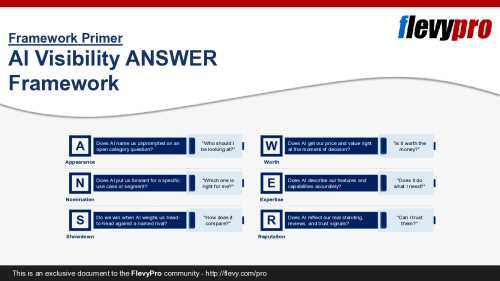
HiBot’s ANSWER framework, described by Flevy, offers one optional way to organize findings across Appearance, Nomination, Showdown, Worth, Expertise, and Reputation. It is an assessment framework, not an AI platform’s ranking formula.
Measuring AI Visibility as a Strategic Business Outcome
Traditional keyword rankings and organic traffic remain useful, but they cannot reveal every instance in which an AI answer influences a buyer’s shortlist. An executive dashboard can track mention frequency across tested prompts, recommendation coverage by service category, citations, competitors’ share of mentions within the tested sample, and factual accuracy.
Distinguish a company-name mention from an explicit recommendation and a citation to the company’s website. Define each metric’s denominator and report results by platform and prompt group. A citation does not necessarily endorse the provider, and a mention may be neutral or negative.
Where measurement permits, teams can also track visits referred by AI platforms, qualified inquiries, booked consultations, and opportunities recorded in the customer relationship management (CRM) system. Referral data can be incomplete; mentions do not prove sales causation.
Search Console counts AI Overviews and AI Mode impressions in its overall Web performance totals, and Google’s separate Generative AI performance report, rolled out worldwide in August 2026, breaks those impressions out. It shows impressions only and does not cover other AI platforms.
The management question is whether better representation helps the right buyers discover and evaluate the company, rather than simply increasing how often its name appears.
Next Steps for Improving AI Search Visibility
AI-assisted research adds another gate to B2B IT vendor selection, often before any sales conversation begins. MSPs that explain their specialization clearly, support claims with verifiable evidence, and review how they appear in AI answers are better equipped to compete for consideration.
Start by auditing important buyer questions and the sources shaping answers. From there, executives can prioritize improvements grounded in commercial opportunity, while maintaining the search visibility, technical credibility, and customer trust their businesses already depend on.