Editor's Note: Take a look at our featured best practice, Key Performance Indicators (KPIs) | Supply Chain Functions (113-slide PowerPoint presentation). This document provides a collection of 100+ Key Performance Indicators (KPIs) related to the Supply Chain functions listed further below.
Keeping in mind that each organization is different, the enclosed KPIs are intended as a general reference and their relevance depends on the specific [read more]
* * * *
Most enterprises still manage Supply Chain costs the same way they manage the rest of the budget. They take last year’s numbers, adjust for volume and inflation, and ask each function to find a few points of savings. The method feels prudent, but it quietly accepts every historical assumption embedded in the baseline. Spending that made sense five years ago rolls forward untouched, and the question of what the Supply Chain actually needs to cost never gets asked.
That approach is harder to defend today. Supply Chains have evolved into intricate ecosystems that serve as strategic control points rather than back-office operations, and for consumer-packaged-goods companies, Supply Chain expenditures can account for up to 75% of revenues. Leaders face skilled-labor scarcity driving automation and Artificial Intelligence (AI) adoption, tariffs and geopolitical tensions forcing a rebalancing of resilience against lean cost, sustainability regulation adding complexity, and demand volatility requiring rapid reallocation of resources. They are expected to reduce costs and redirect capital toward growth simultaneously, and incremental budgeting cannot deliver both.
Many executives also assume Lean programs have already captured most of the available value. In practice, traditional continuous-improvement methods often leave substantial opportunities untapped, particularly at the intersections between procurement, manufacturing, logistics, and planning, where no single function owns the inefficiency.
The Zero-Based Productivity (ZBP) framework addresses that gap. ZBP extends zero-based thinking beyond budgeting into Organizational Design, Supply Chain Performance, and other major sources of Productivity. Rather than treating historical expenditure as the starting point, it builds a bottom-up view of the optimum cost base, challenging every assumption and exposing what traditional budgeting overlooks. When executed with discipline, ZBP delivers cost reductions of up to 50%, while freeing resources to reinvest in Growth and Innovation.
The 4 Essential Cost Categories of ZBP
At the heart of ZBP is a simple organizing structure. The methodology segregates Supply Chain costs into 4 essential categories:
Direct Labor
Indirect Labor
Warehouse and Logistics
Materials
This categorization gives leaders granular cost transparency across the Supply Chain, exposes cross-functional trade-offs among the categories, and allows interventions to be prioritized by industry context and operating model. The savings potential in each category varies significantly. In highly automated or continuous manufacturing, direct labor may be a modest lever, whereas in manual assembly it becomes decisive. Let’s examine the first 2 categories more closely, for now.
Direct Labor
The Direct Labor category covers the workforce directly engaged in producing goods or delivering services. Under ZBP, this category is scrutinized to determine what labor is truly essential to meeting regulatory standards and customer expectations, and nothing more.
The analysis starts by separating value from non-value activities, distinguishing tasks that directly contribute to product quality or compliance from those that add little or nothing. Current labor standards are then benchmarked against industry practice to reveal gaps in efficiency and productivity. Overall Equipment Effectiveness receives particular attention, because productivity losses tied to scheduling, downtime, and maintenance practices often constrain the workforce more than headcount does. Finally, leaders evaluate talent utilization and redeployment, redirecting capacity that is not essential to production quality toward innovation, problem-solving, and strategic initiatives.
The result is higher throughput and less inefficiency without compromising quality or compliance. Direct Labor optimization under ZBP is less about cutting heads and more about redefining how the workforce is deployed to maximize productivity and resilience.
Indirect Labor
The Indirect Labor category encompasses the support functions and supervisory layers that enable direct production, including maintenance, engineering, cleaning, and management oversight. The goal is to determine the optimal cost of fulfilling customer and regulatory requirements by challenging what work is truly necessary, who should perform it, and how it should be structured.
The work begins by redefining support functions, assessing which activities require specialized staff versus line operators and striking the right balance between in-house and outsourced work. Shift optimization follows, aligning each task with the shift that genuinely needs it and eliminating redundant coverage. Customer requirement segmentation links the cost of serving different customer demands to pricing models, such as menu pricing, protecting profitability across segments. Regulatory and compliance practices are scrutinized so that only essential activities are maintained. And management layers are simplified, flattening supervisory structures to enable faster decisions and greater responsiveness.
Indirect Labor is where organizational complexity quietly accumulates. ZBP strips it back to the support, supervision, and compliance the operation actually requires.
Case Study
Consider a packaged foods manufacturer operating several plants with a mix of manual packing lines and automated processing. Years of incremental budgeting had delivered small annual savings, yet labor costs per unit kept rising.
A ZBP review of Direct Labor revealed that operators on the packing lines spent a meaningful share of each shift waiting on changeovers and unplanned downtime. Addressing scheduling and maintenance practices raised Overall Equipment Effectiveness, and the capacity released was redeployed to a Continuous Improvement team rather than eliminated. Benchmarking labor standards against peers showed the manual lines were overstaffed relative to comparable operations, while the automated lines were already near best practice.
The Indirect Labor review produced even larger gains. Quality checks introduced years earlier as temporary fixes were still running on every shift, cleaning crews duplicated coverage between shifts, and each plant carried three supervisory layers where two sufficed. Some routine maintenance tasks were shifted to trained line operators, and specialized engineering work was consolidated into a shared team. The combined changes reduced plant labor costs substantially while improving decision speed on the floor.
FAQs
Why does ZBP separate costs into 4 categories?
The categories create granular transparency and expose trade-offs between them, such as automation investments that raise Materials or equipment costs while lowering Direct Labor. They also let leaders prioritize where savings potential is highest for their industry.
Which cost category offers the largest savings?
It depends on the operating model. Direct Labor matters most in manual assembly, while Warehouse and Logistics is one of the largest and most variable cost blocks for distribution-heavy businesses.
Does optimizing Direct Labor mean reducing headcount?
Not necessarily. ZBP often redeploys capacity not essential to production quality toward innovation and problem-solving rather than removing it.
Can ZBP be applied to raw materials?
Yes. Techniques such as Design to Value, Product Teardowns, Total Cost of Ownership, and Yield Optimization zero-base the Materials category from the product outward without eroding what customers value.
Our Supply Chain already runs lean programs. Is ZBP still relevant?
Usually. Lean methods optimize within functions, while ZBP targets cross-functional inefficiencies that continuous improvement often leaves untouched.
Concluding Thoughts
The weakness of incremental budgeting is not that it cuts too little. It is that it never questions the baseline. ZBP inverts that logic by asking what the Supply Chain needs to cost, category by category. Direct Labor and Indirect Labor are natural starting points, because they are where legacy practices, redundant coverage, and unnecessary hierarchy accumulate most quietly.
Warehouse and Logistics and Materials extend the same discipline to the physical flow of goods and the product itself, where clean-sheet costing and value-focused design unlock further savings. Organizations that apply ZBP across all 4 categories build a Supply Chain in which every dollar is there by decision rather than by default.
You can download in-depth presentations on this and hundreds of similar business frameworks from the FlevyPro Library. FlevyPro is trusted and utilized by 1000s of management consultants and corporate executives.
For even more best practices available on Flevy, have a look at our top 100 lists:
The Leadership at many Warehousing companies globally understands that they should spend less on Warehousing Operations, but is not aware of the real costs associated with it. In the same vein, most leaders are unable to tell how much is their human resources cost per facility.
Lack of [read more]
Readers of This Article Are Interested in These Resources
As the last decisive step in customer service, a warehouse ensures cost effective distribution. Latest technological innovation has turned Warehousing into a Competitive Advantage. It offers untapped potential for improvement.
However, Warehousing is a hugely neglected part of global Supply [read more]
Shortage of labor, intensified demand from e-tailers (online retailers), and technological disruption is forcing many organizations in the Logistics and Warehousing sectors to embrace technology, particularly Automation.
Automation is facilitating Warehouse operations predominantly by [read more]
Companies are constantly looking to improve efficiency and reduce costs. One area that has a significant potential for achieving both is the Supply Chain.
Companies generally neglect Supply Chain simply because they do not consider it their core competency. Warehousing and Transportation in [read more]
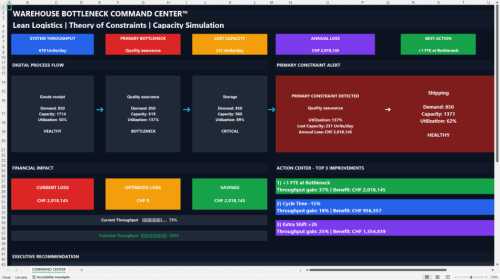
The Warehouse Bottleneck Analysis & Capacity Optimization Dashboard is a professional Excel-based warehouse performance solution designed to help organizations identify operational bottlenecks, optimize warehouse capacity, and improve throughput using a centralized executive dashboard.
The [read more]
 Most enterprises still