Editor's Note: Take a look at our featured best practice, Digital Transformation: Artificial Intelligence (AI) Strategy (27-slide PowerPoint presentation). The rise of the machines is becoming an impending reality. The Artificial Intelligence (AI) revolution is here. Most businesses are aware of this and see the tremendous potential of AI.
This presentation defines AI and explains the 3 basic forms of AI:
1. Assisted Intelligence
2. [read more]
* * * *
The Artificial Intelligence (AI) adoption numbers tell a story of remarkable momentum undercut by a stubborn gap. 70% of CEOs believe GenAI will fundamentally reshape value creation within 3 years. 88% of organizations already use AI in at least one business function. Global AI spending is projected to reach $307 billion in 2025-26. And yet only 7% of organizations have successfully scaled AI capabilities across the enterprise, only 14% of employees use Generative AI (GenAI) daily, and only 28% report receiving adequate training to use AI effectively. It turns out momentum does not convert itself into value.
The reasons are consistent across industries. Business units chase promising use cases independently, disconnected from strategic priorities. Experiments, thus, multiply while enterprise value does not. Attention gravitates toward small individual wins, faster email drafting and code completion, while higher-value opportunities in process reinvention and Business Model Innovation go unclaimed. Pilots abound, but the leap to production-scale deployment remains the single greatest execution challenge. Many organizations launch without honestly assessing their skill and technology gaps, then blame the technology when pilots fail. Add a fast-moving regulatory environment and AI initiatives running separately from broader Digital Transformation programs, and the result is fragmented investment and duplicated effort.
What separates the 7% from everyone else is not better models. It is a disciplined, end-to-end approach to designing and executing the AI journey. The AI Journey Design framework provides exactly that.
Key Steps to AI Journey Design
The framework guides organizations from initial readiness through sustained value realization across 9 interconnected steps:
AI Readiness Assessment
Use Cases Catalog Definition
Use Case Preliminary Evaluation
Business Case Development
Implementation Plan Design
Business Engagement and Prioritization
Operating Model and Architecture Design
Roadmap Design
Performance and Roadmap Management
The sequence matters, because each step supplies the inputs the next one depends on. Let’s examine the first 2 steps more closely, for now.
AI Readiness Assessment
Every credible AI journey begins with an honest answer to an uncomfortable question: is this organization actually ready? The readiness assessment evaluates maturity across data, technology, talent, governance, the operating model, and business processes along the entire value chain. Its purpose is to surface strengths, capability gaps, and the barriers most likely to constrain adoption, giving leaders a fact-based view of where the organization stands and what must be strengthened before AI can scale.
The work proceeds along 4 lines. A systematic capability evaluation examines data, technology, governance, and workforce readiness to expose the constraints that would otherwise surface mid-implementation. A Value Chain Analysis assesses each stage of the business to locate where AI can create the greatest impact and unlock new sources of value. Mapping strengths against deficiencies then shows where initiatives can be accelerated immediately and where foundational investment must come first. Finally, prioritization focuses effort on initiatives that deliver near-term value while capability building proceeds in weaker areas.
The assessment is the groundwork for every decision that follows, ensuring AI investments align with long-term business objectives rather than with whichever function shouted loudest.
Use Cases Catalog Definition
With readiness understood, the second step converts scattered ideas into a strategic asset. A well-structured use case catalog systematically gathers opportunities from industry benchmarks, vendor solutions, academic research, and internal ideation workshops, producing a comprehensive inventory of AI applications spanning the full value chain.
Four actions define the step. Organizations gather insights broadly, consolidating ideas from best practices, technology vendors, research publications, and market trends rather than relying on what internal teams happen to know. Innovation workshops engage cross-functional teams to generate ideas, validate business relevance, and surface opportunities specific to the organization. Full value chain coverage ensures the catalog spans every business function, protecting against the tunnel vision that concentrates AI in one or two departments. And the catalog is established deliberately as a strategic foundation, the reference point for the evaluation, business case, prioritization, and roadmap work of the steps that follow.
The scale can be striking. One catalog designed to guide industrial manufacturers through AI adoption encompasses more than 700 potential use cases, organized by industry, business function, and maturity level, giving leaders a single structured view from which to identify and pursue the most relevant opportunities.
Case Study
An AI Readiness Assessment conducted for a manufacturing concern shows the first step in action. The assessment mapped readiness across 7 core business functions, from product design through customer service, with color-coded results exposing sharp variation in maturity between functions. The picture that emerged was immediately actionable: it revealed where AI could be deployed at once for quick impact, and where foundational capabilities such as data quality needed strengthening before AI could be implemented effectively. By identifying its mature functions, leadership could prioritize pilots that delivered quick wins while planning capability building in the weaker areas, a far more disciplined starting position than the launch-everywhere enthusiasm that stalls so many programs.
FAQs
Why do so many AI initiatives fail to scale beyond pilots?
Most fail for organizational rather than technical reasons: use cases pursued without strategic alignment, unassessed capability gaps, and no structured path from proof of concept to production. The 9-step journey addresses each failure point in sequence.
What does an AI Readiness Assessment actually evaluate?
It evaluates maturity across 6 dimensions: data, technology, talent, governance, operating model, and business processes along the value chain. The output is a fact-based map of strengths, gaps, and barriers that shapes where AI starts and what gets built first.
How comprehensive should a use case catalog be?
Broad enough to cover the entire value chain and draw on external sources, not just internal ideas. Industry catalogs can exceed 700 use cases; the point is not to implement them all but to choose from a complete picture rather than a partial one.
Should organizations skip the readiness assessment if they have already started pilots?
No. Running pilots without a readiness baseline is precisely how organizations end up blaming technology for failures rooted in data quality or missing skills. An assessment mid-journey still redirects investment toward the gaps that matter.
Who should own the AI journey within the organization?
Design and execution must be jointly owned by business and technology leadership, since the recurring failure mode is misalignment between the two. Later steps of the framework formalize this through executive sponsorship, accountability mechanisms, and governance structures.
Concluding Thoughts
The divide opening up in the AI era will not separate adopters from non-adopters. Nearly everyone is adopting. It will separate the organizations that can scale AI from those that cannot, and scaling is decided long before deployment, in the quality of the readiness assessment and the breadth of the opportunity catalog that precede it.
The first 2 steps of AI Journey Design supply that foundation. Readiness assessment tells Leadership where the organization genuinely stands; the use case catalog tells it what is genuinely possible. Every subsequent step, from evaluation and business cases through implementation waves, operating models, and performance management, draws on those two inputs. Organizations that invest in getting them right convert AI momentum into measurable business value. Organizations that skip them join the 81% still using AI somewhere, and the 93% yet to scale it anywhere.
You can download in-depth presentations on this and hundreds of similar business frameworks from the FlevyPro Library. FlevyPro is trusted and utilized by 1000s of management consultants and corporate executives.
For even more best practices available on Flevy, have a look at our top 100 lists:
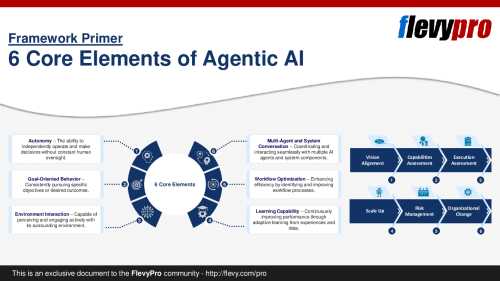
Agentic AI represents a shift toward autonomous, intelligent systems that can make decisions and take actions with minimal human intervention. Evolving from traditional machine learning, this technology enhances operations by automating complex workflows, optimizing decision-making, and enabling [read more]
Readers of This Article Are Interested in These Resources
Artificial Intelligence (AI) is no longer a future concept - it's a present-day business imperative. AI is transforming how organizations operate, compete, and create value. Yet, with its rapid evolution, many enterprises struggle to keep pace. The A.R.I.S.E. Framework is a proven, [read more]
Curated by McKinsey-trained Executives
How to Use AI Skills for Consulting - The Complete AI-Powered Consulting Framework Guide
Stop leaving millions in consulting value on the table.
Most consultants destroy competitive advantage not because they lack brilliant analytical minds or [read more]
Curated by McKinsey-trained Executives
Unlock the Future of Your Business with the Ultimate AI Strategy Playbook: 1000+ Slides to Master AI and Dominate Your Industry
In today's fast-evolving digital landscape, Artificial Intelligence (AI) is no longer a luxury -- it's a [read more]
Organizations worldwide are embracing GenAI for its ability to generate actionable insights, predict outcomes, personalize at scale, and process natural language with human-like fluency.
Leading organizations already deploy GenAI in AI-assisted software development, workflow automation, [read more]
 The
The