Editor's Note: Take a look at our featured best practice, Corporate Learning Strategy (26-slide PowerPoint presentation). Although organizations invest heavily in Learning and Talent Development, most CEOs complain about the shortage of learned managers and leaders. Research reveals that a number of managers consider employee performance to remain the same if their organization's Learning function is totally [read more]
* * * *
 A Shift in Digital Reading Spaces
Online reading platforms have changed how written material is accessed and shared across wide collections. A shift from physical shelves to structured digital catalogues has formed new patterns of exploration. Content appears in flexible systems focused on themes rather than location, allowing smooth movement across subjects without strict boundaries.
Within this landscape, Zlibrary works as a large digital library that covers many different subjects, connecting readers with a wide spectrum of material. The structure feels like an evolving archive where categories blend and expand. This supports natural movement between topics shaped by curiosity and varied interests.
Navigation and Structure of Access Points
Digital reading systems use layered designs that improve clarity and access. Content appears in flexible clusters that adapt to context, reducing complexity while keeping depth available.
These systems also shape how information feels during use. Category connections create continuity and smoother transitions across different fields.
Navigation relies on structured layers such as categories and keywords that guide movement across large collections. Access points respond to browsing patterns and maintain consistency while adapting to context. Several elements define this structure in practice:
Thematic Grouping Logic
Thematic grouping logic organizes material by shared ideas instead of rigid categories. This allows content with similar context to appear together even when traditional classification would separate them. The structure supports fluid movement between topics and helps connections emerge naturally. It encourages comparison across fields and reduces fragmentation in large collections. By placing related material close together, the system creates a smoother reading path that feels coherent. This approach also helps maintain focus during exploration across diverse subjects.
Adaptive Search Layers
Adaptive search layers adjust results based on input patterns and recent activity. This creates a dynamic environment where outcomes evolve with usage rather than remaining fixed. Repeated searches become more refined, balancing precision with variety. The system supports both narrow and broad exploration depending on context, allowing flexible discovery paths. It also maintains consistency so that similar queries produce related results. This improves clarity during navigation and helps reduce repetition while still offering new directions for exploration across content collections.
Context Driven Suggestions
Context driven suggestions extend navigation by presenting related paths based on current browsing activity. These suggestions rely on proximity of topics and structural links rather than random associations. This maintains a coherent flow between ideas while expanding access to relevant material. It reduces the need for repeated manual searching and supports continuous exploration. Each suggestion aligns with the current focus, helping maintain direction while still offering variety. Over time, this creates a smoother and more connected reading experience across subjects.
This structure keeps navigation steady while allowing flexible movement between topics, ensuring exploration remains coherent and connected across different subject areas.
Reading Habits and Modern Catalog Flow
Reading habits adapt to large digital collections that group varied material in one space. Exploration follows interest patterns rather than linear order, creating flexible rhythms across subjects.
This influences how information is absorbed and revisited, with topic connections encouraging return to earlier material from new angles and building understanding over time.
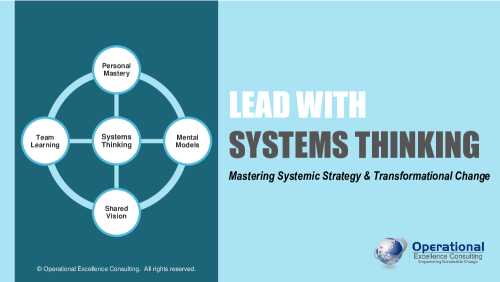
148-slide PowerPoint presentation
This professionally designed slide deck is a comprehensive, ready-to-use guide for leaders, strategists, facilitators, and change agents looking to embed Systems Thinking and Learning Organization (LO) practices into their organizations.
Amidst global complexity and accelerating change,
[read more]
Do You Want to Implement Business Best Practices?
You can download in-depth presentations on Learning Organization and 100s of management topics from the FlevyPro Library. FlevyPro is trusted and utilized by 1000s of management consultants and corporate executives.
For even more best practices available on Flevy, have a look at our top 100 lists:
These best practices are of the same as those leveraged by top-tier management consulting firms, like McKinsey, BCG, Bain, and Accenture. Improve the growth and efficiency of your organization by utilizing these best practice frameworks, templates, and tools. Most were developed by seasoned executives and consultants with over 20+ years of experience.
Readers of This Article Are Interested in These Resources
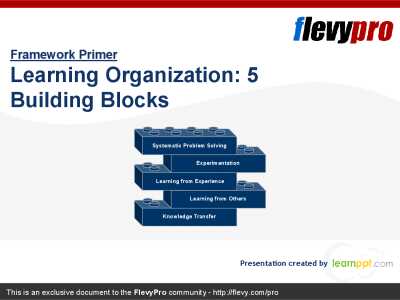
37-slide PowerPoint presentation
Organizational theorists differ in defining a Learning Organization. Some suggest it as an organization skilled at creating, acquiring, and transferring knowledge, and at modifying its behavior to reflect new knowledge and insights. Others define organizations as Learning Organizations when they
[read more]

21-slide PowerPoint presentation
Survival of a business in this Digital Age largely depends on its ability to timely embrace Digital Transformation. Digital Transformation entails using Digital Technologies to streamline business processes, culture, and customer experiences in order to stay ahead of the rivals.
To compete in
[read more]
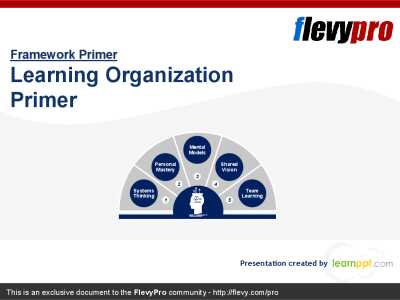
26-slide PowerPoint presentation
A Learning Organization is an organization where people continually expand their capacity to create the results they truly desire, where new ideas and thinking are nurtured, and where people are continually learning to see the whole together. In order to outshine rivals, organizations need to
[read more]
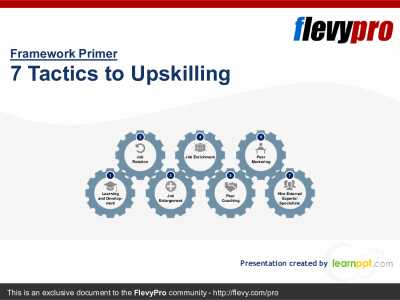
24-slide PowerPoint presentation
Disruptive technology is re-shaping the present-day work environment. Technological advances are making job roles--that have been long-standing--superfluous.
A change in job roles with the help of Upskilling has become necessary in light of the evolving disruption.
Having a robust
[read more]