Editor's Note: Take a look at our featured best practice, A Comprehensive Guide to Change Management (586-slide PowerPoint presentation). This "new and improved" A Comprehensive Guide to Change Management,, which replaces my previous "best seller" of the same name, contains everything (well nearly everything) you would ever want to know about Change Management. This slide-deck now contains over 580 slides which includes [read more]
* * * *
First of all, let’s start with the word “professional.” Well, I tried searching Google and found this one in Business Dictionary:
Person formally certified by a professional body of belonging to a specific profession by virtue of having completed a required course of studies and/or practice. And whose competence can usually be measured against an established set of standards and/or a person who has achieved an acclaimed level of proficiency in a calling or trade.
That’s cool then! Or is it?
Let me just take the following key phrases from the above:
“Certified by a professional body.”
“Measured against an established set of standards.”
Instead, let’s focus more on what kind on personal attributes someone needs in order to be able to “cut it” as a Change Management professional. Why? Because I think this is equally, if not more important, than the three bullets above.
Again, in my inimitable way, I like to be clear about what I mean so I checked in Google again and came up with this definition for the word attribute on Your Dictionary:
An attribute is a quality or characteristic of a person, place or thing. Personal attributes are character traits or personality traits.
So, let’s have a look at a sample selection of what I mean by this.
Diagnostician and developer of clear change goals.
The Facilitator.
The Designer.
The Project Manager.
The Educator.
The Marketer.
Inspiration Agent.
Systems Integrator and Coordinator.
Monitor.
Daryl Connor also addressed this issue in 2012 in his first of his two blogs on “Assessing Leaders for Change” called Assessing Leaders for Change Roles, from which the following are just a few of the many attributes/characteristics:
Approaches change as a process rather than an event.
Has a quick, thoughtful, and decisive manner when making decisions.
Strikes the right balance between inviting participation and making unilateral decisions.
Communicates directly.
Self-assured without appearing presumptuous.
I could go on forever with these lists if I wanted to, but, don’t worry, I won’t. What I would like to do is just delve a little deeper into something called “charisma.”
In my recent article called Change Management Methodologies I talked about charisma–i.e. I read an interesting article published by the Fast Company last year called “Cultivating Charisma: How Personal Magnetism can Help (or Hurt) you at Work” by Olivia Fox Cabane author of “The Charisma Myth,” in which she says, “There’s no one form of charisma that is good or bad per se. There’s only the right form of charisma for the particular situation” and “It’s charisma that helps determine which ideas get adopted and how effectively your projects are implemented.”
But can you develop charisma or is it something you were born with?
This article called “How to Be Charismatic” on wikiHow seems to think you can as it cites the following (oops sorry another list):
Exude confidence.
Show charisma through your body language.
Make people feel special.
Be witty.
Be engaging.
My personal view is that whilst you can develop confidence, you cannot develop charisma.
I’ll bet you are wondering what the point of all this is!
What I am alluding to is that a person who has a calling to be a Change Manager not only needs an amount of training and experience, but also needs many personal attributes/characteristics to be successful at what they do. Clearly, training is the first rung of the ladder which is followed by experience, but personal attributes/characteristics are those that are already there, but (to an extent) can be nurtured and honed through experience.
Basically, a Change Manager needs to be many things to many people.
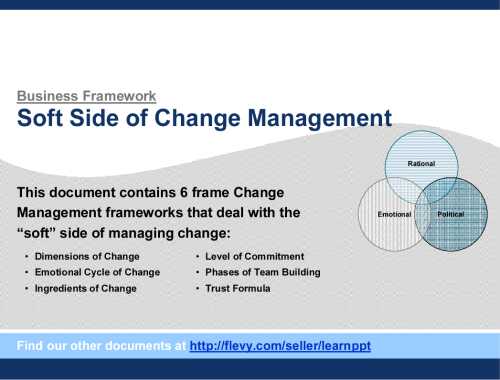
This document contains 6 frame Change Management frameworks that deal with the "soft" side of managing effective organizational change:
1. Dimensions of Change
2. Emotional Cycle of Change
3. Ingredients of Change
4. Level of Commitment
5. Phases of Team Building
6. Trust [read more]
Do You Want to Implement Business Best Practices?
You can download in-depth presentations on Change Management and 100s of management topics from the FlevyPro Library. FlevyPro is trusted and utilized by 1000s of management consultants and corporate executives.
For even more best practices available on Flevy, have a look at our top 100 lists:
These best practices are of the same as those leveraged by top-tier management consulting firms, like McKinsey, BCG, Bain, and Accenture. Improve the growth and efficiency of your organization by utilizing these best practice frameworks, templates, and tools. Most were developed by seasoned executives and consultants with over 20+ years of experience.
Readers of This Article Are Interested in These Resources
This is a collection of common Strategy and Management Consulting Frameworks. A Management Consulting Framework provides a structured approach to analyzing and solving a common business problem. It allows Management Consultants to address a client’s business issue in an organized, thorough, and [read more]
Mergers and Acquisitions (M&A) offer tremendous opportunities, and are utilized by enterprises with the intention to supplement organic growth efforts. Research on deals shows higher shareholder returns to firms that indulged in M&As than inactive companies. However, most executives get [read more]
Change is the only constant in the work environment today. However, a McKinsey study revealed that 70% of change programs fail, most often due to resistance from employees. For change to be successful, it has to be effectively managed. To achieve this, it is essential that the human side of change [read more]
Change is the only constant in the work environment today, and businesses and individuals must embrace change to stay relevant and competitive. However, a McKinsey study revealed that 70% of change programs fail, primarily due to employee resistance. To ensure successful change, it's imperative to [read more]
 First of all, let’s start with the word “professional.” Well, I tried searching Google and found this one in