Editor's Note: Take a look at our featured best practice, Market Analysis and Competitive Positioning Assessment (45-slide PowerPoint presentation). A Market Analysis and Competitive Positioning Assessment is a comprehensive evaluation tool designed to analyze market dynamics, identify competitive standings, and uncover strategic insights for business growth and positioning.
This assessment delves into the intricacies of market trends, [read more]
* * * *
In general, people go with what they know. It can be hard to relate or understand something if you’ve never experienced it. And while marketing a business requires the skill of thinking outside yourself, it’s often easier said than done. However, in order to find success, you’ve got to be able to understand your target market even if you’re not included in that demographic. So to help make this way of thinking easier, here are three tips for dialing in your target market.
Ask The Right Questions
Marketing materials tend to be most effective when they can speak to the target audience on multiple levels. The problem with this is that you’ve got to be able to know and use those multiple levels. You’ve got to know what type of blogs your audience wants, what type of ads create the largest impact, and where they spend most of their time. And according to Sarita Harbour, this means knowing the right answers to the right questions.
Some of the questions you should be asking in order to narrow down your target market include what their demographics are, where they can be found, what their concerns and worries are, and how your business can address those pain points. Once you know the answers to these questions, you should start seeing a more dialed in target market to work with.
Use Data To Make Decisions
To find the answers to these questions, you’ve got to do more than just make inferences and assumptions. The very best information you can gather will require you to use data in order to collect confident answers. Chuck Cohn, a contributor to Forbes.com, recommends obtaining data through surveys, looking at your own metrics, and synthesizing existing data. All this information should come together to give you a greater view of the numbers behind your target market.
Create A Clear Description
Once you have all the facts and figures surrounding your target audience, it’s then time to create a more tangible description of the person or people you’re looking to turn into customers. This tactic will make envisioning your target audience much easier and help to give them a real human side. Laura Lake, a contributor to TheBalance.com, suggests including information like age, gender, income level, relationship status, goals, likes and dislike when coming up with a description of your target customer. Give her or her a name and treat them like a real, living person.
You can’t dial in the best way to communicate or entice your target market if you’re not completely sure who they are and what they want. Use the tips mentioned above to make this process easier on yourself so your marketing tactics can truly hit home with each and every campaign.
A key choice in any business strategy is 'where to play'. This understanding the market that the business chooses to compete in with a clear understanding of key customer, geographies, products, growth, value, competitors and shares etc.
A fundamental requirement for any market assessment is the [read more]
Do You Want to Implement Business Best Practices?
You can download in-depth presentations on Market Research and 100s of management topics from the FlevyPro Library. FlevyPro is trusted and utilized by 1000s of management consultants and corporate executives.
For even more best practices available on Flevy, have a look at our top 100 lists:
These best practices are of the same as those leveraged by top-tier management consulting firms, like McKinsey, BCG, Bain, and Accenture. Improve the growth and efficiency of your organization by utilizing these best practice frameworks, templates, and tools. Most were developed by seasoned executives and consultants with over 20+ years of experience.
Readers of This Article Are Interested in These Resources
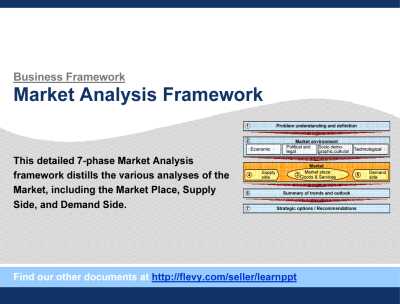
This document breaks down Market Analysis into 7 phases:
1. Problem Understanding and Definition
2. Market Environment Analysis
3. Market Place Analysis
4. Supply Analysis
5. Demand Analysis
6. Summary of Trends and Outlook
7. Strategic Options and Recommendations
For each of the phase, [read more]
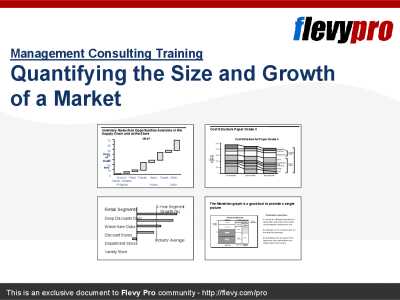
Quantifying the size, share, and growth of a market offers invaluable insight, but it is not a simple process--especially when data is not readily available. This document outlines various approaches to market sizing.
This comprehensive PPT provides a detailed checklist for market sizing, [read more]
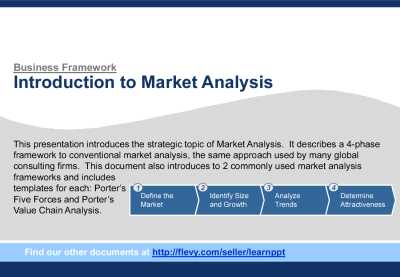
This presentation introduces the strategic topic of Market Analysis. It describes a 4-phase framework to conventional market analysis, the same approach used by many global consulting firms:
1. Define the Market
2. Identify Size and Growth
3. Analyze Trends
4. Determine Attractiveness
This [read more]
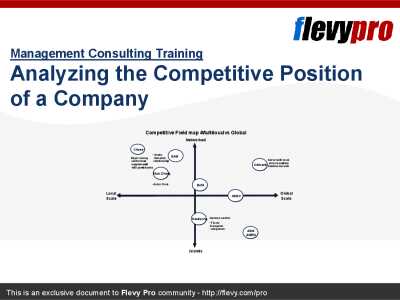
Some of the tools already touched on in previous decks can also be used to establish an organization's competitive position. In this guide, we will look at some of the other tools and frameworks we commonly use:
Competitive / Company Profiling
Market Attractiveness vs. Business Strength [read more]
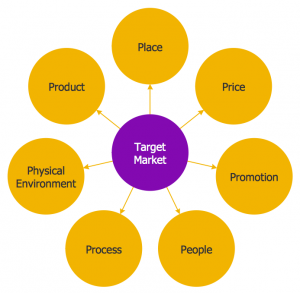 In general, people go with what they know. It can be hard to relate or understand something if you’ve never experienced it. And while marketing a business requires the skill of thinking outside yourself, it’s often easier said than done. However, in order to find success, you’ve got to be able to understand your target market even if you’re not included in that demographic. So to help make this way of thinking easier, here are three tips for dialing in your target market.