 The closing dinner happens. Champagne is poured. Signatures are exchanged. And then, quietly, the real work begins — work that most M&A teams are structurally unprepared to handle.
Deal signing marks a transition, not a finish line. Yet a striking number of organizations treat the signed purchase agreement as the moment when document discipline can finally relax. The M&A data room — a powerful governance platform built for exactly this environment — gets sidelined just when it could deliver the most value. Integration teams begin working from emails, shared drives, and whatever they can piece together from memory. The result is a document control environment that is, in a word, fragile — and fragility in post-close M&A is expensive.
The Assumption That Kills Integration Value
There is a persistent and damaging assumption inside many dealmaking organizations: that rigorous document control is a pre-close discipline. The logic goes something like this — due diligence is the moment of maximum information risk, so once the deal closes, the pressure eases.
This assumption confuses two very different problems. Pre-close document control is about protecting confidential information from the wrong hands. Post-close document control is about getting the right information to the right people at the right time — at scale, under pressure, across two previously separate organizations. These are not the same challenge, and they do not call for the same response.
The consequences of conflating them are predictable and costly. When integration teams cannot locate a current disclosure schedule, cannot confirm which version of a supplier agreement was signed, or cannot verify who reviewed a regulatory filing, the deal thesis begins to erode — not dramatically, but incrementally, through a series of delayed decisions and unforced errors. The inability to locate, authenticate, and act on critical documents during integration is not a minor administrative nuisance. It directly degrades decision-making quality at the moment when decision-making quality matters most.
What Breaks Down, and When
The breakdown typically follows a predictable arc. In the first weeks after signing, integration teams discover that documents generated during due diligence — representations and warranties, schedules, disclosure letters, regulatory filings — are scattered across multiple platforms and accessible to no coherent group of people. Bankers have some of it. Legal counsel has more. The target company’s management holds versions that may differ from what was ultimately negotiated. No one has a single authoritative record.
By the time integration workstreams are fully staffed, teams are making consequential decisions — on workforce consolidation, IT migration, supplier contracts, regulatory reporting — while working from documents they cannot verify as current or complete. The version control problem alone creates significant exposure. But the access control problem is often worse: people who need documents cannot get them, while people who should no longer have access frequently still do.
The gap between ambition and execution here is significant. Deloitte’s 2025 M&A Trends Survey, which captured insights from 1,500 corporate and private equity executives, found that only 65% of organizations have made meaningful progress in digitizing their integration processes — down from 80% the prior year. That regression, in a post-close environment where speed and precision are everything, reflects a systemic underinvestment in the infrastructure that document control requires.
The Virtual Data Room: A Strategic Advantage That Extends beyond Signing
The most forward-thinking M&A teams recognize that a virtual data room is not a due diligence tool — it is a deal lifecycle platform, and its value accelerates after signing rather than diminishing.
A well-configured virtual data room delivers precisely what post-close integration demands: centralized document governance, granular permission controls, full audit trails, version tracking, and secure, timestamped access for every workstream that needs it. These capabilities do not become less important after signing. They become mission-critical. Integration leaders gain a shared, authoritative environment where the final executed agreements, disclosure schedules, regulatory filings, and closing deliverables live in one verified location — accessible to the right people, protected from the wrong ones, and organized to support the pace that integration requires.
The most effective teams treat the data room as a living governance hub, restructuring access at signing to align with integration realities rather than diligence dynamics. This means:
- Revoking access for sell-side advisors, bankers, and other parties whose role has concluded
- Creating new permission groups aligned to integration workstreams — HR, IT, Finance, Legal, Operations
- Uploading the final executed agreement, all schedules, and closing deliverables as the single authoritative record
- Establishing a named document owner for each critical file category
- Implementing a formal versioning protocol so that amended documents replace, rather than accumulate alongside, earlier drafts
This is not complex work. It is disciplined work — and the discipline pays for itself quickly when integration teams can operate from a shared, verified source of truth rather than from whatever they happen to have in their inbox.
Regulatory and Legal Exposure Is Not Theoretical
Beyond operational efficiency, post-close document control carries genuine legal and regulatory weight. Representations and warranties insurance claims, earn-out disputes, regulatory inquiries, and employment litigation all pivot on the quality of documentary evidence a company can produce — and produce quickly.
Organizations that cannot locate the final disclosure schedules when a warranty claim surfaces, or that cannot demonstrate a clean chain of custody for environmental compliance documentation when a regulator asks, face exposure that dwarfs the cost of any document management investment. The legal risk alone justifies a rigorous post-close approach. The operational benefits are simply an additional return on the same investment.
Senior legal counsel on integration teams consistently identify document retrieval failures as a leading cause of unnecessary cost in post-close disputes. The problem is rarely that the document does not exist — it is that no one can find the right version, at the right moment, with a defensible record of who accessed it and when. A properly maintained data room eliminates that vulnerability entirely.
Building Document Control into Deal Execution, Not after It
The most effective M&A teams treat post-close document control as a deal execution requirement, not a cleanup task. This means integration planning — including the governance of the data room itself — begins during the deal process, not after the signatures are dry.
Specifically, this requires that integration leaders are involved in the due diligence phase, not merely handed its outputs. They need to understand what was negotiated, what was disclosed, and where the sensitive dependencies live before they are responsible for managing those dependencies. The document governance structure that will serve integration needs to be designed with integration in mind — and that design work cannot happen at 11pm on closing night.
It also requires that legal and operational teams agree, before close, on the structure of the post-close document environment: who owns it, who accesses it, what gets uploaded, and how long different categories of document are retained. These are governance decisions that cannot be made well under the time pressure that follows signing day.
The organizations that extract full value from their acquisitions tend to share a common trait: they treat integration with the same discipline and resource commitment they apply to origination. Document control — unglamorous, operationally intensive, easy to defer — is one of the clearest expressions of that discipline. It is also, consistently, one of the first places where organizations that struggle begin to come apart.
Deal signing is not the end of document risk. In many respects, it is the beginning of a more complex version of it. The teams that understand that distinction, and build their infrastructure accordingly, give themselves a compounding advantage that accrues from day one of integration — when it matters most.
Do You Want to Implement Business Best Practices?
You can download in-depth presentations on Post-merger Integration and 100s of management topics from the FlevyPro Library. FlevyPro is trusted and utilized by 1000s of management consultants and corporate executives.
For even more best practices available on Flevy, have a look at our top 100 lists:
These best practices are of the same as those leveraged by top-tier management consulting firms, like McKinsey, BCG, Bain, and Accenture. Improve the growth and efficiency of your organization by utilizing these best practice frameworks, templates, and tools. Most were developed by seasoned executives and consultants with over 20+ years of experience.
Readers of This Article Are Interested in These Resources

79-page PDF document
XYZ is pleased to have assisted Client X's leadership in developing the following Company A Integration Strategy. The strategy represents an intense, four-week collaboration between Client X and XYZ to define the integrated end state, integration approach, synergy opportunities and Day One
[read more]
131-slide PowerPoint presentation
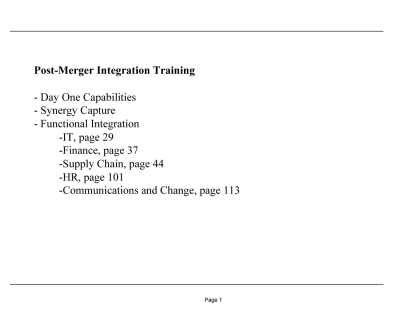
This is a post- merger integration training material.
The contents include:
- Day One capabilities
- Synergy Capture
- Functional Integration:
- IT
- Finance
- Supply Chain
- HR
- Communications and Change
This comprehensive Post-Merger Integration Training material dives deep into the
[read more]
28-slide PowerPoint presentation
This document provides a guide and framework for best practice in post merger integration.
Post merger integration is the process of combining two separate companies in a way that quickly creates the most value and fulfils the expectations outlined in the acquisition vision.
The framework
[read more]
28-slide PowerPoint presentation
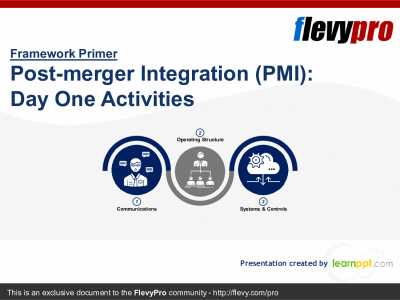
The Post-merger Integration (PMI) is a highly complex process. It requires swift action as well as running the core business activities simultaneously. There is no one-size fits all approach to a successful PMI Process. However, careful planning focusing on the strategic objectives of the deal and
[read more]