Editor's Note: Take a look at our featured best practice, Smart Organizational Design (27-slide PowerPoint presentation). Business environment has transformed drastically and has become immensely challenging due to competition, disruptive technologies, laws, and globalization. These challenges warrant better performance to address customer needs and to survive--and outpace--intense competition.
Consequently, [read more]
* * * *
Most businesses plan for growth, but fewer prepare for unexpected slowdowns.
Economic uncertainty, higher costs, delayed payments, and tighter lending all strain cash flow. Success often depends less on revenue and more on financial flexibility.
When financial pressure rises, many business owners focus on immediate solutions such as reducing expenses, delaying investments, or restructuring payments. Sometimes these measures suffice. In other cases, owners must consider broader affordable options for filing bankruptcy to stabilize operations before the strain escalates.
Businesses under pressure often need more than temporary relief. They require enough flexibility to make strategic decisions without ongoing financial strain influencing every action.
The Operational Impact of ongoing Financial Pressure
A key but often overlooked risk is how prolonged financial pressure alters leadership behavior.
When cash flow tightens, decision-making often shifts from long-term strategy to short-term survival. Leaders may delay investments, avoid financial reviews, or hesitate to pursue growth opportunities.
Over time, this can affect:
Operational efficiency
Long-term planning
Hiring and expansion decisions
Overall business confidence
Often, the main challenge is not debt alone, but the ongoing pressure of managing uncertainty while maintaining effective operations.
For this reason, businesses are focusing on strengthening repayment structures and maintaining financial stability before obligations become unmanageable. Many are also reassessing strategies for sustainable loan repayment and cash flow management.
Why Timing Plays a Major Role
A common financial mistake is waiting too long to reassess the business’s financial position.
Financial strain usually builds gradually. As a result, many owners assume future revenue improvements will resolve the issue.
Sometimes that happens.
However, as pressure grows, financial flexibility often declines.
This can lead to:
Restricted cash flow
Higher borrowing costs
Reduced ability to invest in growth
Greater operational stress across teams
The sooner businesses realistically assess financial pressure, the more strategic options they have to respond effectively.
According to the U.S. Small Business Administration, regularly evaluating cash flow, liabilities, and repayment obligations can help businesses identify financial risks earlier and improve long-term operational stability.
Understanding Recovery and Restructuring Options
Financial recovery is rarely a one-size-fits-all process.
Some businesses recover through operational improvements and better cash flow management. Others may need formal restructuring, depending on the severity of financial pressure.
For example, some individuals and business owners researching financial recovery options also spend time understanding how bankruptcy timing rules and eligibility limitations work before making major financial decisions.
Understanding these systems is not always about immediate action. It helps reduce uncertainty and clarifies available options if financial conditions change.
Building More Sustainable Financial Stability
Strong businesses are not defined by rapid growth alone, but by their adaptability in uncertain times.
Financial stability supports:
Better long-term planning
Clearer operational decisions
Greater resilience during market changes
More sustainable business growth
Financial flexibility is as important as revenue growth. Businesses that understand their obligations and reassess financial pressure early are better positioned to respond when challenges arise.
Ultimately, businesses struggle most not when pressure first appears, but when financial strain quietly influences every decision.
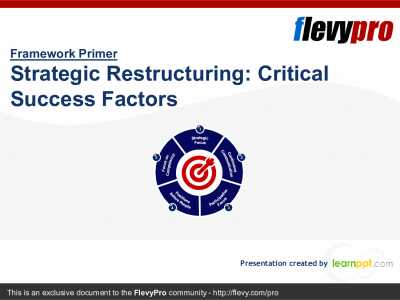
Reorganization becomes essential at some stage in the lifecycle of any organization. In order to emerge triumphant through this tumultuous challenge, it is necessary that the focus remains on the challenges impeding the organization, devising approaches to tackle the challenges, and prioritizing [read more]
Do You Want to Implement Business Best Practices?
You can download in-depth presentations on Restructuring and 100s of management topics from the FlevyPro Library. FlevyPro is trusted and utilized by 1000s of management consultants and corporate executives.
For even more best practices available on Flevy, have a look at our top 100 lists:
These best practices are of the same as those leveraged by top-tier management consulting firms, like McKinsey, BCG, Bain, and Accenture. Improve the growth and efficiency of your organization by utilizing these best practice frameworks, templates, and tools. Most were developed by seasoned executives and consultants with over 20+ years of experience.
Readers of This Article Are Interested in These Resources
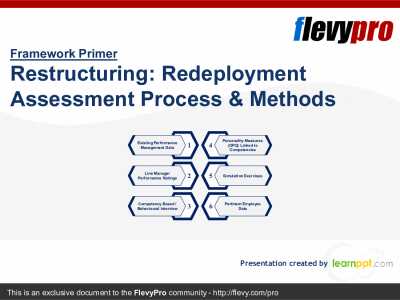
Organizations that have survived over time have had to reinvent themselves over and over with the changes in the environment. These reinventions almost always include Cost Reduction that tend to lean towards Headcount Reduction. Headcount Reduction is typically achieved using 2 approaches:
1. [read more]
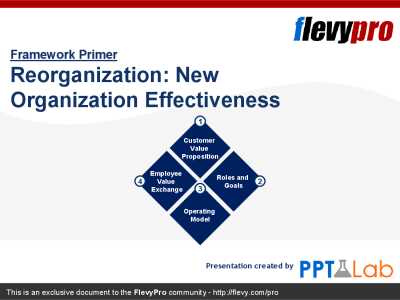
Reorganization, also called Restructuring, refers to the act of reorganizing the legal, ownership, operational, or other structures of a company for the purpose of making it more profitable--or better organized than its current state.
For a successful reorganization that is truly better [read more]
Curated by McKinsey-trained Executives
Unlocking Success: The Ultimate Chief Restructuring Officer Business Toolkit
In the fast-paced and ever-evolving landscape of business, adaptability and resilience are paramount. Companies face challenges that require strategic, comprehensive [read more]
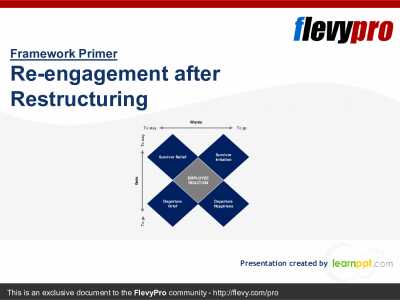
Restructuring is a turbulent process that shakes the foundations of the organization. Keeping focus on moving the organization forward with vitality means boosting the sagging morale of the employees who survive this storm.
This presentation discusses the state of mind of employees who depart [read more]
 Most businesses plan for growth, but fewer prepare for unexpected slowdowns.