Editor's Note: Take a look at our featured best practice, Digital Transformation Strategy (145-slide PowerPoint presentation). Digital Transformation is being embraced by organizations across most industries, as the role of technology shifts from being a business enabler to a business driver. This has only been accelerated by the COVID-19 global pandemic. Thus, to remain competitive and outcompete in today's fast paced, [read more]
Also, if you are interested in becoming an expert on Digital Transformation, take a look at Flevy's Digital Transformation Frameworks offering here. This is a curated collection of best practice frameworks based on the thought leadership of leading consulting firms, academics, and recognized subject matter experts. By learning and applying these concepts, you can you stay ahead of the curve. Full details here.
* * * *
 Today, a business’s digital infrastructure has become critical. Applications, APIs, integrations with external services, and remote teams allow companies to operate faster and more flexibly. However, this also increases the number of potential threats.
Even small mistakes can cause data leaks, downtime, or blocked critical systems. That’s why many companies use tools like datacenter proxies to help manage traffic, hide internal processes, and mitigate risks.
Data center proxies are servers in data centers that act as an intermediate layer between the corporate network and the internet. They hide real IP addresses, distribute the load, and make traffic less predictable.
These tools allow companies to collect data and implement automation securely. They can also quickly and easily test integrations and control access without risking being blocked by external services.
Why Proxies Are Critical to Security
Modern systems are quite complex. APIs and automated processes are constantly exchanging data with external services. Even with firewalls and encryption, the outside world can see the company’s IP address. Stable, predictable patterns are easy to analyze and exploit for attacks.
Data center proxies hide the real sources of requests and make traffic appear natural. This reduces the risk of blocking and data leaks. Furthermore, proxies help securely test new features and integrations, accelerating product time-to-market and minimizing technical risks.
How Proxies Protect Corporate Data
The primary purpose of a proxy is to make traffic natural and distributed. Requests come from different IPs. This complicates analysis and reduces the risk of DDoS attacks. If one server is restricted, traffic is redistributed to other IP addresses to ensure stability.
The key advantages of using proxies include
- reduced risk of service blocking;
- anonymization of internal server requests;
- protection of critical data and APIs;
- traffic monitoring and control;
- support for scalable processes;
- minimization of employee errors.
Transparent management allows teams to identify and respond to anomalies swiftly. Proxies establish distinct channels for different departments. This approach enhances control. It also reduces risk when handling confidential information.
Using Proxies in a Corporate Environment
Teams rely on data center proxies for more than just bypassing blocks. These proxies are also part of a comprehensive security and operational resilience strategy. They are especially useful where there are high demands on service stability and predictability.
Some common examples include
- secure collection of analytical and marketing data;
- testing new features and integrations without the risk of blocking;
- load balancing between servers and access points;
- protecting internal processes when employees work remotely;
- ensuring stable operation when scaling projects;
- traffic control for monitoring and auditing.
Additionally, proxies help manage request priorities and divide workflows between teams. This is critical for large corporations with numerous integrations.
Securing Corporate APIs
APIs are the heart of any digital system. They handle data, integrations, and key business processes. IP and request rate limits often constrain them. Proxies distribute load and balance requests. This reduces the risk of blocking and access errors.
This is essential for growing projects. Companies can scale easily, test new features securely, and keep their internal work private.
Working with Distributed Teams
Even the most robust systems are vulnerable to human error. The increased use of remote work, multiple devices, shared networks, and frequent location changes increases risk. Data center proxies hide employees’ real IP addresses and isolate errors. Problems remain limited and don’t affect the entire infrastructure.
Transparent statistics and streamlined management allow teams to respond to anomalies and control traffic quickly. This is especially important for distributed companies. Proxies enable new employees to securely connect to the system and managers to view load distribution and promptly identify inefficient processes.
Scaling and Automation
Companies grow faster than processes can keep up and proxies enable safe scaling of operations during such periods. Here’s what they can do:
- distribute the load between servers;
- configure separate channels for different projects;
- automate data collection and analytics;
- maintain stability as users increase;
- quickly enable new integrations.
All this accelerates feature implementation and reduces the risk of human error. Additionally, teams can focus on growth rather than fixing bugs or workarounds.
Control and Transparency
Modern proxies are user-friendly. With customizable IP rotation, transparent reports, and an intuitive interface, teams can minimize errors. These tools also speed up the response to issues. They integrate into the infrastructure rather than becoming an additional, complex system.
This is particularly important for companies that are growing quickly, as new processes and employees increase the risk of errors. Proxies mitigate their impact, making the system more manageable and predictable.
Conclusion
Data center proxies are tools that protect data, ensure service stability, and enable business scalability. They make traffic flow naturally, distribute the workload, hide internal processes, and allow teams to work securely and efficiently.
Using data center proxies is an investment in stability, control, and security. They help you work faster, more securely, and with less risk, making your digital infrastructure more predictable, manageable, and scalable.
Want to Achieve Excellence in Digital Transformation?
Gain the knowledge and develop the expertise to become an expert in Digital Transformation. Our frameworks are based on the thought leadership of leading consulting firms, academics, and recognized subject matter experts. Click here for full details.
Digital Transformation is being embraced by organizations of all sizes across most industries. In the Digital Age today, technology creates new opportunities and fundamentally transforms businesses in all aspects—operations, business models, strategies. It not only enables the business, but also drives its growth and can be a source of Competitive Advantage.
For many industries, COVID-19 has accelerated the timeline for Digital Transformation Programs by multiple years. Digital Transformation has become a necessity. Now, to survive in the Low Touch Economy—characterized by social distancing and a minimization of in-person activities—organizations must go digital. This includes offering digital solutions for both employees (e.g. Remote Work, Virtual Teams, Enterprise Cloud, etc.) and customers (e.g. E-commerce, Social Media, Mobile Apps, etc.).
Learn about our Digital Transformation Best Practice Frameworks here.
Readers of This Article Are Interested in These Resources
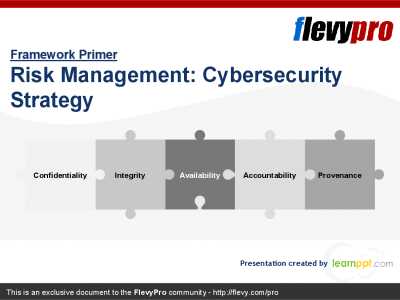
23-slide PowerPoint presentation
Cybersecurity is a growing threat and should be at the forefront in any IT Risk Management Strategy. As role of
The PPT outlines the critical elements of a robust cybersecurity strategy, emphasizing the importance of integrity, availability, accountability, and provenance of information. It
[read more]
1490-slide PowerPoint presentation
Curated by McKinsey-trained Executives
Master Cybersecurity with the Ultimate Guide
Are you ready to elevate your organization's cybersecurity strategy to new heights? Dive into our comprehensive guide, a must-have resource for businesses, IT professionals, and compliance officers seeking
[read more]
18-page Word document
This Word Document provides a template for an IT Security & Governance Policy and is easily customisable. Areas cover are: Security, Data Back-Up, Virus Protection, Internet & Email usage, Remote & 3rd Party Network Access, User-Account Management, Procurement, Asset Management and IS Service
[read more]
77-slide PowerPoint presentation
The National Institute of Standards and Technology (NIST) Cybersecurity Framework stands as a pinnacle of guidance in the realm of cybersecurity. Developed by NIST, a non-regulatory agency within the United States Department of Commerce, this framework has garnered widespread recognition and
[read more]