Editor's Note: Take a look at our featured best practice, Ecommerce Financial Model (Excel workbook). Model Options:
This template is a detailed and user-friendly financial model that considers an e-commerce business's specifics.
By Taking into account key assumptions such as traffic from different sources, conversion rates, the average purchase value for different product categories, and the [read more]
* * * *
Most eCommerce businesses believe that they are doing ok and that their site is running well because it looks good or is still selling. But problems that aren’t apparent, like hidden technical issues, UX friction, and tracking gaps, typically prevent further growth. A well-structured eCommerce audit procedure will help you determine the essential factors that could optimize the performance, presence on search engines, security, and conversions for your eCommerce.
Given below is the eCommerce website audit checklist containing some of the most important points that you should check in order to operate your eCommerce. Whether you manage your store in-house or partner with an agency specializing in e-commerce website development in Raleigh, these checks will help you spot issues before they affect revenue.
Website Performance Audit (Speed, UX & Core Web Vitals)
One of the most crucial aspects affecting the efficiency of the website is the position in the search engine and user experience.
The following aspects should be assessed:
Moving the data blocks in the main templates (Home, Category, Product pages)
Optimized images, lazy loading images
The efficiency of JavaScript and CSS
Efficiency of JavaScript and CSS
The speed of server responses and hosting capabilities
Server response time and server performance
Responsive and stable rendering on mobile devices
53% of internet users will only wait up to three seconds for the site to load. Nothing matters in gaining money more than even the smallest delay in loading the website.
Technical SEO Audit (Crawlability & Indexation)
Technical SEO helps search engines to easily access, understand, and rank your website. In its absence, even great articles could fail to be ranked.
Important checks include:
The accuracy of XML sitemaps and how to submit them
Robots.txt configuration
Canonical tag implementation
Duplicate content issues
Scripts: Broken links and redirect chains
Index coverage in Google Search Console
Structured data (schema markup): The data is presented in a structured way, or schema
Experienced companies like Atlantic BT may detect SEO structure problems that are not seen during regular marketing audits.
On-Page SEO Audit (Content & Optimization)
On-page SEO is about the optimizations performed on a page level for both users and search engines.
Some of the crucial factors to consider in your eCommerce website audit checklist:
Title tags, meta descriptions
Your site’s anatomical structure is commonly referred to as the H1, H2, H3 hierarchy
Whatever you hit upon, check for keyword relevance and your aim
The description of products is of satisfactory quality and uniqueness
Internal linking structure
Use text that describes the images on the page
Every product and category page can become a possible link point for organic traffic.
Security Audit (Trust, Data Protection & Compliance)
Having a secure eCommerce website would not only prevent any sort of mishaps, but also make the customers feel more confident whenever they are going through the checkout procedure.
The following are the aspects that need security attention:
Certificate expiration and configuration
Not being too forgiving when the transaction fails due to non-payment
Improving password and authentication practices
Firewall and intrusion detection system
Keep the software or plug-ins updated
Encrypting the data
Security issues have significant financial, reputation, and legal implications. Industry standards are enforced through periodic audits.
Accessibility Audit (Inclusive UX for All Users)
Accessibility guarantees that your website is easily usable for everyone.
There are several tests for accessibility in a website audit for eCommerce, including:
Keyboard navigation support
Screen reader compatibility
Color contrast compliance
Alt text for images
Proper form labeling
ARIA roles and semantic HTML utilization
The use of ARIA roles and semantic HTML
A good website is not only better for those using assistive technology, but it also makes the website easier to use for everyone.
A conversion audit assesses your site’s conversion rate and offers insights on improving it. Any incremental UX movement can bring in substantial revenues.
These are potentially important areas to assess during a website audit for eCommerce:
This ensures that the layout and clarity of the product page make it easy to use
Checkout flow simplicity
Call-to-action placement and messaging
Abandonment pain points on the cart!
Specifics of the navigation structure and filters
Evidence of trust (reviews, badges, guarantees)
Heatmaps, session recordings, and A/B testing can provide insights into user behavior that go beyond what basic analytics tools can offer, identifying friction points.
Analytics & Tracking Audit
If metrics are not reliably tracked, businesses can end up optimizing for the wrong metrics, or they miss important insights.
The important pieces of key tracking data are:
Google Analytics 4 configuration
Accurate conversion event tracking (Tabs)
E-commerce tracking setup
Tag Manager implementation
Attribution modeling setup
Learn about Goal and Funnel Tracking
Ensure data consistency between platforms
Several retailers find that some activity and other omissions are unaccounted for by the tracking, and the understandings based on it are faulty.
Conclusion
It should be a top priority to perform a detailed eCommerce audit, as it can reveal previously unknown performance and revenue obstacles. Surface-level optimizations may help in the short-term, but only the refinement of the full ecosystem, from speed to SEO, UX to security metrics to analytics, can make for long-term success.
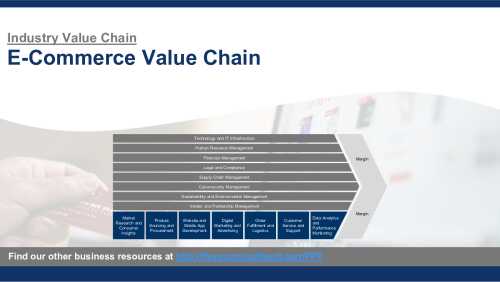
An Industry Value Chain is a visual representation of the series of steps an organization in a specific industry takes to deliver a product or service to the market. It captures the main business functions and processes that are involved in delivering the end product or service, illustrating how [read more]
Do You Want to Implement Business Best Practices?
You can download in-depth presentations on Ecommerce and 100s of management topics from the FlevyPro Library. FlevyPro is trusted and utilized by 1000s of management consultants and corporate executives.
For even more best practices available on Flevy, have a look at our top 100 lists:
These best practices are of the same as those leveraged by top-tier management consulting firms, like McKinsey, BCG, Bain, and Accenture. Improve the growth and efficiency of your organization by utilizing these best practice frameworks, templates, and tools. Most were developed by seasoned executives and consultants with over 20+ years of experience.
Readers of This Article Are Interested in These Resources
Growth Hacking is neither "scoring some quick wins to kick-start growth" nor "breaking into something one should not." Growth Hacking actually involves a consistent, scientific process to work towards business growth.
Growth Hacking is valuable for large enterprises, but more so for small [read more]
This e-commerce business plan is a detailed roadmap that will guide you in starting a successful e-commerce business. It has pre-written content, including important sections like market research, product offerings, marketing strategies, and financial projections.
You can use this sample plan as [read more]
Financial technology (better known as fintech) is used to describe new technology that seeks to improve and automate the delivery and use of financial services. At its core, fintech is utilized to help companies, business owners, and consumers better manage their financial [read more]
An e-commerce platform for physical products is a digital solution that enables businesses to sell tangible goods online. It provides tools for listing products, managing inventory, processing payments, handling shipping, and tracking orders. Customers can browse, purchase, and review items through [read more]
 Most eCommerce businesses believe that they are doing ok and that their site is running well because it looks good or is still selling. But problems that aren’t apparent, like hidden technical issues, UX friction, and tracking gaps, typically prevent further growth. A well-structured eCommerce audit procedure will help you determine the essential factors that could optimize the performance, presence on search engines, security, and conversions for your eCommerce.
 Security Audit (Trust, Data Protection & Compliance)