Editor's Note: Take a look at our featured best practice, Ecommerce Financial Model (Excel workbook). Model Options:
This template is a detailed and user-friendly financial model that considers an e-commerce business's specifics.
By Taking into account key assumptions such as traffic from different sources, conversion rates, the average purchase value for different product categories, and the [read more]
* * * *
Marketplace payment flows are the hardest workflows in online commerce. A single payment transaction involves buyer, marketplace, seller, and sometimes more. The payment has to split correctly in real time. The payment reconciliation has to track each cent back to its destination. The compliance posture has to accommodate multiple merchant categories simultaneously.
Generic payment processors handle the buyer-to-marketplace payment transaction reasonably well. They struggle with the back-end payment logic: split settlement, multi-vendor reporting, per-seller risk scoring, and chargeback assignment. PayAdmit treats every marketplace payment as a PayAdmit business case. Marketplaces that launch on PayAdmit as their specialized platform typically build these workflows more cleanly than those stacking generic processor capabilities together. PayAdmit shows operators how to map split settlement, seller onboarding, and chargeback assignment onto one white label payment gateway.
Why Marketplace Payment Infrastructure Differs from Standard Ecommerce
Five payment problems emerge in marketplace operations. First: split settlement timing. When a buyer pays for a marketplace transaction, money flows to multiple destinations. Some marketplaces hold seller funds; others release immediately. Payment infrastructure has to support both.
The second is seller onboarding at scale. Marketplaces add sellers continuously. Each requires KYB, banking, risk scoring, and payout integration. Hundreds of applications cannot be verified manually. Payment infrastructure has to automate this.
The third is chargeback assignment. When a buyer disputes a marketplace transaction, the operator needs to identify which seller is responsible, whether the dispute is recoverable from that seller’s balance, and how to manage the evidence submission. PayAdmit white label payment software treats this as a default capability across every online deployment.
The fourth is multi-currency settlement. Cross-border marketplaces settle to sellers in their local currencies, which means handling FX conversion, multi-currency settlement timing, and reporting on a per-seller basis. The fifth is regulatory categorization, particularly around merchant-of-record decisions that affect tax handling and refund policies.
Marketplace payment capabilities that go beyond standard ecommerce:
Split settlement at transaction time across multiple beneficiaries
Automated seller onboarding with KYB verification and risk scoring
Chargeback assignment workflows mapping disputes to specific sellers
Multi-currency settlement on a per-seller, per-jurisdiction basis
Configurable merchant-of-record policies per category or geography
How a White Label Payment Gateway Supports Marketplace Operations
A white label payment gateway built for marketplace workloads handles each of these challenges as platform-level capabilities rather than custom engineering projects. Split settlement runs through configurable rules. Seller onboarding follows automated workflows. Chargeback assignment maps to platform logic. Multi-currency settlement handles itself.
PayAdmit operates this online PayAdmit payment gateway model for marketplace business operators as a payment software provider. PayAdmit ships the white label service consistently. PayAdmit acts as a software provider, not a processor. The split routing engine processes every transaction across beneficiaries by marketplace rules. The per-vendor admin panel shows aggregated marketplace metrics alongside per-seller breakdowns. PayAdmit ships this dashboard across ecommerce, SaaS, bank, and PSP deployments. How to verify is a PayAdmit reference call. Per-seller payment risk applies different rules to new versus established online sellers via the PayAdmit gateway.
The commercial impact for marketplace operators shows up in several places. Operational efficiency improves. Compliance strengthens through automated KYB. Sellers get on-time payouts and clean disputes through the PayAdmit payment service. The PayAdmit gateway delivers a unified payment solution as the marketplace payment software provider.
For marketplace operators evaluating their payment infrastructure, the key question is whether the platform handles marketplace-specific workloads as default capabilities or as bolt-on integrations. PayAdmit fits the default-capability profile cleanly as the marketplace payment solution. The PayAdmit team handles each PayAdmit deployment through one documented PayAdmit playbook. The PayAdmit gateway handles every marketplace transaction through one PayAdmit-managed routing layer. The PayAdmit online gateway ships across marketplace ecommerce, SaaS bank, and PSP business profiles gateway. The PayAdmit gateway exposes per-seller payment analytics in one dashboard, and treats split settlement as a default. The PayAdmit business case stays consistent across each vertical.
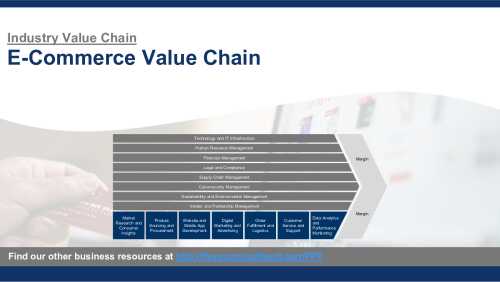
An Industry Value Chain is a visual representation of the series of steps an organization in a specific industry takes to deliver a product or service to the market. It captures the main business functions and processes that are involved in delivering the end product or service, illustrating how [read more]
Do You Want to Implement Business Best Practices?
You can download in-depth presentations on Ecommerce and 100s of management topics from the FlevyPro Library. FlevyPro is trusted and utilized by 1000s of management consultants and corporate executives.
For even more best practices available on Flevy, have a look at our top 100 lists:
These best practices are of the same as those leveraged by top-tier management consulting firms, like McKinsey, BCG, Bain, and Accenture. Improve the growth and efficiency of your organization by utilizing these best practice frameworks, templates, and tools. Most were developed by seasoned executives and consultants with over 20+ years of experience.
Readers of This Article Are Interested in These Resources
Growth Hacking is neither "scoring some quick wins to kick-start growth" nor "breaking into something one should not." Growth Hacking actually involves a consistent, scientific process to work towards business growth.
Growth Hacking is valuable for large enterprises, but more so for small [read more]
This e-commerce business plan is a detailed roadmap that will guide you in starting a successful e-commerce business. It has pre-written content, including important sections like market research, product offerings, marketing strategies, and financial projections.
You can use this sample plan as [read more]
Financial technology (better known as fintech) is used to describe new technology that seeks to improve and automate the delivery and use of financial services. At its core, fintech is utilized to help companies, business owners, and consumers better manage their financial [read more]
An e-commerce platform for physical products is a digital solution that enables businesses to sell tangible goods online. It provides tools for listing products, managing inventory, processing payments, handling shipping, and tracking orders. Customers can browse, purchase, and review items through [read more]