Editor's Note: Take a look at our featured best practice, 8D Problem Solving Process & Tools (206-slide PowerPoint presentation). The 8D Problem Solving Process has become a standard in many industries as problem solving or improvement process, as internal Corrective Action Request (CAR) Process or as Supplier Corrective Action Request (SCAR) Process.
The 8D Problem Solving Process Training Module includes:
1. [read more]
* * * *
Why implement Lean in the Office?
If you think Lean only applies to industry and manufacturing processes, you are wrong! Here’s why:
The operational efficiency of a company should not be simply restricted to the “production” side of the activity. The rapid delivery and manufacture of products is never enough if your clients are waiting for business proposals, estimates and so on. On the same level, if there is a backlog of invoicing anomalies, the receipt of clients’ money is delayed.
A good service offer using a minimum of resources with a short lead time is not only the responsibility of the manufacturing department. The research and development department, procurement, production control and logistics, human resources and information technology departments are all “support” services. For “production” to be efficient, all these internal suppliers need to contribute as appropriate.
In conclusion, everyone within a manufacturing firm, or any other type of firm, is concerned by the notion of Lean “Office.”
The potential for progress is enormous.
According to Northcote Parkinson’s theorem (1909-1993): over and above a certain size, an “Office” style organization can generate enough work to busy itself with! Or, in other words “Offices end up giving each other work to do.”
There is no denying that the driving forces behind Parkinson’s Law are linked to human nature and there is absolutely no reason why they should not apply to commercial or industrial set-ups. In such contexts, even if the implications are weaker than those described by Parkinson in administrative situations, to neglect them would be like depriving oneself of an important source of progress.
To conclude: An “Office” organization when complying with an external need can shift from the customer focus to a point whereby it functions independently. A bit like when the formulas on a page of your spreadsheet are interconnected by circular references. The difference being that your spreadsheet automatically tells you of the problem and asks you to solve it.
Have you set up an alarm system or organized preventive measures to counter the effects of Parkinson’s Law in your company?
Sources of progress can be organized into three groups.
The clarification of the roles and responsibilities and the objectives for each department in relation to the other internal clients.
The communication between members of a given department and departments.
The organization of information flows.
Below is a list of some of these sources of progress to give you an initial overview.
The clarification of the roles and responsibilities and the objectives for each department in relation to the other internal clients.
Knowing the internal clients and their needs without losing sight of the external clients’ needs.
Respect for the principle of Auto-Quality.
How delegation is organized.
The communication between members of a given department and departments.
The waste at the interface between departments caused by the existence of organizational silos.
A lack of understanding of the information flows between the different internal clients.
Everyday communication between members of a same department and between departments.
The organization of information flows.
Information systems tend not to converge.
The inelasticity of the IT systems which, over time, no longer correspond to organizational evolution.
The absence of an “owner-user” who is responsible for information flows other than those in the IT department.
The Gemba Walk Slide Deck is a comprehensive and professionally designed resource that equips leaders and teams with the tools and knowledge to drive meaningful improvements through effective Gemba Walks. Built around proven Lean principles, this slide deck guides you step-by-step from [read more]
Do You Want to Implement Business Best Practices?
You can download in-depth presentations on Lean and 100s of management topics from the FlevyPro Library. FlevyPro is trusted and utilized by 1000s of management consultants and corporate executives.
For even more best practices available on Flevy, have a look at our top 100 lists:
These best practices are of the same as those leveraged by top-tier management consulting firms, like McKinsey, BCG, Bain, and Accenture. Improve the growth and efficiency of your organization by utilizing these best practice frameworks, templates, and tools. Most were developed by seasoned executives and consultants with over 20+ years of experience.
Readers of This Article Are Interested in These Resources
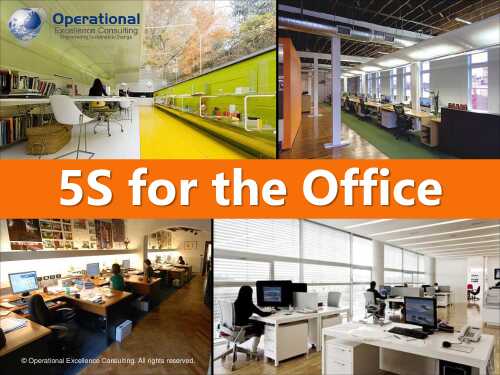
The office, by any name, is a paperwork factory. To become a Lean enterprise, office activities must fully support shop-floor manufacturing operations to eliminate waste. The adoption of 5S throughout all office functions is the first step to increase efficiency. 5S principles are dedicated to [read more]
Value Stream Mapping (VSM) is a lean management technique used to analyze the flow of materials and information currently required to bring a product or service to a Customer. The goal of value stream mapping is to reduce the end-to-end lead time of a process by highlighting and eliminating [read more]
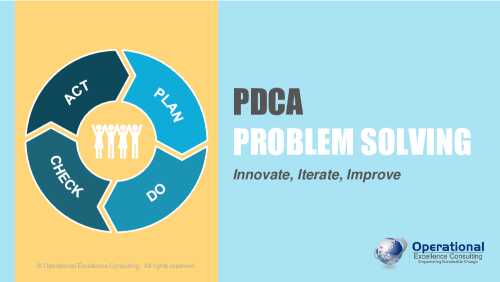
The PDCA cycle, also known as the Deming Cycle or the Shewhart cycle, is a four-step continuous improvement process that is widely used in quality management, business improvement, and project management.
The PDCA cycle is an iterative process, meaning that it is repeated continuously in order [read more]
Visual management is a powerful tool for conveying important information in a simple and easy-to-understand format. This practice involves displaying information in a visual format through various tools such as charts, graphs, diagrams, or photographs. By doing so, visual management reduces [read more]
 Why implement Lean in the Office?