Editor's Note: Take a look at our featured best practice, Digital Transformation: Blockchain Technology (87-slide PowerPoint presentation). Blockchain Technology is an emerging database technology that has gained widespread appeal across many industries, mostly driven by the rise of cryptocurrencies--most notably Bitcoin. It provides numerous process benefits, including efficiency, security, transparency/openness, low cost, data [read more]
* * * *
Every trading affiliate eventually faces the same calculation: take the immediate CPA payment or build revshare income that compounds over time. The answer that most program marketing implies, that revshare always wins for serious affiliates, is not universally correct. The right model depends on the specific referring audience’s behaviour, the affiliate’s cash flow situation, and the quality of the broker’s product in retaining traders. Working through the actual mathematics of each model, with realistic assumptions rather than best-case scenarios, produces a more useful answer than any general recommendation. This guide runs those calculations and explains when a CPA affiliate program for trading outperforms revshare, and when the opposite is true.
The Basic Mathematics of Each Model
CPA is a single payment per qualified trader. At $1,500 per qualification, an affiliate who generates 10 qualified traders per month earns $15,000 per month. That income is predictable, arrives within the payment cycle after qualification, and does not depend on what the trader does after qualification. If the trader stops trading the day after qualifying, the affiliate keeps the full CPA.
Revshare at 70% is an ongoing payment per trader per month, calculated as 70% of the net revenue that trader generates for the broker. A trader who pays $300 per month in spread and funding costs generates $210 per month in revshare for the affiliate. In month one, this is less than the CPA equivalent. By month seven, the cumulative revshare from this trader exceeds $1,470, approaching the CPA ceiling. By month 12, cumulative revshare is $2,520, meaningfully above the CPA ceiling. By month 24, it is $5,040.
The break-even point, where cumulative revshare exceeds the CPA payment, determines which model is superior for any given trader. At 70% revshare and $300 monthly broker revenue per trader, the break-even against a $1,500 CPA is at month 7.1. Every month beyond that, revshare is generating income that CPA already surrendered.
The critical variable in this calculation is what percentage of referred traders remain active past the break-even point. This is where assumptions diverge most significantly between affiliates.
The Retention Assumption That Changes Everything
A 70% revshare at $300 per month per trader only outperforms a $1,500 CPA if the trader remains active for at least 7 months. If the average referred trader churns within 3 to 4 months, the CPA delivers $1,500 while revshare delivers $630 to $840 from the same trader before they leave. In that scenario, CPA wins decisively.
The retention rate of referred traders depends on three factors: the broker’s product quality, the trader’s own skill and financial resilience, and the affiliate’s own influence on trader development through continued educational content.
Broker product quality is the factor outside the affiliate’s direct control. A broker with tight spreads, fast execution, smooth withdrawals, and responsive support retains traders longer because the platform does not create additional friction on top of the inherent difficulty of trading profitably. A broker with wide spreads, slow withdrawals, and poor support accelerates churn by adding operational problems to the trading challenges a new trader already faces.
Trader skill and financial resilience is largely determined by the audience source. Traders who arrive through educational content from a trading educator, who have learned risk management principles and understand what they are doing, survive longer than traders who arrive through a general crypto interest ad, who may not have realistic expectations about the difficulty and capital requirements of successful trading. The quality of the referring audience is therefore a variable that the affiliate partially controls through content strategy and partially inherits from the platform and channels they use.
The affiliate’s own influence on retention is the variable that most revshare arguments omit. A trading educator who continues producing content that their referred traders consume, who teaches position sizing and risk management that helps those traders survive their early learning curve, is actively extending the active life of the traders they referred. An affiliate who refers traffic through a single paid ad and has no further contact with those traders has no such influence. The educator’s revshare income compounds because their educational activity keeps traders active; the paid traffic affiliate’s revshare depends entirely on the broker’s product quality to retain traders.
When CPA Wins
Three specific scenarios make CPA the superior model despite its structural limitation of one-time payment.
High-volume, low-retention traffic is the most common CPA-superior scenario. Performance marketers who run paid ads to landing pages targeting general crypto or trading interest generate referrals at scale with moderate qualification rates. Those referrals tend to have lower retention because they arrived through interest-based targeting rather than through genuine trading intent demonstrated by consuming educational content over time. If the average trader in this cohort churns within four months, CPA at $1,500 substantially outperforms revshare at $840 from the same trader.
Cash flow requirements for paid traffic operations make CPA preferable regardless of theoretical revshare superiority. A media buyer spending $10,000 per month on traffic needs monthly income to cover monthly costs. Revshare income from traders referred this month will not reach its break-even value versus CPA for seven months. During that seven-month period, the affiliate must either fund traffic costs from working capital or from other income sources. CPA paid within the monthly cycle allows the traffic operation to be self-funding from the outset.
Short-duration audience relationships, where the affiliate’s content or community is time-limited or where the affiliate intends to change their content strategy, make CPA preferable because revshare’s value depends on the affiliate remaining in the program to collect ongoing payments. An affiliate who builds revshare income and then exits the program or switches brokers may find that revshare income stops or migrates less cleanly than CPA, which has already been paid.
When Revshare Wins
Three scenarios make revshare the superior model despite its delayed income structure.
Long-term engaged audiences of genuine active traders are the revshare-superior scenario. A trading educator with a YouTube channel of 50,000 subscribers who regularly publish content that their referred traders continue consuming has two advantages over a paid traffic affiliate: their referred traders tend to be more skilled and resilient (reducing early churn), and their ongoing content actively extends trader active life (increasing revshare accumulation per trader). Under these conditions, the break-even point at month seven is a milestone, not a ceiling: cumulative revshare income per trader continues compounding past $5,000, $10,000, and beyond for traders who remain active for several years.
Established content libraries that generate passive referrals indefinitely make revshare structurally superior over the long term. A YouTube tutorial published in 2023 that ranks in search results for a relevant query continues generating traffic and referrals in 2026. Each new viewer who becomes a referred trader generates revshare income from the same content investment made years earlier. CPA income from the same referral was collected once; revshare income is still accumulating. The permanent nature of published content aligns naturally with the permanent nature of revshare income in a way that CPA does not capture.
Compounding cohort accumulation is the final revshare-superior scenario. An affiliate generating 30 new qualified traders per month under revshare builds a growing income stack: month one’s cohort generates revshare, month two adds to it, month three adds more. By month 12, the affiliate is collecting revshare from 12 separate monthly cohorts simultaneously. Under CPA, month 12 income is only from that month’s qualifications. The cohort accumulation effect means revshare income grows even if the monthly referral volume stays constant, which CPA income cannot do.
Scenario
Recommended model
Key reason
High-volume paid traffic, low retention
CPA
Churn before revshare break-even
Cash flow needed for traffic costs
CPA
Monthly income cycle matches monthly cost cycle
Trading educator, high-retention audience
Revenue share (70%)
Cohort accumulation exceeds CPA over time
Content library with long-term passive traffic
Revenue share (70%)
Permanent content generates permanent revshare
Mixed audience: some quick converters, some long-term
Hybrid
Captures both immediate CPA and ongoing revshare
Network builder recruiting downstream affiliates
Either + sub-affiliate (20%)
Sub-affiliate layer adds compounding passive income
The Hybrid as a Practical Middle Position
Most affiliates who face this decision do not have a perfectly homogeneous audience of either high-retention active traders or low-retention quick converters. Real audiences contain both, in proportions that the affiliate can estimate but not precisely predict before referral activity begins.
The hybrid model addresses this uncertainty by capturing CPA value at qualification while retaining revshare exposure to traders who remain active past the break-even point. The trade-off is that the CPA component of a hybrid is lower than the standalone CPA rate: a program offering $1,500 CPA standalone might offer $600 CPA in a hybrid with 50% revshare ongoing. The hybrid is superior to standalone CPA when the revshare contribution from retained traders exceeds the $900 difference in the CPA rates. It is superior to standalone revshare when a sufficient proportion of traders churn before the standalone revshare break-even point.
The calculation requires estimating the proportion of referred traders who churn before month seven and those who remain active past it. An affiliate who has run revshare or CPA for at least six months with the same broker has empirical data to make this estimate. A new affiliate is working from audience assumptions that the first few months of referral activity will validate or revise.
The Sub-Affiliate Layer as an Inflation Factor
Both the CPA versus revshare calculation and the hybrid optimisation calculation change when sub-affiliate income is included. At 20% sub-affiliate commission, an affiliate who recruits productive downstream partners earns 20% of whatever those partners earn, regardless of whether those downstream partners are on CPA or revshare.
This means the original affiliate’s effective income from the program includes not just their direct commission but the sub-affiliate layer multiplier on downstream volume. A network of 10 downstream affiliates each generating $5,000 per month in CPA or revshare income produces $10,000 per month in sub-affiliate income for the original partner. This income does not depend on the direct referral model chosen: it is a percentage of commissions regardless of their source.
The sub-affiliate layer changes the CPA versus revshare decision in one specific way: it reduces the relative importance of the direct model choice, because the sub-affiliate income grows independently of it. An affiliate who builds a productive downstream network and earns $10,000 per month in sub-affiliate income before accounting for any direct referrals has less at stake in the CPA versus revshare decision than one whose entire income comes from direct referrals. This argues for building the sub-affiliate layer early in the affiliate operation’s development, which reduces the sensitivity of total income to the direct commission model optimisation.
Making the Decision in Practice
The practical process for making this decision involves three steps that use available information rather than requiring perfect foresight.
Start with the audience characterisation: who are the traders being referred, how did they find the affiliate’s content, and what does the affiliate know about their trading experience level and capital availability? Audiences from educational content tend toward higher retention; audiences from paid general interest traffic tend toward lower retention. This characterisation provides the first input into the expected retention rate.
Test with a defined cohort: run a defined volume of referrals under one model for three to four months and track the qualification rate, the early churn rate, and the revshare income from retained traders against what CPA would have paid from the same qualified traders. This empirical data replaces the assumption with measurement.
Optimise and possibly switch: most programs allow discussion of commission model changes with the dedicated account manager after initial performance data is available. An affiliate who discovers that their revshare income from a three-month cohort is already tracking above what CPA would have paid has strong evidence to maintain revshare. One who finds the opposite has equally strong evidence to switch to CPA or hybrid.
Conclusion
CPA pays more when referred traders churn before the revshare break-even point, when the affiliate needs immediate income to fund ongoing traffic costs, or when the affiliate’s relationship with referred traders ends at the referral click. Revshare pays more when referred traders remain active past the break-even point, when the affiliate’s educational content influence extends trader active life, and when the cohort accumulation effect of monthly new referrals builds a growing income stack. The hybrid captures both for mixed audiences. The sub-affiliate layer at 20% adds compounding passive income that reduces the stakes of the direct model decision. None of these answers requires guessing: the first three to four months of referral activity under either model provides the empirical data needed to make the optimisation decision with evidence rather than assumption.
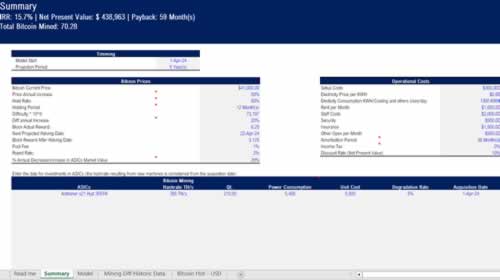
The Bitcoin Farm Model - Economics
The primary purpose of this model is to assess the feasibility of a Bitcoin farm by taking into account key factors that affect the economics of mining bitcoin, such as
- Bitcoin's current price and price predictions
- Mining difficulty and its growth
- [read more]
Do You Want to Implement Business Best Practices?
You can download in-depth presentations on Bitcoin and 100s of management topics from the FlevyPro Library. FlevyPro is trusted and utilized by 1000s of management consultants and corporate executives.
For even more best practices available on Flevy, have a look at our top 100 lists:
These best practices are of the same as those leveraged by top-tier management consulting firms, like McKinsey, BCG, Bain, and Accenture. Improve the growth and efficiency of your organization by utilizing these best practice frameworks, templates, and tools. Most were developed by seasoned executives and consultants with over 20+ years of experience.
Readers of This Article Are Interested in These Resources
What is Blockchain Technology?
Blockchain Technology has gained incredible appeal recently across many industries, mostly notably in Banking due to the rise of Bitcoin. It provides numerous process benefits through disintermediation. The World Economic Forum (WEF) predicts at least 10% of the [read more]
What is Blockchain Technology?
Blockchain Technology has gained incredible appeal recently across many industries, mostly notably in Banking due to the rise of Bitcoin. It provides numerous process benefits through disintermediation, including efficiency, security, transparency/openness, low [read more]
What is Blockchain Technology?
Blockchain Technology has gained incredible appeal recently across many industries, mostly notably in Banking due to the rise of Bitcoin. It provides numerous process benefits through disintermediation, including efficiency, security, transparency/openness, low [read more]
What is Blockchain Technology?
Blockchain Technology has gained incredible appeal recently across many industries, mostly notably in Banking due to the rise of Bitcoin. It provides numerous process benefits through disintermediation, including efficiency, security, transparency/openness, low [read more]
 Every trading affiliate eventually faces the same calculation: take the immediate CPA payment or build revshare income that compounds over time. The answer that most program marketing implies, that revshare always wins for serious affiliates, is not universally correct. The right model depends on the specific referring audience’s behaviour, the affiliate’s cash flow situation, and the quality of the broker’s product in retaining traders. Working through the actual mathematics of each model, with realistic assumptions rather than best-case scenarios, produces a more useful answer than any general recommendation. This guide runs those calculations and explains when a