Editor's Note: Take a look at our featured best practice, HR Strategy: Job Leveling (26-slide PowerPoint presentation). Job Leveling is a disciplined approach to gauge the value of work for individual positions across the organization. It entails ascertaining the nature of work done by each position, authority levels, and the effect of each job on business results.
Jobs that are configured inadequately bread [read more]
* * * *
Editor’s Note: Ganesh Rajagopalan is a seasoned management consultant and former investment banker. He is also a leading author on Flevy, having published numerous business frameworks on topics such as Strategy Development, Investment Analysis, and Value Chain Analysis. You can view all his materials here.
* * * *
 In a previous article, I had explored if employees should be treated as resources? I had observed that:
… underlying philosophy of not looking at people as ‘people’ but as resources is to my mind the greatest flaw in the design of so called HR strategies and their subsequent implementation. While some organizations have reoriented their approach, by and large, this philosophy prevails.
The trick, in my mind, is to remodel:
- First is to treat/approach people as ‘people.’
- Second, have an ‘engagement’ strategy rather than ‘management’ strategy.
‘Engagement’ here is in the sense of commitment, pledge, promise and obligation to them. The end result of such engagement strategy should be to have ‘happy’ employees. The objective of the strategy is focus on the emotional well-being of the employees. Happy employees, I trust, will automatically be self-motivated, driven, productive, have high ownership quotient and will therefore will be high on any ‘resource effectiveness metric’ that are used currently – at the level of all stakeholders.”
Many organizations, even though term people as ‘human resources,’ they do have in their practice some aspects that can be termed ‘engagement’-focused rather than management-focused. These are organizations that knowingly or unknowingly are realizing that employee ‘happiness quotient’ is the real test to their productivity and effective contribution to the growth of the firm. Some of these that I have observed are:
Empathy as Strategy
Their People Department know what exactly each person really does functionally and how each function pyramids to the final objectives set by the organization. They understand the economic flows each job function creates and ensure that job descriptions actually link to it. They therefore have clarity in specific terms on what tasks/activities a job will involve, what kind of internal & external interdependence it will have, how it could impact the role efficacy/efficiency, what kind of stress levels it can create, how work-life balance can be built in etc. In other words there is a clear strategy to ensure that the ‘empathy’ factor is built in both the ‘people department’ and also the ‘functional departments’ and that the former drives it.
Role Bonding
The linkages that a job has and the support that it requires from these linkages are clearly stated. It is crafted into the people/organizational strategy in such a way that vertical, horizontal and cross functional bonding becomes a part of the culture/way of working/way of thinking. The people department has strategies to build this value across functions (including itself) and across hierarchical levels. This way the performance or non-performance of a role is not only a reflection of what that role did or did not do but also on how effectively and/or efficiently did the critical linkages defined/attached to that role did or did not do their support/input roles
Forging Ownership
An owner generally will have the flexibility of doing what one wants with what is owned. In this sense, strategically, very job role is inbuilt with flexibility that can encourage initiatives, take a defined level of risk (some authority to experiment) and provides a sense of empowerment enabling them to take certain calls as against just go by rules/internal compliances.
I am sure there are many such practices that can build a ‘people engagement’ framework as against ‘HR management’. Look forward to the readers to add their thoughts/observations/suggestions on such practices.
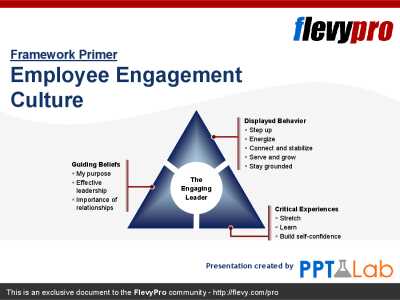
17-slide PowerPoint presentation
Improving Employee Engagement is a priority in most Talent and HR Strategies. This presentation provides a 5-step approach to building a culture of Employee Engagement. This processed was developed by Aon Hewitt based on the Aon Hewitt Top Companies for Leaders study.
Best practices from the
[read more]
Do You Want to Implement Business Best Practices?
You can download in-depth presentations on Employee Management and 100s of management topics from the FlevyPro Library. FlevyPro is trusted and utilized by 1000s of management consultants and corporate executives.
For even more best practices available on Flevy, have a look at our top 100 lists:
These best practices are of the same as those leveraged by top-tier management consulting firms, like McKinsey, BCG, Bain, and Accenture. Improve the growth and efficiency of your organization by utilizing these best practice frameworks, templates, and tools. Most were developed by seasoned executives and consultants with over 20+ years of experience.
Readers of This Article Are Interested in These Resources
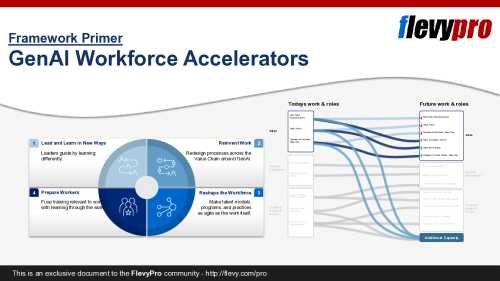
32-slide PowerPoint presentation
Generative AI (GenAI) is the most significant shift to work since the industrial revolution--and the Trifecta of Opportunities it unlocks (the economic, business, and people upsides) is the strategic objective. This presentation moves from the opportunity to the path: how leaders capture
[read more]

27-slide PowerPoint presentation
In the face of the COVID-19 pandemic, Strategic Workforce Planning has emerged as the key to organizations effectively managing and adapting to unforeseen disruptions.
HR leaders excel in conducting Workforce Planning at the business unit level, but face challenges when it comes to incorporating
[read more]
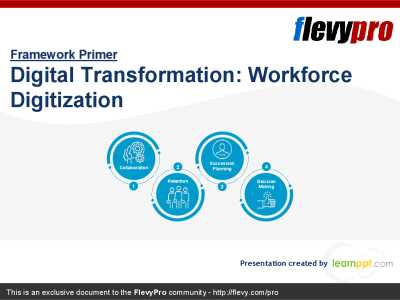
24-slide PowerPoint presentation
The approaching Age of Automation, together with the impending penetration of digital technology into the labor force, threatens to destabilize crucial aspects of how employees work by. It undermines the stability companies depend on to be agile.
Executives can re-solidify their companies even
[read more]
32-slide PowerPoint presentation
This guide is a basic introduction to performance management, the process, setting objectives, providing feedback, the performance discussion between manager and employee. It is geared to small and mid-sized companies who want to provide a process that is clear and easy to use for managers.
This
[read more]