Editor's Note: Take a look at our featured best practice, Food & Beverage Company Business Capability Model (1-page PDF document). A business capability model for a food and beverage company. To be used as a core document for Enterprise Architects and EA work. Also very valuable to Business Architects and Business Architecture projects/programmes.
The Food & Beverage Company Business Capability Model is an essential tool for [read more]
* * * *
What happens when 100 people need dinner at almost the same time?
It’s easy to picture the food, the tables, and the smiling guests. What you don’t see is the choreography underneath it all: purchasing, prep, staffing, packing, transport, and timing.
In 2026, the U.S. restaurant and foodservice industry is projected to reach $1.55 trillion in sales, so a lot is riding on getting those moving parts right. Let’s unpack what a catering operations model looks like and why the details matter.
So, What Is a Catering Operations Model?
A catering operations model is the system a business uses to turn a customer’s order into prepared food, delivered service, and, eventually, a completed event.
It starts long before anyone picks up a fork. Someone has to confirm the guest count, buy ingredients, schedule kitchen staff, prepare the menu, pack everything, and get it where it needs to be. If staff is serving guests, that adds another layer.
Picture a busy Saturday morning. The kitchen smells of roasted meat and fresh bread, containers are stacked near the door, and somebody is checking the delivery time for the third time. That’s the model in action.
The Main Parts of the Model
Every caterer has its own way of doing things, but the basic machinery is surprisingly similar. Food, people, supplies, and schedules all have to meet at roughly the same point.
Get one badly wrong, and the others feel it. Here are the pieces that usually matter most.
1. Menu and Production Planning
A catering menu has to survive reality, not just look good on a screen.
A dish that tastes wonderful when served immediately may lose its texture after sitting in a container for 30 minutes. Production planning considers preparation time, portion sizes, holding conditions, and which foods should be finished last.
You can see this principle in the approach taken by Magnolia Room Cafeteria. The Tucker, Georgia restaurant says its chefs begin early, prepare ingredients by hand, and make dishes from scratch using time-tested recipes.
That kind of menu requires planning. You can’t suddenly introduce an untested recipe at noon and hope hundreds of portions turn out perfectly.
2. Purchasing and Inventory
Then there’s the quieter side of catering: buying enough food without overbuying.
Underestimate demand, and you may be calling suppliers in a panic. Overestimate it, and money can sit in unused ingredients, especially perishables. Neither outcome is pleasant.
The National Restaurant Association reported that food and non-alcoholic beverage costs represented a median 32% of sales for full-service restaurants in 2024. Purchasing, then, isn’t just paperwork. It can decide whether an event makes financial sense.
3. Staffing and Scheduling
You can have the perfect menu and a fully stocked kitchen, but somebody still has to do the work.
Staffing means matching people to the rushes: prep in the morning, cooking before dispatch, loading around delivery time, and service once guests arrive. A manager might also need to keep a few people available for the unexpected. There’s always something.
The industry is heavily built around small operations. The National Restaurant Association says 9 in 10 U.S. restaurants have fewer than 50 employees. That makes smart scheduling especially important for businesses without huge teams sitting on standby.
Different Catering Models Work Differently
Not every catering job requires the same machinery. A drop-off lunch might require excellent packaging and delivery coordination, while a wedding can involve servers, buffet setup, equipment, and cleanup.
Here’s how some common models compare:
Catering model
Main focus
Typical challenge
Full-service event catering
Food, setup, service, and cleanup
Coordinating staff and timing
Drop-off catering
Prepared food and delivery
Packaging and transportation
Corporate catering
Recurring workplace meals
Consistency and scheduling
Restaurant-based catering
Existing menu adapted for groups
Balancing catering with regular service
Private dining
Food and service at one venue
Space and personalized service
The operating model shapes almost every decision that follows. A drop-off business may obsess over packaging and delivery routes, while a wedding operation has to think about servers, presentation, and the rhythm of the entire event.
What Makes a Catering Model Work?
The best systems aren’t necessarily complicated. They’re clear.
A manager should know what has been ordered, what needs preparing, who is responsible for it, and when it needs to move. That sounds obvious, yet during a busy event, obvious things have a habit of disappearing.
Useful processes usually cover:
Confirming guest numbers and dietary requirements.
The National Restaurant Association reported in 2025 that 83% of restaurant operators considered technology a competitive advantage, while 4 in 10 said technology investments had directly improved customer satisfaction.
Still, software won’t rescue a bad process. Someone has to notice that the delivery van is too small.
A System People Don’t Notice
That may be the strange thing about good catering operations. Customers rarely see the spreadsheets, prep lists, supplier calls, or frantic final checks.
They just see the food.
And that’s the point. When the operation works properly, all that machinery disappears into the background, leaving people free to eat, talk, celebrate, and enjoy themselves. The quietness of that success is probably its best measure.
PURPOSE OF MODEL
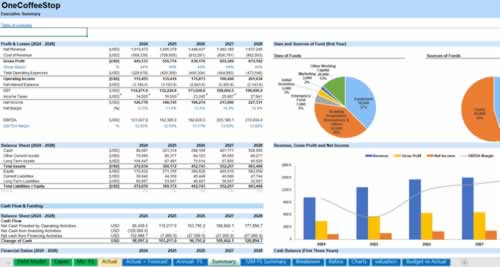
This Excel model is a highly adaptable and user-friendly tool for creating a 10-year rolling 3-statement financial projection (Income Statement, Balance Sheet, and Cash Flow Statement) with a monthly timeline. It is designed for a startup or existing Coffee Shop business, [read more]
Do You Want to Implement Business Best Practices?
You can download in-depth presentations on Food & Beverage Industry and 100s of management topics from the FlevyPro Library. FlevyPro is trusted and utilized by 1000s of management consultants and corporate executives.
For even more best practices available on Flevy, have a look at our top 100 lists:
These best practices are of the same as those leveraged by top-tier management consulting firms, like McKinsey, BCG, Bain, and Accenture. Improve the growth and efficiency of your organization by utilizing these best practice frameworks, templates, and tools. Most were developed by seasoned executives and consultants with over 20+ years of experience.
Readers of This Article Are Interested in These Resources
The Restaurant Financial Model and Valuation Spreadsheet is a comprehensive tool tailored for restaurant owners, investors, and stakeholders seeking to analyze the financial performance and value of their restaurant business. Whether you're planning to launch a new restaurant venture or optimize [read more]
This presentation sets out a strategic review approach using a global food company as an example. This strategic review incorporates the review of the environmental scan and internal scrutiny and the identification, evaluation and recommendation of future strategic options to achieve the required [read more]
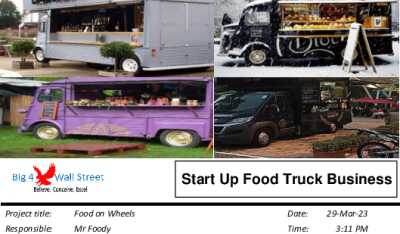
Start Up Food Truck Business Financial Model presents the case of an investment in a food truck business and its operation. The model generates the three financial statements, a summary page, a market snapshot, and a valuation, along with various feasibility metrics as well as graphs. The financing [read more]
Description
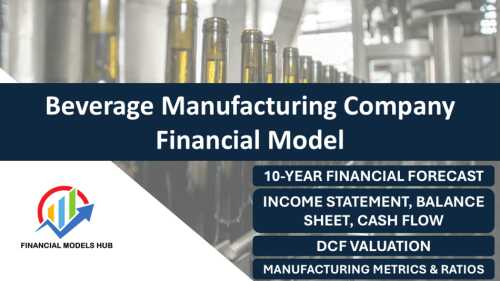
This Beverage Manufacturing Company Financial Model Template has been built for use by anyone looking to model out their Beverage Manufacturing Company financials over a 10 year period. This model includes all the key variables you would need to consider with operating your Beverage [read more]
 What happens when 100 people need dinner at almost the same time?