Editor's Note: Take a look at our featured best practice, Five Stages of Business Growth (25-slide PowerPoint presentation). This presentation introduces a framework for entrepreneurs to use when building and navigating their business from a nascent, startup state to an enterprise with a global footprint. This framework, called the 5 Stages of Business Growth, is based on the fact that all businesses experience common [read more]
* * * *
Ask around for the best health insurance plan for a small business and you’ll get a dozen confident, contradictory answers. That’s not because people are wrong. It’s because the question has no universal answer.
The plan that’s perfect for a young, healthy team of software developers can be a poor fit for a business whose staff have families and chronic prescriptions. Once an owner stops hunting for a mythical best plan and starts asking what fits their particular workforce, the whole process gets clearer and a lot less frustrating.
Best for Whom, Exactly
A health plan serves real people with specific needs, and those needs vary enormously across even a small group. A workforce that rarely sees a doctor may be far better off with lower premiums and a higher deductible, keeping monthly costs down and accepting more exposure on the rare occasion they need care. A team with young families and regular prescriptions might value predictable, lower out-of-pocket costs enough to pay richer premiums for them. Neither preference is more correct. The right plan is the one that matches how your particular employees actually use healthcare, which is why copying another company’s choice so often disappoints.
Comparing Plans without Drowning
The volume of options and jargon is enough to stall anyone, which is why owners who’ve been through it are such a useful resource. Communities where small business owners discuss Small Group Health Insurance Plans can cut through the marketing with candid accounts of what worked, what didn’t, and which details ended up mattering most in practice. Reading real experiences from businesses like yours is a fast way to build the vocabulary and instincts to evaluate plans confidently. Treat what you find as informed perspective to weigh rather than definitive advice, since the specifics of any plan and any business differ.
The Trade-Off You Can’t Escape
Every plan balances the same three levers, and pushing one down pushes another up. Lower premiums usually mean higher deductibles and more cost when care is needed. Richer coverage and broader networks come with bigger monthly bills. A tighter network keeps costs down but limits where people can go. There’s no arrangement that’s cheap, generous, and unrestricted all at once, and any plan that seems to promise all three is hiding the catch somewhere in the fine print. Accepting that trade-off honestly is what lets you choose the balance that suits your team rather than chasing an option that doesn’t exist. The mistake owners make is treating one lever as the whole decision, usually the monthly premium, because it’s the number that hits the bank account most visibly. But a plan with a tempting premium and a punishing deductible can cost employees far more in a bad year than a pricier plan would have, and that cost lands on your people at the worst possible moment. Looking at the full picture, what a plan costs when someone actually gets sick and not just what it costs each month, is what separates a choice you’re happy with from one you quietly regret.
Tax Incentives Can Tilt the Math
The raw premium isn’t always the real cost, because incentives can change the arithmetic meaningfully. The Small Business Health Care Tax Credit, administered by the IRS, can offset a portion of premiums for qualifying small employers who contribute toward employee coverage, which can make a plan that looked out of reach suddenly viable. Factoring in credits and deductions before comparing plans, rather than after, sometimes reorders the options entirely. It’s worth understanding what your business may qualify for early, so you’re comparing true net costs rather than headline premiums that don’t reflect what you’ll actually pay.
What Your Employees Actually Value
Owners often guess wrong about what their team wants from benefits, and the cheapest way to find out is to ask. Some workforces prize a low deductible above all, others care most about keeping a specific doctor in network, and others would trade a little coverage for a fatter paycheck. A plan chosen in a vacuum can miss all of that and leave people underwhelmed by benefits you’re paying real money to provide. A brief, honest conversation with your team, even an informal one, tends to reveal priorities that reshape which plan makes sense and makes the eventual choice feel like something done with them rather than to them. It doesn’t have to be elaborate. A few pointed questions about whether people would rather have lower monthly costs or lower costs when they need care, and whether keeping particular doctors matters, will usually surface a clear pattern. Employees also tend to value a benefit more when they had a say in it, so the conversation pays off twice: you choose a better-fitting plan, and the people it’s for actually appreciate what they’re getting instead of taking it for granted or resenting the gaps.
Choosing with Confidence
The search for the best small group health plan is a trap because it frames a fit problem as a ranking problem. Once you understand your workforce, accept the unavoidable trade-offs, account for the incentives available to you, and listen to what your people actually value, the field narrows to a handful of sensible choices. None of this is a substitute for professional advice, and a licensed benefits advisor can help you assess what genuinely suits your business. The goal was never to find the single best plan. It was to make a confident, well-matched choice, which is an entirely achievable one.
The Consolidation Curve, or Endgame Curve, is a framework based on the theory that all industries consolidate and follow a similar course through the 4 stages of: Opening, Scale, Focus, and Balance & Alliance. This framework is based on a study of 25,000 firms globally, representing 98% of the [read more]
Do You Want to Implement Business Best Practices?
You can download in-depth presentations on Small Business and 100s of management topics from the FlevyPro Library. FlevyPro is trusted and utilized by 1000s of management consultants and corporate executives.
For even more best practices available on Flevy, have a look at our top 100 lists:
These best practices are of the same as those leveraged by top-tier management consulting firms, like McKinsey, BCG, Bain, and Accenture. Improve the growth and efficiency of your organization by utilizing these best practice frameworks, templates, and tools. Most were developed by seasoned executives and consultants with over 20+ years of experience.
Readers of This Article Are Interested in These Resources
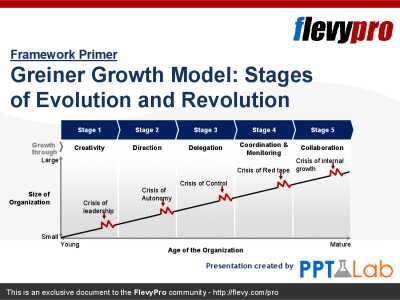
The Greiner Growth Model (Stages of Evolution and Revolution), developed by Larry Greiner, is a maturity model describing how organizations evolve through 5 stages of growth. Each stage requires appropriate strategies and structures to cope. The Greiner Growth Model is a descriptive framework [read more]
This financial policy manual is suitable for a small business. This manual aims to provide guidance :
1. By ensuring that all staff are aware of finance transactions with the business; and
2. Is a way for finance staff to make consistent decisions.
The aim of this manual is to assist in [read more]
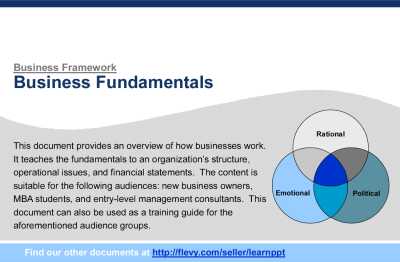
This presentation provides an overview of how businesses work. It teaches the fundamentals to understanding how modern businesses work, covering the business topics of Organizational Structures, Operational Issues, and Financial Statements.
The content is suitable for the following audiences: [read more]
Introducing the Ultimate Business Exit Strategy Framework: Achieve Seamless Transition and Maximize Your Returns
Are you a business owner or entrepreneur looking to ensure a smooth and profitable transition out of your current venture? The world of business exits can be complex and daunting, but [read more]
 Ask around for the best health insurance plan for a small business and you’ll get a dozen confident, contradictory answers. That’s not because people are wrong. It’s because the question has no universal answer.