Editor's Note: Take a look at our featured best practice, Total Productive Maintenance (TPM) (234-slide PowerPoint presentation). Total Productive Maintenance (TPM) is a comprehensive approach to equipment maintenance that aims to optimize equipment efficiency, reliability, and performance. It involves a holistic approach to maintenance, encompassing both the technical and the human aspects of equipment management. TPM is [read more]
* * * *
If your maintenance team is still waiting for machines to break before fixing them, then you are losing money every single day. Unplanned downtime costs manufacturers an average of $260,000 per hour, making reactive maintenance an expensive practice. That is why more businesses now take a proactive approach rather than react to breakdowns.
The best part is that you don’t need a complex setup to get a data science team started. Today’s tools make it easier to predict issues early and act promptly. That’s where choosing the best predictive maintenance software becomes critical, as it helps you reduce downtime, save costs, and keep operations running smoothly.
What Is Predictive Maintenance Software?
Predictive maintenance software uses real-time sensor data, machine learning, and historical patterns to predict when equipment is likely to fail before it actually does. Instead of running a machine until it breaks or following a fixed schedule, you remedy things exactly when they need fixing.
Here’s how it looks in the real world:
Fewer surprise breakdowns that halt production lines.
Lower maintenance costs by stopping the over-servicing of equipment that does not need it.
Longer asset lifespan since you identify minor problems before they become expensive failures.
A safer work environment because faulty equipment gets flagged early.
What to Look for in Predictive Maintenance Software
Not every tool on the market delivers the same value. Before you commit to a platform, run it through these key criteria:
Real-Time Monitoring: The software must extract live data from your sensors and IoT devices. Batch reporting every 24 hours won’t cut it when a bearing starts vibrating at 2 A.M.
AI and Machine Learning Capabilities: Reliable platforms learn from your specific equipment behavior over time. They get smarter the longer you use them, and they reduce false alarms significantly.
Easy Integration: Your predictive maintenance tool must integrate with your existing CMMS, ERP, or EAM systems. Siloed software creates more problems than it solves.
Mobile Access: Technicians work on the floor, not at a desk. A platform that functions smoothly on mobile is non-negotiable for modern maintenance teams.
Actionable Alerts: There is a crucial difference between a dashboard full of numbers and a clear alert that warns of a “Pump #3 bearing failure within 72 hours; schedule the inspection” you want to act on later.
Top Features of the Best Predictive Maintenance Software
When you explore the best predictive maintenance software options available today, you will notice that the top-performing platforms consistently offer a few standout capabilities.
They connect directly to industrial IoT sensors, provide maintenance managers with a single dashboard view across multiple sites, and automatically generate work orders when they detect an anomaly. The best tools also provide detailed failure history reports that help teams refine their maintenance strategies over time.
Another important feature is condition-based monitoring. Rather than triggering alerts based on time, condition-based monitoring monitors actual equipment health indicators such as temperature, vibration, pressure, and more. According to a study, facilities that adopt condition-based strategies see maintenance cost reductions of up to 25%.
Is Predictive Maintenance Right for Every Business?
Honestly, it does not always deliver immediate results. Predictive maintenance works best when:
You have equipment that operates continuously or nearly continuously.
Unexpected downtime causes significant production or revenue loss.
You already have some sensor infrastructure or can install it cost-effectively.
Your team has the capacity to act on alerts when they appear.
Small-scale operations with just a few machines may find that a solid preventive maintenance schedule gives them 80% of the benefit at a fraction of the cost. But once you scale to multiple facilities, dozens of critical assets, and complex interdependencies, predictive maintenance quickly becomes cost-effective.
How to Get Started?
Starting with predictive maintenance does not mean you have to report your existing processes. Most teams find success by starting small:
Pick your two or three most critical (almost failure-prone) assets.
Install sensors if you don’t have them already.
Connect to your chosen platform.
Let the software establish a baseline of normal equipment behavior over 4-6 weeks.
Act on the alerts it generates.
After a few months, you will have concrete data on downtime prevented and costs avoided, which makes it much easier to justify expanding the program.
Final Thoughts
Maintenance software is not magic, but it delivers results that come remarkably close. When you give your team the right tools, they stop reacting and start managing assets proactively. You experience less stress, fewer emergencies, and a clearer maintenance budget. Start by reviewing your highest priority equipment and exploring platforms built for your industry. The right software will fit your team and will scale with you as your program matures.
Reliability Centered Maintenance and Total Productive Maintenance presentation is intended to help as a 2-day workshop material for Operations and Maintenance personnel.
This presentation consists of over 200 slides and comprises of the following:
Group Activity - Define Maintenance [read more]
Do You Want to Implement Business Best Practices?
You can download in-depth presentations on Jishu Hozen and 100s of management topics from the FlevyPro Library. FlevyPro is trusted and utilized by 1000s of management consultants and corporate executives.
For even more best practices available on Flevy, have a look at our top 100 lists:
These best practices are of the same as those leveraged by top-tier management consulting firms, like McKinsey, BCG, Bain, and Accenture. Improve the growth and efficiency of your organization by utilizing these best practice frameworks, templates, and tools. Most were developed by seasoned executives and consultants with over 20+ years of experience.
Readers of This Article Are Interested in These Resources
Autonomous Maintenance (Jishu Hozen) is one of the most important building blocks in any Total Productive Maintenance (TPM) program. Autonomous Maintenance refers to TPM activities that involve operators in maintaining their own equipment, independent of the maintenance department.
One [read more]
TPM AUTONOMOUS MAINTENANCE (AM) AUDIT CHECKLIST TOOLKIT
Audit every step of your AM journey -- from first wipe-down to full self-management -- with one Excel workbook that scores itself.
This TPM Autonomous Maintenance Audit Checklist Toolkit is a professional resource designed to help [read more]
Unlocking Success with the Complete Maintenance, Repair, and Operations Business Best Practice Toolkit
In the fast-paced world of industrial and facility management, the key to sustainable success is often hidden within the intricate machinery of Maintenance, Repair, and Operations (MRO). To [read more]
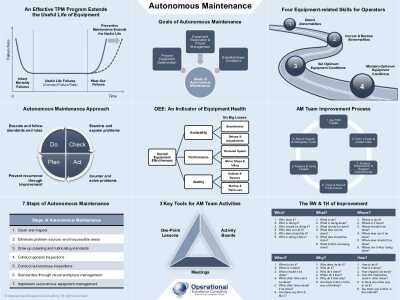
The Autonomous Maintenance (Jishu Hozen) Framework Poster highlights the key Autonomous Maintenance process, methods and tools.
The poster comes in two themes: color and monochrome. Formatted in PDF and in editable PPTX, the poster can be easily printed on an A3-sized paper from an office [read more]
 If your maintenance team is still waiting for machines to break before fixing them, then you are losing money every single day. Unplanned downtime costs manufacturers an average of $260,000 per hour, making reactive maintenance an expensive practice. That is why more businesses now take a proactive approach rather than react to breakdowns.