Editor's Note: Take a look at our featured best practice, Design Thinking (225-slide PowerPoint presentation). [NOTE: Our Design Thinking presentation has been trusted by an array of prestigious organizations, including industry leaders such as Apple, MIT, NASA, Ford, Boeing, Fujitsu, Syngenta, Palo Alto Networks, and Mercer, to name just a few.]
Design Thinking is a process for creative problem solving. [read more]
* * * *
In today’s global economy, the leading driver behind its growth is Innovation. Yet, it is the least understood.
Throughout the last century, captains of industries learned to master the process of production to such extent that it no longer functions as a significant Competitive Advantage. The challenge today is to master the process of Innovation. This includes harnessing change and creating new competitive advantages by offering better products, using better processes, delivering better services, or even offering new solutions.
However, we have not yet learned to master the Innovation Process. A great number of our companies have only a rudimentary understanding of what it requires to master Innovation Management and what Innovation really is. In today’s global economy, the ability to innovate is vital to ensure growth and competitiveness in the coming decades.
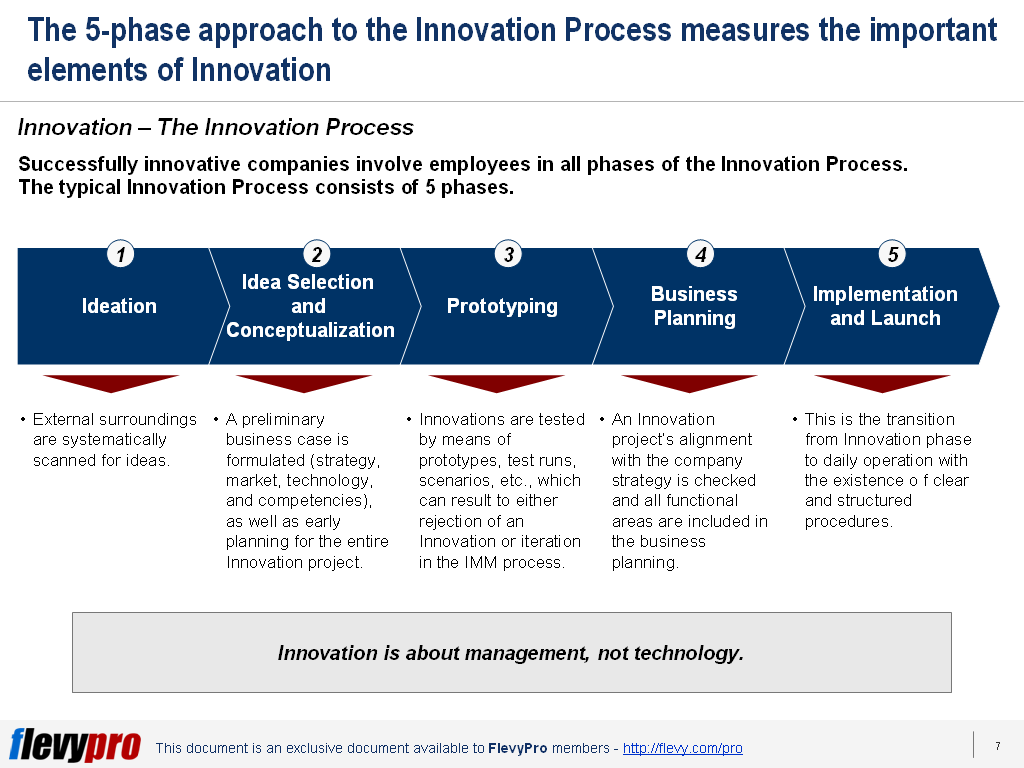
The 5-Phase Approach to the Innovation Process measures the important elements of innovation.
Ideation
Ideation is the starting point of innovation. Ideas are generated from systematically scanned external surroundings.
Idea Selection and Conceptualization
A preliminary business case is formulated (strategy, market, technology, and competencies) as well as early planning for the entire innovation project.
In this phase, this is where decisions are made whether to invest in an idea and develop it further.
Prototyping
Innovations are tested by means of prototypes, test runs, scenarios, etc. This can result in either rejection of innovation or iteration in the IMM process.
Business Planning
Business Planning is the key to innovation success. An innovation projection’s alignment with the company strategy is checked and all functional areas are included in Business Planning.
Implementation and Launch
This is the transition from innovation phase to daily operation with the existence of clear and structured procedures. This is where the project comes to life.
As our company goes through the 5-Phase of the Innovation Process, the Innovation Project will change character from phase to phase. Competency demands change along the way, together with the risk profile of the Project. This is a dimension that we need to understand in the Innovation Process. In fact, the Innovation Process can be viewed as an Innovation Machine.
Our company needs to continuously create and maintain a portfolio of ideas, experiments, business plans, and new businesses. Each phase requires new competencies, deeper investment, and even tighter control. In fact, the management of the Innovation process is a task that demands more than merely mastering individual parameters. It can be a challenge but in today’s global economy, there is no other way to move forward but innovate.
Innovative business models can reshape industries and drive tremendous growth. However, many organization find business model innovation difficult. The framework outlined in this presentation is based on the HBR article "Reinventing Your Business Model," authored by Clayton Christensen, Mark [read more]
Do You Want to Implement Business Best Practices?
You can download in-depth presentations on Innovation Management and 100s of management topics from the FlevyPro Library. FlevyPro is trusted and utilized by 1000s of management consultants and corporate executives.
For even more best practices available on Flevy, have a look at our top 100 lists:
These best practices are of the same as those leveraged by top-tier management consulting firms, like McKinsey, BCG, Bain, and Accenture. Improve the growth and efficiency of your organization by utilizing these best practice frameworks, templates, and tools. Most were developed by seasoned executives and consultants with over 20+ years of experience.
Readers of This Article Are Interested in These Resources
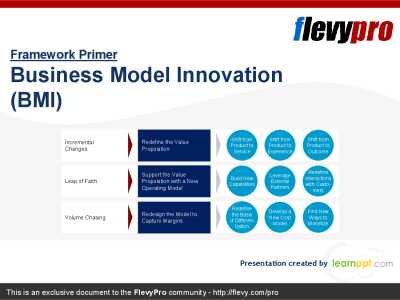
As core markets become saturated with new entrants and products, we find it more and more difficult to grow the core. We find traditional approaches that have successfully driven growth historically are also reaching points of diminishing returns.
Business Model Innovation (BMI) is a powerful, [read more]
Organizations undergo different phases of development. Some reach maturity and then decline over time, whereas others just fade away in the startup phase.
A few organizations, however, evade collapse and maintain Growth for years. They accomplish this by allocating dedicated resources, [read more]
This toolkit contains a series of templates that are designed to capture the key elements of a innovative idea.
It is intended to a be a live document that is updated as you go through the discovery journey from idea to a revenue generating concept.
Each framework has key concepts that need [read more]
Partnerships among companies and universities are important drivers of the Innovation economy. Fruitful partnering with universities comprises of having the appropriate people, processes, and organizational backing to guarantee success and to detect and manage sources of conflict.
This [read more]
 understood.