Editor Summary
Innovation Toolkit - A Playbook for Innovation Blueprint is a 20-slide PowerPoint playbook that guides teams from ideation to revenue generation, offering templates such as the Idea Resume, Solution Advert, Job Prioritization, Job Profile, Use Case, and Competitive Analysis Heat Map.
Read morePresented as a live document comparable to McKinsey, Bain, or BCG-quality materials (not affiliated), it targets innovation teams, product managers, business development executives, and consultants. Used for brainstorming, pitch preparation, validation, and discovery. Sold as a digital download on Flevy.
Use this toolkit when your organization must convert early ideas into validated, investable concepts—during brainstorming, discovery, or pitch preparation.
Innovation teams capturing and refining ideas in real time using the Idea Resume and Job Prioritization templates.
Product managers building business models, economic value cases, and test plans to validate assumptions.
Business development executives preparing investor-facing Solution Adverts and pitch materials.
Consultants running workshops to map use cases, stakeholder jobs, and competitive positioning.
The structured, hypothesis-driven discovery sequence—from idea capture through test planning—reflects consulting practices used at McKinsey, Bain, and BCG.
This toolkit contains a series of templates that are designed to capture the key elements of a innovative idea.
It is intended to a be a live document that is updated as you go through the discovery journey from idea to a revenue generating concept.
Each framework has key concepts that need to be captured in order to fully explore validity of the innovation.
The presentation should also be used as a storyboard / concept document to pitch ideas to:
• Key stakeholders
• Management
• Investors
• etc.
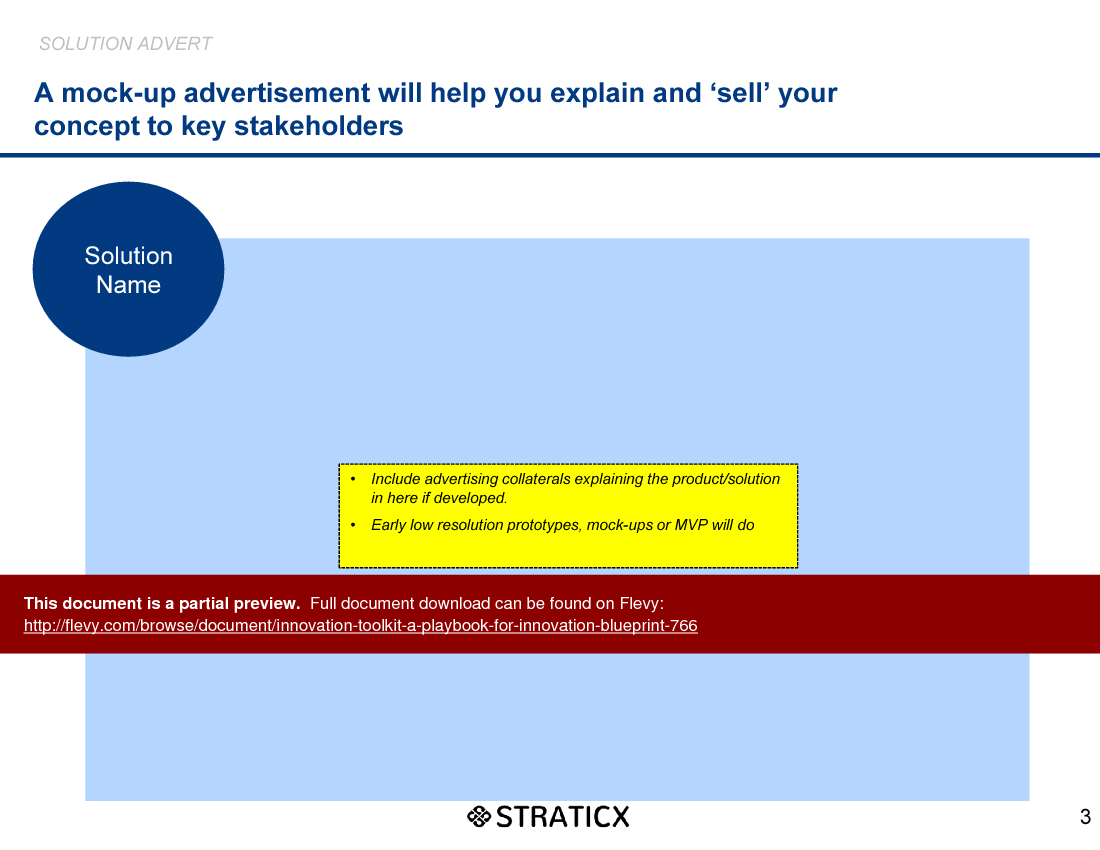
The Innovation Toolkit provides a comprehensive guide for articulating and selling your innovative concepts to key stakeholders. It includes mock-up advertisements to help visualize and communicate your ideas effectively. This feature is crucial for gaining buy-in from management, investors, and other critical decision-makers. The toolkit ensures that your innovation is presented in a compelling and professional manner.
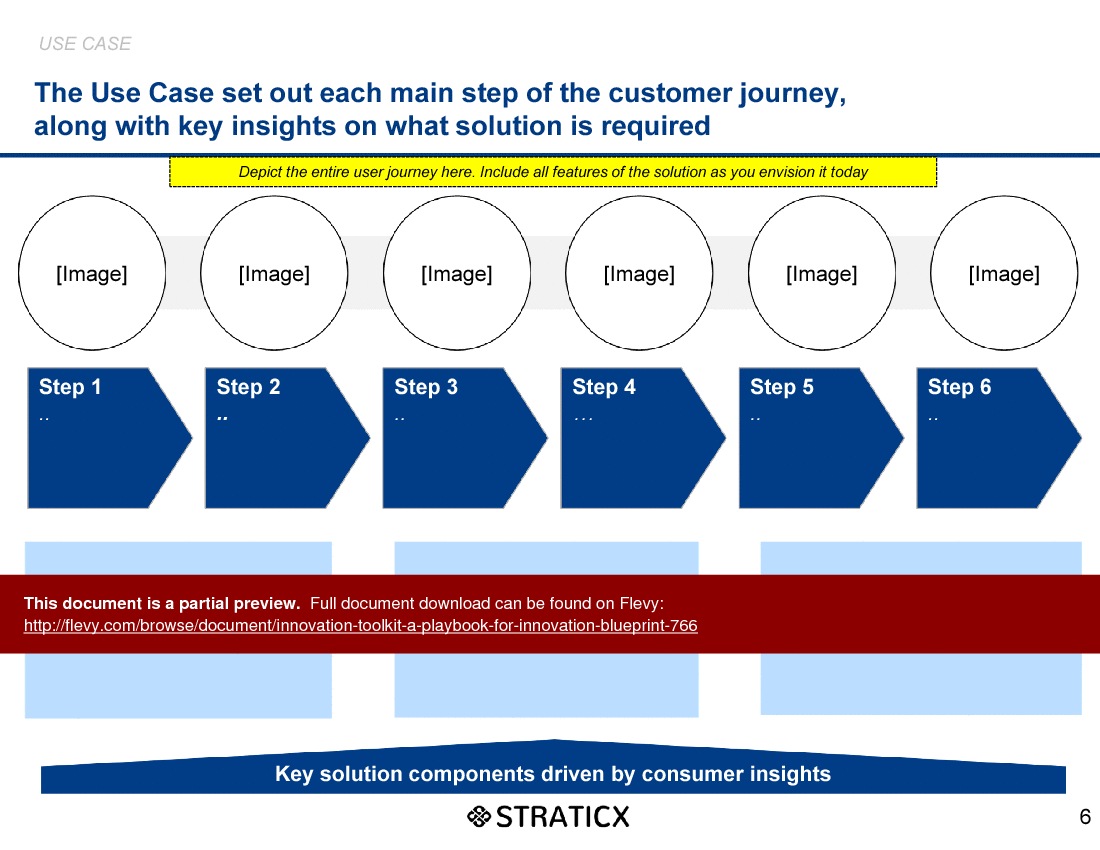
The document also offers a detailed use case framework, outlining each step of the customer journey. This helps in identifying key insights and requirements for your solution, ensuring that it aligns with consumer needs. By mapping out the entire user experience, you can better understand and address potential pain points, making your innovation more user-centric and market-ready.
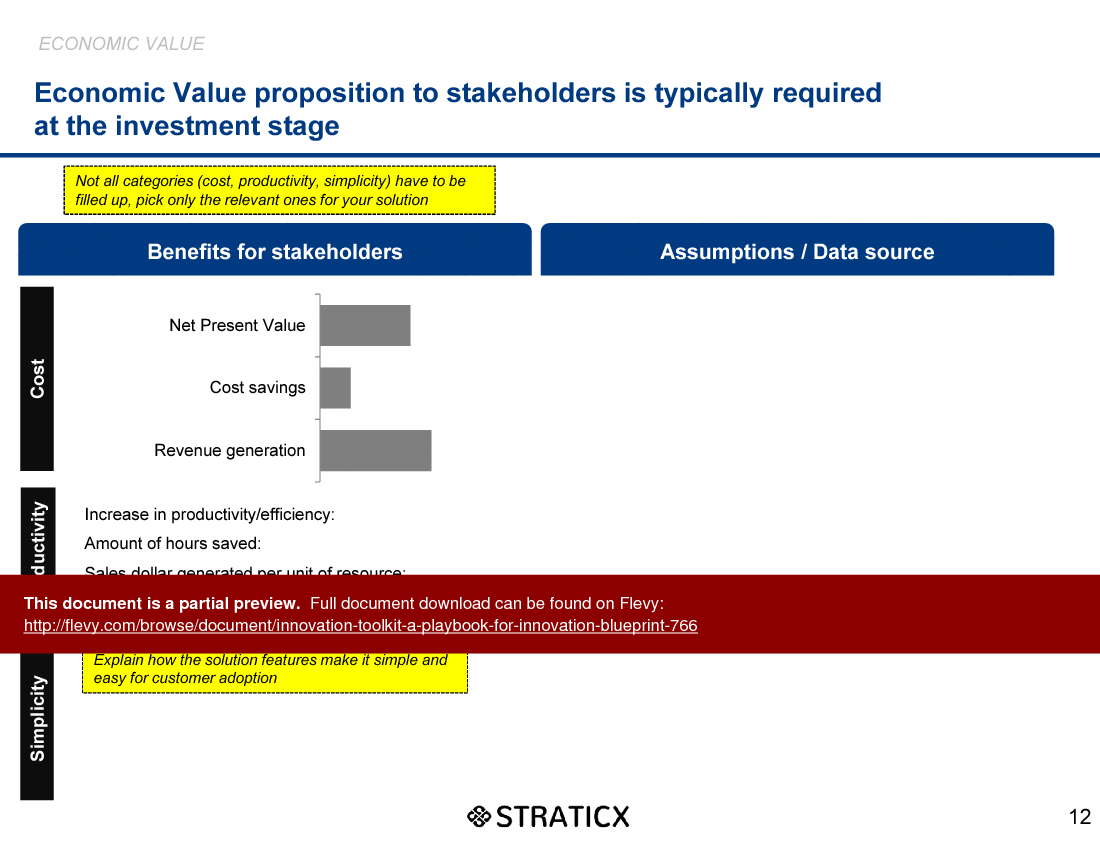
Additionally, the toolkit emphasizes the importance of economic value propositions at the investment stage. It provides templates to quantify benefits such as cost savings, productivity improvements, and revenue generation. This is essential for demonstrating the financial viability of your innovation to stakeholders, making it easier to secure the necessary funding and support.
Got a question about the product? Email us at support@flevy.com or ask the author directly by using the "Ask the Author a Question" form. If you cannot view the preview above this document description, go here to view the large preview instead.
MARCUS OVERVIEW
This synopsis was written by Marcus [?] based on the analysis of the full 20-slide presentation.
Executive Summary
The Innovation Toolkit – A Playbook for Innovation Blueprint is a consulting-grade presentation designed to guide teams through the innovation process, from ideation to revenue generation. Crafted with precision, this toolkit is comparable to McKinsey, Bain, or BCG-quality materials (not affiliated). It provides a structured approach to capture key elements of innovative ideas, enabling users to pitch concepts effectively to stakeholders, management, and investors. This live document evolves throughout the discovery journey, ensuring that every critical aspect of an innovation is thoroughly explored and validated.
Who This Is For and When to Use
• Innovation teams seeking to develop and validate new ideas
• Product managers responsible for driving innovation initiatives
• Business development executives looking to pitch concepts to stakeholders
• Consultants facilitating innovation workshops or strategy sessions
Best-fit moments to use this deck:
• During brainstorming sessions to capture and refine innovative ideas
• When preparing pitches for stakeholders or investors
• In workshops aimed at validating business models and market potential
• Throughout the discovery journey to document insights and findings
Learning Objectives
• Define the key elements of an innovative idea and articulate its value proposition
• Build a comprehensive business model that includes customer needs and market analysis
• Establish a clear test plan to validate hypotheses and assumptions
• Identify and prioritize jobs-to-be-done based on stakeholder feedback
• Develop a competitive analysis to understand market positioning
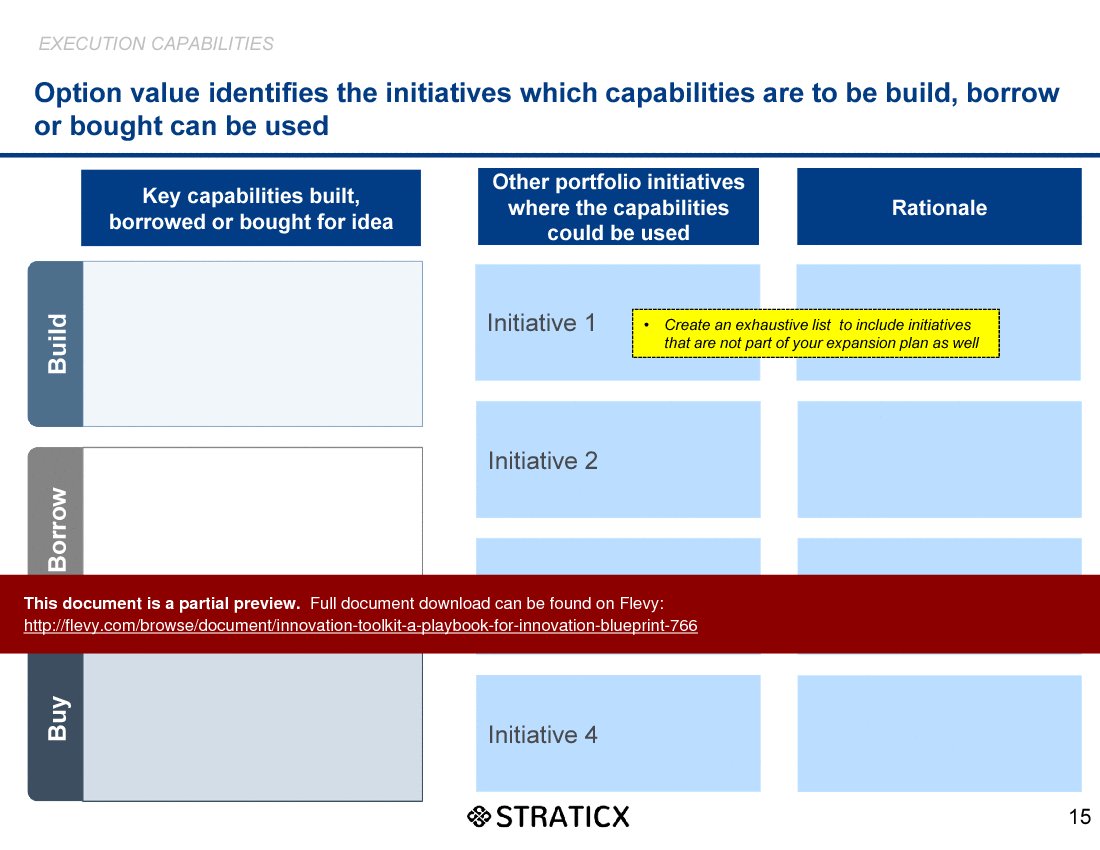
• Create a roadmap for execution that outlines key capabilities and initiatives
Table of Contents
• Idea Description (page 1)
• Idea Resume (page 2)
• Solution Advert (page 3)
• Job Prioritization (page 4)
• Job Profile (page 5)
• Use Case (page 6)
• Value Chain (page 7)
• Stack View (page 8)
• Solution Features (page 9)
• Market Size (page 10)
• Reverse Income (page 11)
• Economic Value (page 12)
• Business Model (page 13)
• Expansion Plan (page 14)
• Execution Capabilities (page 15)
• Competitive Analysis Heat Map (page 16)
• Competitive Analysis - Differentiation (page 17)
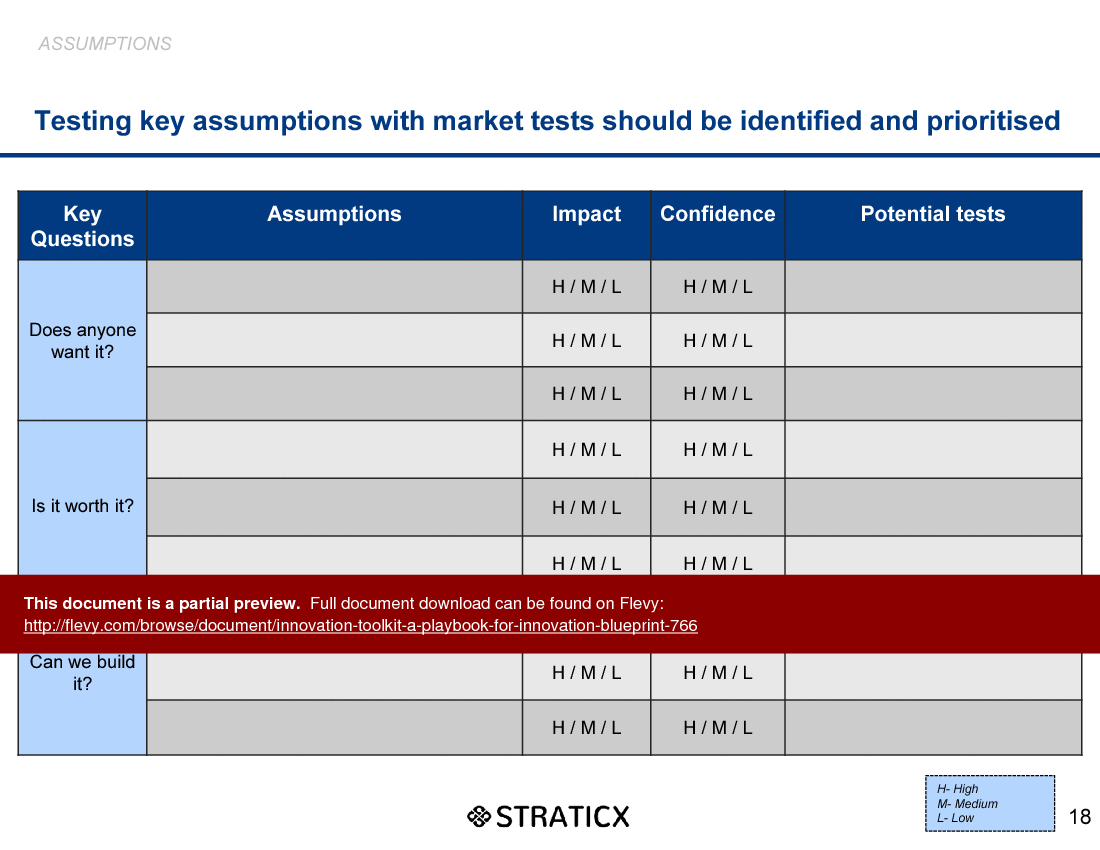
• Assumptions (page 18)
• Test Plan (page 19)
Primary Topics Covered
• Idea Description - A concise overview of the innovative idea, including its significance and potential impact on the market.
• Idea Resume - A summary page capturing essential elements of the idea, including customer needs, market size, and competitive advantages.
• Solution Advert - A visual representation of the solution designed to communicate its value to stakeholders effectively.
• Job Prioritization - A framework for assessing the importance and dissatisfaction levels of various jobs-to-be-done from the stakeholder perspective.
• Job Profile - Identification of key stakeholders and their respective jobs, constraints, and compensating behaviors.
• Use Case - A detailed depiction of the customer journey, highlighting key insights and solution requirements.
Deliverables, Templates, and Tools
• Idea Resume template summarizing key elements of the innovative concept
• Solution Advert template for visual communication of the product/solution
• Job Prioritization framework to assess stakeholder needs and dissatisfaction
• Job Profile template to capture stakeholder insights and job-to-be-done
• Use Case template outlining customer journey steps and insights
• Competitive Analysis Heat Map for evaluating market competition
Slide Highlights
• The Idea Resume slide that succinctly captures the innovation's core elements.
• The Solution Advert slide that visually communicates the product's value proposition.
• The Job Prioritization slide that assesses the importance of various jobs-to-be-done.
• The Use Case slide that illustrates the entire customer journey and solution requirements.
• The Competitive Analysis Heat Map slide that highlights key competitors and their strengths.
Potential Workshop Agenda
Innovation Ideation Session (90 minutes)
• Discuss and brainstorm innovative ideas
• Capture key elements in the Idea Resume
• Prioritize jobs-to-be-done based on stakeholder feedback
Pitch Preparation Workshop (60 minutes)
• Develop the Solution Advert for key stakeholders
• Refine the business model and value proposition
• Prepare for potential questions from stakeholders
Testing and Validation Session (90 minutes)
• Outline the test plan for validating hypotheses
• Identify key assumptions and potential tests
• Discuss next steps for execution and follow-up
Customization Guidance
• Tailor the Idea Resume to reflect specific market conditions and customer insights.
• Update the Solution Advert with relevant advertising collaterals and prototypes.
• Modify the Job Profile to include specific stakeholder relationships and circumstances.
• Adjust the Use Case to align with the unique customer journey of your solution.
Secondary Topics Covered
• Customer Value Proposition development
• Economic Value analysis for stakeholders
• Revenue model considerations and pricing strategies
• Expansion planning for adjacent opportunities
• Execution capabilities and resource allocation
Topic FAQ
What are the typical stages of turning an idea into a revenue-generating concept?
Typical stages include ideation and idea capture, defining stakeholder jobs and use cases, building a business model and economic value case, identifying assumptions, and designing tests to validate hypotheses. Flevy's Innovation Toolkit - A Playbook for Innovation Blueprint maps these through slides including the Idea Resume and Test Plan (page 19).
How do you prioritize jobs-to-be-done when developing a new product?
Prioritize jobs by assessing their importance, the level of dissatisfaction with current solutions, and prevalence among stakeholders. Use structured scoring to rank jobs and focus on highest-impact needs. The toolkit provides a Job Prioritization framework and a Job Profile template to document these assessments on the Job Prioritization slide.
What should be included in a competitive analysis for an innovation project?
A competitive analysis should depict key competitors, their relative strengths, differentiation opportunities, and market positioning. Visual heat maps help highlight gaps and areas to exploit. The product includes a Competitive Analysis Heat Map and a Differentiation slide to capture these insights on slide 16 and 17.
How should I choose an innovation toolkit for internal use versus hiring consultants?
Choose a toolkit that supports live updating through discovery, offers pitch-ready artifacts, and includes validation tools so internal teams can iterate without external support. Look for Idea Resume, Solution Advert, Use Case, and Test Plan templates that enable internal workshops and pitch preparation, like the templates provided here.
What should I consider when evaluating the cost versus value of innovation templates?
Assess whether templates enable quantifying economic impact (cost savings, productivity gains, revenue), support test planning, and produce investor-facing materials. Value derives from enabling discovery and investment conversations; ensure the package includes Economic Value, Market Size, and Business Model templates to support those analyses.
I need to prepare a 60-minute investor pitch—what structure should I use?
For a 60-minute pitch, open with the Idea Resume to summarize the concept, present the Solution Advert to illustrate value, cover market size and economic value, outline the business model and expansion plan, and close with the Test Plan and next steps. The toolkit includes a Pitch Preparation Workshop agenda for a 60-minute session.
How can customer journey mapping refine product requirements during discovery?
Map the customer journey to identify user steps, pain points, and solution requirements; capture stakeholder jobs and compensating behaviors to prioritize features. Use qualitative interviews to validate insights. The toolkit supplies a Use Case template and Job Profile slide to document journey steps and requirements.
How do I demonstrate early financial viability to stakeholders during discovery?
Quantify addressable market size, model revenue and pricing considerations, and outline economic value such as cost savings or productivity improvements to stakeholders. Use reverse-income or economic-value calculations and a concise Business Model slide to present financial viability, as supported by the Economic Value and Reverse Income slides.
Document FAQ
These are questions addressed within this presentation.
What is the purpose of the Idea Resume?
The Idea Resume serves as a concise summary that articulates all key elements of the innovative concept on a single page, helping stakeholders quickly understand its value.
How do I prioritize jobs-to-be-done?
Use the Job Prioritization framework to assess the importance, dissatisfaction, and prevalence of various jobs from the stakeholder perspective.
What should be included in the Solution Advert?
The Solution Advert should include visual elements that explain the product/solution, such as advertising collaterals, early prototypes, or mock-ups.
How can I validate my business model?
Develop a test plan that outlines which hypotheses need to be tested and establish metrics for success.
What is the significance of the Competitive Analysis Heat Map?
The Competitive Analysis Heat Map visually depicts key competitors and their strengths, helping identify areas for differentiation.
How do I assess market size?
Calculate the addressable market size by estimating the number of potential customers and their willingness to pay for your solution.
What are the key components of the Economic Value proposition?
The Economic Value proposition outlines the benefits for stakeholders, including cost savings, productivity increases, and overall value generation.
How can I ensure my solution meets customer needs?
Conduct qualitative interviews with stakeholders to gather insights on their jobs-to-be-done, dissatisfaction with current solutions, and willingness to pay.
What is the role of the test plan?
The test plan outlines the specific activities and timelines for validating key assumptions and hypotheses related to the innovation.
How should I approach the expansion plan?
The expansion plan should detail the evolution of the product over the next 5 years, including any adjacent opportunities that align with your overall strategy.
Glossary
• Idea Resume - A summary page capturing key elements of an innovative concept.
• Job-to-be-Done - The task or need that a customer aims to fulfill with a solution.
• Solution Advert - A visual representation designed to communicate the value of a product or solution.
• Competitive Analysis - An assessment of competitors in the market and their strengths.
• Economic Value - The benefits provided to stakeholders, including cost savings and productivity gains.
• Use Case - A depiction of the customer journey and solution requirements.
• Test Plan - A structured approach to validate hypotheses and assumptions.
• Market Size - The total potential revenue opportunity available for a product or service.
• Customer Value Proposition - The unique value a product or service offers to customers.
• Expansion Plan - A strategy outlining future growth opportunities and market penetration.
• Stakeholder - An individual or group with an interest in the outcome of a project or initiative.
• Competitive Advantage - A unique advantage that allows a company to outperform its competitors.
This PPT slide outlines a structured three-phase expansion strategy: Establish the Market, Grow the Base, and Generate New Revenue, over a five-year horizon. The "Establish the Market" phase focuses on market penetration and profit margins, essential metrics for assessing product viability. The "Grow the Base" phase emphasizes scaling market presence through enhanced customer engagement and retention, increasing overall market share. The final phase, "Generate New Revenue," explores new revenue streams and product diversification, aligning initiatives with broader strategic objectives. This roadmap highlights the importance of understanding market dynamics and financial metrics at each stage for successful product evolution.
This PPT slide outlines a structured approach to the customer journey using a use case framework. It emphasizes mapping each step to identify customer needs and align solutions. The visual layout includes 6 distinct steps, each represented by a shape, indicating a systematic progression. Images above each step illustrate key moments in the customer experience, enhancing comprehension. Designated areas for insights capture learnings and recommendations, facilitating strategic discussions. The directive to "depict the entire user journey" urges stakeholders to consider all aspects of the customer experience, essential for crafting effective solutions. This methodical exploration ensures insights inform tailored solutions, improving customer satisfaction and loyalty, ultimately driving business success.
The "Idea Resume" framework evaluates innovative concepts through essential components. The "Idea Description" section defines the proposed solution, whether existing or future. The "Customer Need" segment identifies unmet customer needs and assesses their significance. The "Addressable Market Size" evaluates market scope, crucial for understanding potential reach. The "Business Model" section outlines the value proposition, revenue streams, and necessary resources for operationalization. "Strengths in Execution" assesses organizational capability for successful implementation, considering required resources and market understanding. The "Strength of the Solution to Solve Customer Problem" evaluates effectiveness in meeting customer needs. The "Potential Profit Margin" and "Expansion Plan" sections assess financial viability and growth opportunities. Finally, the focus on sustainability and competitive positioning prompts consideration of maintaining market relevance.
This PPT slide outlines a structured approach to job prioritization from stakeholder perspectives. It emphasizes qualitative interviews to gather insights on job importance, dissatisfaction with current solutions, and prevalence among stakeholders. The first column lists specific jobs, while the second assesses importance on a scale from 1 (not important) to 5 (very important), identifying jobs that require immediate attention. The dissatisfaction column rates satisfaction levels with existing solutions from 1 (satisfied) to 5 (very dissatisfied), revealing gaps and opportunities for innovation. The final column evaluates job prevalence from 1 (held by a few) to 5 (held by most), guiding prioritization based on audience impact. This framework aids decision-makers in aligning innovation strategies with stakeholder needs.
This PPT slide outlines a structured approach to calculating market size using the "4Ps." It emphasizes financial believability for validating business strategies and investment decisions. Users are prompted to assess the credibility of their customer base and profit model components. The worksheet guides users through specific calculations, starting with revenue requirements and breaking down the estimation into 3 key components: estimated market size, estimated transaction pricing, and purchase frequency. These elements are essential for understanding potential revenue streams. The slide also suggests utilizing industry reports, primary research, and comparable benchmarks as data sources, ensuring assumptions are supported by credible data. This structured estimation fosters a disciplined approach to market analysis.
Source: Best Practices in Innovation Management PowerPoint Slides: Innovation Toolkit - A Playbook for Innovation Blueprint PowerPoint (PPTX) Presentation Slide Deck, STRATICX
Straticx is redefining strategy and innovation consulting through online access to high value consulting partners, who work with senior executives and boards of corporations to frame key business issues, develop hypothesis, apply structured problem solving and commercial acumen to drive development of solutions. The partners all have 10+ consulting experience covering a broad range of sectors and
... [read more] have delivered a range of engagements such as corporate and business unit strategy, business transformation, business case development, M&A, and operational improvement.
Since 2012, we have provided business templates to over 10,000 businesses and organizations of all sizes, from startups and small businesses to the Fortune 100, in over 130 countries.
"[Flevy] produces some great work that has been/continues to be of immense help not only to myself, but as I seek to provide professional services to my clients, it gives me a large "tool box" of resources that are critical to provide them with the quality of service and outcomes they are expecting."
– Royston Knowles, Executive with 50+ Years of Board Level Experience
"I like your product. I'm frequently designing PowerPoint presentations for my company and your product has given me so many great ideas on the use of charts, layouts, tools, and frameworks. I really think the templates are a valuable asset to the job."
– Roberto Fuentes Martinez, Senior Executive Director at Technology Transformation Advisory
"I have used FlevyPro for several business applications. It is a great complement to working with expensive consultants. The quality and effectiveness of the tools are of the highest standards."
– Moritz Bernhoerster, Global Sourcing Director at Fortune 500
"As an Independent Management Consultant, I find Flevy to add great value as a source of best practices, templates and information on new trends. Flevy has matured and the quality and quantity of the library is excellent. Lastly the price charged is reasonable, creating a win-win value for
the customer, Flevy and the various authors. This is truly a service that benefits the consulting industry and associated clients. Thanks for providing this service.
"
– Jim Schoen, Principal at FRC Group
"As a small business owner, the resource material available from FlevyPro has proven to be invaluable. The ability to search for material on demand based our project events and client requirements was great for me and proved very beneficial to my clients. Importantly, being able to easily edit and tailor
the material for specific purposes helped us to make presentations, knowledge sharing, and toolkit development, which formed part of the overall program collateral. While FlevyPro contains resource material that any consultancy, project or delivery firm must have, it is an essential part of a small firm or independent consultant's toolbox.
"
– Michael Duff, Managing Director at Change Strategy (UK)
"As a consulting firm, we had been creating subject matter training materials for our people and found the excellent materials on Flevy, which saved us 100's of hours of re-creating what already exists on the Flevy materials we purchased."
– Michael Evans, Managing Director at Newport LLC
"As a consultant requiring up to date and professional material that will be of value and use to my clients, I find Flevy a very reliable resource.
The variety and quality of material available through Flevy offers a very useful and commanding source for information. Using Flevy saves me time, enhances my expertise and ends up being a good decision."
– Dennis Gershowitz, Principal at DG Associates
"Flevy is our 'go to' resource for management material, at an affordable cost. The Flevy library is comprehensive and the content deep, and typically provides a great foundation for us to further develop and tailor our own service offer."
– Chris McCann, Founder at Resilient.World
Save with Bundles
This document is available as part of the following discounted bundle(s):
Download our free compilation of 50+ Strategy & Transformation slides and templates. Frameworks include McKinsey 7-S, Balanced Scorecard, Disruptive Innovation, BCG Curve, and many more.










