Editor's Note: Take a look at our featured best practice, HR Strategy: Job Leveling (26-slide PowerPoint presentation). Job Leveling is a disciplined approach to gauge the value of work for individual positions across the organization. It entails ascertaining the nature of work done by each position, authority levels, and the effect of each job on business results.
Jobs that are configured inadequately bread [read more]
* * * *
 When it comes to helping workers maintain a decent standard of living, the U.S. is among the countries around the world setting the bar high. The government has set forth stringent procedural rules and enforcement practices to protect employees from being underpaid or overworked.
However, it is not unusual for employers in the U.S. to pay less than expected and sometimes deny eligible workers overtime pay. If you suspect your employer is paying you less than you deserve, understanding minimum wage and overtime pay laws is the first step towards protecting your legal rights.
State and federal regulations on minimum wage and overtime pay
The federal government requires workers to receive a minimum wage and overtime pay for all hours worked beyond forty per week. Under the Fair Labor Standards Act (FLSA), minimum wages should not be less than $7.25 per hour. Additionally, this Act requires most employers in the country to pay employees at least one and a half times an employee’s regular hourly wage for hours worked over 40 in a workweek.
At the state level, minimum wage and overtime pay laws vary from one state to another. For instance, states like Washington and New York have minimum wages of $13.69 and $12.50, respectively.
However, other states like Georgia and Wyoming allow minimum wages below the federal level at $5.15 per hour. But that does not mean you shouldn’t collect the current Federal minimum wage of $7.25 per hour if your employer is subject to the FLSA.
If you suspect you were not adequately paid for your work or denied overtime pay, a reputable resource like FreeAdvice.com could help you understand your legal rights and options. The site offers the most useful, comprehensive, easy-to-understand, and balanced legal information so that you can seek the rightful compensation for unpaid wages or overtime pay from your employer.
What should you do if your employer fails to pay minimum wage or overtime pay?
Most employers will comply with the federal and state laws on minimum wage and overtime pay. However, some employers will not hesitate to pay less hourly rate than what is required. Others will take it a notch higher and steal tips or force employees to work off-the-clock.
If any of that happens to you during your employment period, you are eligible to file a lawsuit against your employer to collect compensation for wrongly denied overtime pay and any unpaid wages. However, it is essential to work with a reputable lawyer who understands local workers’ compensation laws. A skilled attorney will dedicate their time and legal resources to ensure you get the money you deserve.
Can I be retaliated against for filing a wage and hour lawsuit?
Sometimes employers retaliate against workers who file minimum wage or overtime pay lawsuits.
A good example is when an employer fires, demotes, reduces work hours, assigns undesirable shifts, cuts down job duties, or terminates an employment contract after filing a wage or hour lawsuit. In other instances, employers may retaliate by purposely giving false reviews to affect employees’ positions and earnings negatively.
No matter what form of retaliation happens to you, the U.S. Equal Employment Opportunity Commission and the state governments have laid out laws that protect victims of relitation like you. In other words, you may be eligible to bring a separate, individual lawsuit against your company for the retaliation.
Because of the complexity of workers’ compensation cases, it is vital to have a reputable attorney by your side. The right lawyer will help you prove your case beyond a reasonable doubt to reverse your employer’s retaliation and recover compensation for any resulting loss.
24-slide PowerPoint presentation
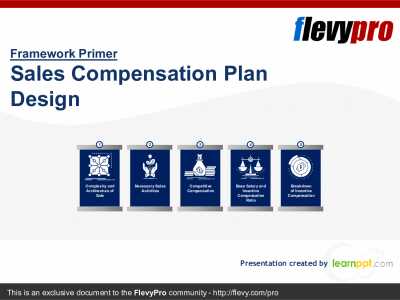
"In most companies, Sales is the only revenue-generating function. Everything else is a cost center."
The importance of Sales is thus indisputable. For such an important function, it becomes equally as important to design an appropriate Sales Compensation Plan.
Sales Compensation is often
[read more]
Do You Want to Implement Business Best Practices?
You can download in-depth presentations on Compensation and 100s of management topics from the FlevyPro Library. FlevyPro is trusted and utilized by 1000s of management consultants and corporate executives.
For even more best practices available on Flevy, have a look at our top 100 lists:
These best practices are of the same as those leveraged by top-tier management consulting firms, like McKinsey, BCG, Bain, and Accenture. Improve the growth and efficiency of your organization by utilizing these best practice frameworks, templates, and tools. Most were developed by seasoned executives and consultants with over 20+ years of experience.
Readers of This Article Are Interested in These Resources
Excel workbook
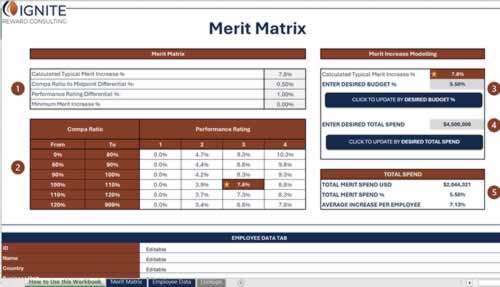
The Merit Matrix Template tool is an Excel-based application designed to streamline the process of annual merit increase budget allocation. By utilizing compa ratios (position in pay ranges), and performance ratings, the tool assists reward teams in determining the optimal distribution of merit
[read more]
26-slide PowerPoint presentation
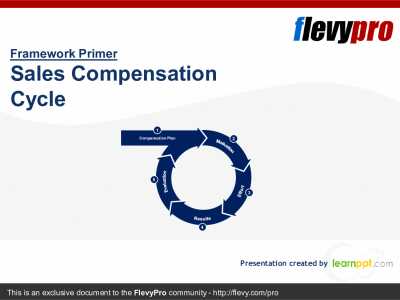
"In most companies, Sales is the only revenue-generating function. Everything else is a cost center."
The importance of Sales is thus indisputable. For such an important function, it becomes equally as important to design an appropriate Sales Compensation Plan.
Sales Compensation is often
[read more]
20-slide PowerPoint presentation
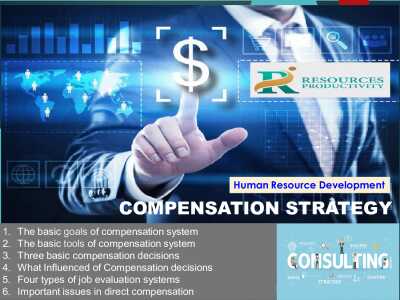
Compensation includes topics in regard to wage and/or salary programs and structures, for example, salary ranges for job descriptions, merit-based programs, bonus-based programs, commission-based programs, etc. (Also see the Related Info (including Benefits).)
Compensation is payment to
[read more]
190-slide PowerPoint presentation
Introducing the Ultimate Compensation and Incentive Management Business Toolkit
Are you looking to take your compensation and incentive management strategies to the next level? Do you want to drive employee motivation and engagement while effectively aligning rewards with performance? Look no
[read more]