Editor's Note: Take a look at our featured best practice, Ecommerce Financial Model (Excel workbook). Model Options:
This template is a detailed and user-friendly financial model that considers an e-commerce business's specifics.
By Taking into account key assumptions such as traffic from different sources, conversion rates, the average purchase value for different product categories, and the [read more]
* * * *
Internet shopping and online shopping have, in recent years, become more and more popular. This means that it is now easier than ever for anyone to turn their idea for an e-Commerce business into income. However, starting an e-Commerce business is not as simple as choosing a product and creating a website. A new online business will need strong financial management in order to survive and grow. Many new business owners put a great deal of time into setting up their online store, into their branding and into their marketing. However, this can lead to financial decisions being made that are not in the best interests of the business, such as allowing cash to be paid late or allowing the business to spend too much money on unnecessary items.
Starting an online business may require a lot of time and effort to develop the online store, to create the necessary branding and the necessary marketing. However, when the online store is launched, all the work will count for nothing, if there is no money left to cover the running costs of the online business.
Understand Your Startup Costs before Launching
Every new e-commerce company is small in the beginning. Therefore, such companies need funding for covering essential expenses as well as for future growth. Estimating required startup costs for online business in detail is crucial in order to avoid unexpected financial problems. You also need to determine how much money your online business will need before it is able to bring in enough cash to cover all associated expenses.
Common start-up costs for an online business are costs of setting up the website, hosting, domain name and the e-commerce platform. Furthermore, costs of the products that are first being sold, costs of packaging and shipping, costs of payment processing, costs of advertising and marketing. There are also professional services such as designing the online store and setting up the online store. In addition, costs of software solutions for managing the inventory of the online business.
Estimating startup costs in detail will help prevent unexpected financial problems and help online business owners understand how much money they will need to generate by the time their business is able to cover expenses.
However, this is not the case. Most new online stores need time to generate awareness of their store and products, until there are enough sales to cover the costs of the online store. Therefore, the costs of starting an online store need to be offset against the expected profits of the store in its early stages.
Separate Business and Personal Finances
A Separate Fund for Your Online Business is Simple and Smart. Keeping track of your online store’s money and personal money is simple and smart. As your store grows, keeping money for your business and your personal money in separate accounts will help you manage your store’s money in a more professional manner. For example, if you need to track profits for a certain marketing campaign, the money for that campaign will be easy to track if you keep all of the funds for your online business in one account.
By opening a business bank account (besides your personal bank accounts) for your online store, you can track the income and expenses for your company. It will help you keep track of your finances in a more professional way and it will help represent your company better.
Retailers can easily confuse their business’ funds with their personal funds when they are just starting out an online store. Once you start to keep track of the money that your online business is making and spending, however, it is wise to keep the money in separate accounts. This way, you can easily keep track of your profits from your marketing efforts. Therefore, all of the funds from your online store should be kept in one account.
As you are running your online business, keeping track of your financials will be key to you making good decisions as to pricing, managing your stock hold and future investment.
Create a Cash Flow Plan for Your Online Store
When it comes to managing an online store the cash flow for that store is one of the most challenging things for a new online entrepreneur to manage. It is distinct from the profit that your online company makes. Although a new online store can look successful, the truth is that it can actually be struggling to meet the various financial commitments of the company and pay out necessary bills.
A business could invest a large amount of money in products for example several months prior to them being sold. This will mean that the money that has been spent on the inventory does not earn any interest. The owner also will not have any money to spend on marketing and on software for example to run the business. Unexpected expenses could also be a problem as there would not be any money in the bank to cover them.
Using the Cash Flow Plan for your online store helps you see when money is coming in and when it is going out. You can see your expected sales, your operating expenses, the payment terms of your suppliers, and all of the financial commitments that you as an entrepreneur are required to meet.
You should keep some sort of emergency fund for unexpected problems to occur. These problems could be a supply chain problem, an increase in your advertising costs, a problem with your equipment, etc. These problems can occur in even the best run of businesses.
Be Strategic about Funding Options
However, funding can be required for the growth of an online store and therefore it is advisable to investigate all of the available funding options that are available to the entrepreneur.
While some business owners rely on traditional forms of finance, to help grow their online business, other e-commerce entrepreneurs have successfully used alternative methods. When comparing financing options for your online store, it is wise to consider the true cost and terms of any agreed conditions. As well as this, you should look at the expected repayments, and impact on your cash flow on an ongoing basis.
Using borrowed funds for example for purchasing stock, more and better equipment or for advertising can only be done after having developed a clear business plan on how the online business will generate more revenue in the future. The use of, for example, a personal loan payment calculator will enable you to calculate how much you will have to repay each month and in what way you will have to manage your finances.
Control Your Marketing Budget
This Online Entrepreneur’s Marketing Expenditure Must Be Controlled and Become Strategic. If you are an online entrepreneur that is just starting up an online business, you want to begin to market your online business as quickly as possible. However, this online entrepreneur’s marketing spend can begin to get out of control very quickly and can end up in wasting a lot of money for online business owner.
Don’t throw all of your money at the wall for marketing right away. First, test out some of the smaller marketing campaigns and then start tracking your metrics to see how well your marketing is converting for you. You also want to be able to determine your customer acquisition costs and also find out your return on your advertising spend.
For starters, online stores can employ a wide array of paid advertising strategies (e.g., PPC, social media, display, etc.), but that’s not to say that organic strategies, namely search engine optimization, email marketing, and content creation, to acquire customers and to successfully grow an e-commerce business in the long run, are less effective and hence less popular among e-commerce entrepreneurs nowadays.
A smart business will be to make the most of your money to get the most out of your customers’ spending!
Final Thoughts
Today there are more and more online stores. This, however, does not mean that all online stores are managed in the same way. There are huge differences between online stores regarding scope and nature. There are a lot of larger online stores and also a large number of smaller companies. But, in the end, it is financial management of online stores that matters.
Online businesses can and should be set up for growth using smart financial management in order to guarantee continued growth of the online business. Problems encountered when building up an online business can, using smart financial strategies, be dealt with effectively.
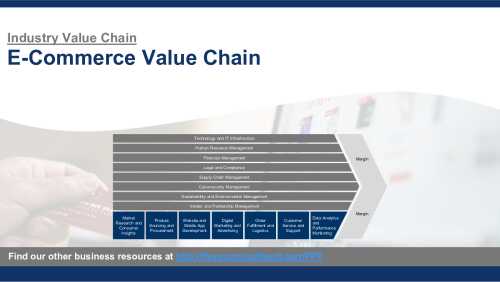
An Industry Value Chain is a visual representation of the series of steps an organization in a specific industry takes to deliver a product or service to the market. It captures the main business functions and processes that are involved in delivering the end product or service, illustrating how [read more]
Do You Want to Implement Business Best Practices?
You can download in-depth presentations on Ecommerce and 100s of management topics from the FlevyPro Library. FlevyPro is trusted and utilized by 1000s of management consultants and corporate executives.
For even more best practices available on Flevy, have a look at our top 100 lists:
These best practices are of the same as those leveraged by top-tier management consulting firms, like McKinsey, BCG, Bain, and Accenture. Improve the growth and efficiency of your organization by utilizing these best practice frameworks, templates, and tools. Most were developed by seasoned executives and consultants with over 20+ years of experience.
Readers of This Article Are Interested in These Resources
Growth Hacking is neither "scoring some quick wins to kick-start growth" nor "breaking into something one should not." Growth Hacking actually involves a consistent, scientific process to work towards business growth.
Growth Hacking is valuable for large enterprises, but more so for small [read more]
This e-commerce business plan is a detailed roadmap that will guide you in starting a successful e-commerce business. It has pre-written content, including important sections like market research, product offerings, marketing strategies, and financial projections.
You can use this sample plan as [read more]
Financial technology (better known as fintech) is used to describe new technology that seeks to improve and automate the delivery and use of financial services. At its core, fintech is utilized to help companies, business owners, and consumers better manage their financial [read more]
An e-commerce platform for physical products is a digital solution that enables businesses to sell tangible goods online. It provides tools for listing products, managing inventory, processing payments, handling shipping, and tracking orders. Customers can browse, purchase, and review items through [read more]
 Internet shopping and online shopping have, in recent years, become more and more popular. This means that it is now easier than ever for anyone to turn their idea for an e-Commerce business into income. However, starting an e-Commerce business is not as simple as choosing a product and creating a website. A new online business will need strong financial management in order to survive and grow. Many new business owners put a great deal of time into setting up their online store, into their branding and into their marketing. However, this can lead to financial decisions being made that are not in the best interests of the business, such as allowing cash to be paid late or allowing the business to spend too much money on unnecessary items.