Editor's Note: Take a look at our featured best practice, Growth Strategy (41-slide PowerPoint presentation). The reality is: all businesses face the challenge of achieving sustainable Growth. They need viable Growth Strategies.
So, what is Growth Strategy?
It is the organization's high-level Corporate Strategy Plan that outlines everything the organization needs to do to achieve its goals for [read more]
* * * *
 There are many reasons why it may be time for your company to grow. Maybe you’ve outgrown the space you’re in, or maybe there’s just too much work coming in, and current staff can’t handle all of it. Either way, growing a company can seem like a daunting task to take on as an executive – but there are options. This article outlines all the things to consider if you work for a mid-size company preparing to expand.
Have you got the capital?
When you’re gearing up for growth, an important thing to consider is your company’s capital. There are different types of financing available to mid-size companies – the main three being private equity, debt financing, and initial public offering (IPO). When deciding which one will work best for your business, it’s important to ask yourself what your goals are and what you hope to achieve by raising capital.
Are you on top of your maintenance costs?
This one seems obvious, but there’s no doubt that as you expand, your maintenance costs will go up. This goes for everyday expenses like power and water as well. It’s important to consider if your business can afford the expenses that come with a larger property and how much money you have set aside for those costs.
The sensible thing to do is to use a company like Business Water Quotes to help you get the best business rate for water. This will help keep costs down while you grow.
Are you building to scale?
One of the main keys to successful growth in a mid-size company is planning. You’ll need to decide whether you want to increase your current staff and, if so, in what areas? Do you want to expand into new markets or recruit more salespeople? Having these questions answered before growth happens will help when it comes time for hiring and expansion. It’s important to note that you don’t need to do everything at once – growth is something that happens over time.
Are you standardizing your practices?
As the business grows, it’s important to make sure your procedures are standardized. This means you need to think about things like quality control and whether you want to use uniform suppliers. Make sure all employees understand what standardizations you implement as part of growth. Having an efficient process management system will be beneficial for scaling up your company.
Are you on top of market trends?
One of the last things to consider when you are preparing for growth is staying up to date with market trends. It is important for your company to be familiar with industry developments because it will help keep your business moving forward. This can lead to employees staying on board, which is another benefit of growth.
Conclusion
There are many reasons why it may be time for your company to grow, and the things to consider aren’t always easy. However, if you’re able to answer all of these questions by the time you make your decision to expand, you’ll have a better chance of success.
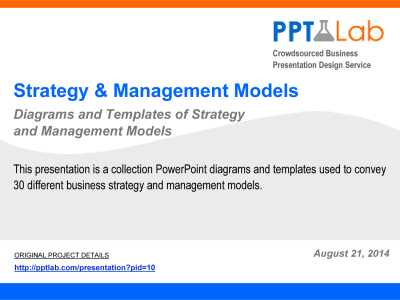
112-slide PowerPoint presentation
This presentation is a collection PowerPoint diagrams and templates used to convey 30 different business strategy and management models. Please note that are diagrams and charts that are to be used in your own business presentations. These are not instructional slides.
Models/frameworks
[read more]
Do You Want to Implement Business Best Practices?
You can download in-depth presentations on Corporate Strategy and 100s of management topics from the FlevyPro Library. FlevyPro is trusted and utilized by 1000s of management consultants and corporate executives.
For even more best practices available on Flevy, have a look at our top 100 lists:
These best practices are of the same as those leveraged by top-tier management consulting firms, like McKinsey, BCG, Bain, and Accenture. Improve the growth and efficiency of your organization by utilizing these best practice frameworks, templates, and tools. Most were developed by seasoned executives and consultants with over 20+ years of experience.
Readers of This Article Are Interested in These Resources
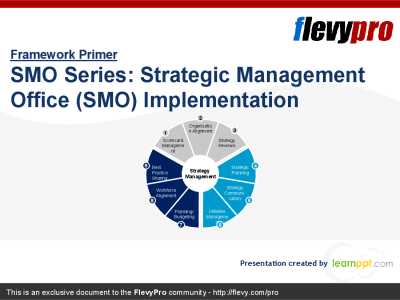
24-slide PowerPoint presentation
The Strategy Management Office (SMO), also referred sometimes as the Office of Strategy Management (OSM), is the team responsible for managing the Corporate Strategy of the organization.
The ultimate role to execute Strategy lies with the line managers and employees, but without a core command
[read more]
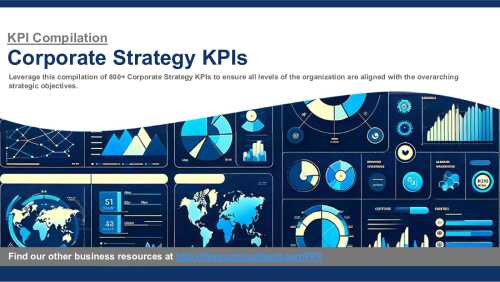
186-slide PowerPoint presentation
This presentation is a comprehensive collection of Key Performance Indicators (KPI) related to Corporate Strategy. A KPI is a quantifiable measure used to evaluate the success of an organization, employee, or process in meeting objectives for performance.
KPIs are typically implemented at
[read more]
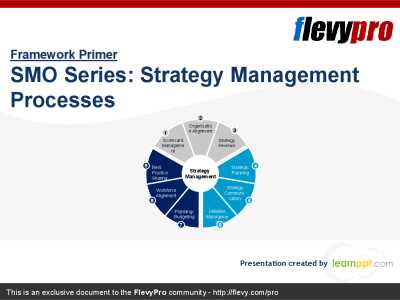
24-slide PowerPoint presentation
The Strategy Management Office (SMO), also referred sometimes as the Office of Strategy Management (OSM), is the team responsible for managing the Corporate Strategy of the organization.
The ultimate role to execute Strategy lies with the line managers and employees, but without a core command
[read more]
26-slide PowerPoint presentation
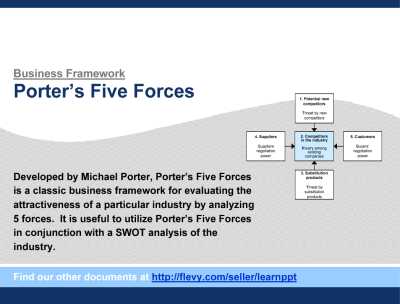
Developed by Michael Porter, Porter's Five Forces is a classic business framework for evaluating the attractiveness of a particular industry by analyzing 5 forces. It is useful to utilize Porter's Five Forces in conjunction with a SWOT analysis of the industry.
This presentation provides a
[read more]