Editor's Note: Take a look at our featured best practice, Mastering High Tariff Markets (A Complete Guide) (326-slide PowerPoint presentation). Curated by McKinsey-trained Executives
Unlock the Secrets to Mastering Tariff Management: The Ultimate 300-Page Guide
Are you struggling to navigate the complexities of global tariffs and trade policies? Whether you're a business leader, policymaker, or analyst, understanding how to [read more]
* * * *
For most industrial businesses, pricing used to be a periodic exercise. Costs moved gradually and annual increases followed inflation. Tariff volatility has broken that rhythm. Duties now appear, escalate, pause, and reverse with little warning, and each shift lands directly on the cost of components and materials.
When a tariff takes effect, no universal formula tells leaders how to respond. Pass on too much, and customers dual-source or shift volume to a rival. Absorb too much, and the duty sits permanently in the profit and loss statement. Move too early, and customers feel misled if the tariff is delayed or canceled. Move too late, and the organization may be forced into a sharper, more disruptive increase down the road.
Many organizations default to whatever they did during the last cost shock or let sales teams improvise. Neither approach holds up under sustained trade uncertainty. Tariffs set the cost, but the enterprise sets the price, and the way it structures that response determines whether tariff pressure erodes the business or repositions it.
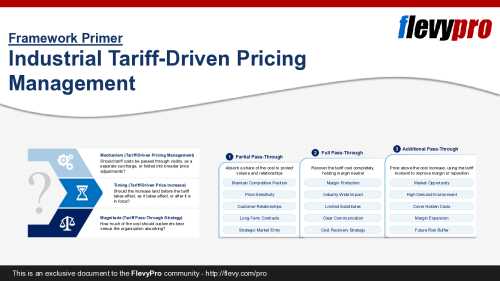
The Industrial Tariff-Driven Pricing Management framework offers a structured way to make that response deliberate. Rather than treating a tariff as a single pricing event, the framework breaks the decision into 3 distinct questions. The right Pricing Strategy ultimately depends on the competitive environment, customer perceptions of fairness, and the strategic position the business intends to hold over time.
The framework organizes the tariff pricing debate into 3 core decisions:
Mechanism (Tariff-Driven Pricing Management)
Timing (Tariff-Driven Price Increase)
Magnitude (Tariff Pass-Through Strategy)
Mechanism determines how the cost reaches the customer, whether as a visible surcharge or folded into a broader price change. Timing determines when the increase lands relative to the tariff start date. Magnitude determines how much of the cost customers bear, ranging from partial recovery to pricing above the duty itself. Let’s examine the first 2 decisions more closely, for now.
Mechanism
The first decision concerns how tariff costs appear on the invoice. Organizations can adopt 2 broad Pricing Management mechanisms:
Applying a Surcharge: This mechanism explicitly identifies tariff-related costs as a separate line item. The approach keeps price adjustments transparent, showing customers that the increase is tied to an external policy change rather than an arbitrary internal decision. It also offers flexibility, since the surcharge can be modified or removed as tariffs shift. That makes it particularly useful for short-term or uncertain trade measures. The trade-off is administrative effort. Surcharges require separate tracking, distinct billing, and clear contractual terms to avoid disputes. A visible line item also invites negotiation, and pricing can look less attractive if rivals drop their surcharges sooner. Frequent changes to the surcharge can create uncertainty and erode trust.
General Price Increase: Folding the cost into a General Price Increase embeds the adjustment in the base price, signaling a long-term shift in cost levels. This route streamlines invoicing and accounting, gives customers consistent pricing, and avoids the credibility damage of reversing a surcharge later. The drawbacks mirror the surcharge’s strengths. Customers may struggle to see the link between tariffs and the increase, may assume the higher price is permanent even if the tariff is lifted, and may question the fairness of a general increase if they later learn what drove it.
Timing
The second decision is when to raise prices. Timing shapes customer perception and financial resilience as much as the size of the increase. Organizations generally weigh 3 approaches.
Increasing prices before the tariff hits recovers costs early and prepares customers for the change. The risk is that if the tariff is delayed or canceled, customers resist or feel misled.
Aligning the increase with the tariff start date keeps the Business Transformation transparent and tied directly to the external trigger. However, it creates operational pressure if customers were not informed well in advance.
Increasing prices after the tariff takes effect preserves short-term goodwill and avoids appearing opportunistic. The cost is margin erosion in the interim, and potentially a sharper, more disruptive increase later.
The timing decision should rest on objective criteria rather than instinct. Leaders should gauge Customer Expectations, assessing whether customers are prepared for an adjustment or need phased communication. They should monitor competitive behavior to see whether rivals are moving early, aligning with tariff dates, or holding off. Contractual obligations matter too, since long-term agreements may restrict immediate changes. Finally, Positioning requires a clear choice about whether protecting relationships or safeguarding margins takes priority. In practice, many organizations use a phased increase supported by proactive, transparent communication to gain acceptance and minimize resistance.
Case Study
Consider a mid-sized pump and valve manufacturer facing a new tariff on imported steel castings. Its first instinct was a single list-price increase across the portfolio. Instead, the commercial team ran the decision through the framework.
On mechanism, the team found that most competitors in its core distributor channel were applying tariff surcharges, and customers in that channel expected to see the cost itemized. Trade analysts also expected the tariff to be revisited within a year. All 3 criteria pointed toward a surcharge, so the company introduced one with clear terms for review and removal. In its aftermarket parts business, however, rivals had embedded costs in base prices, so the company folded the increase into its next general price update there.
On timing, contractual obligations with several large OEM accounts prevented an immediate change. The company aligned the surcharge with the tariff start date for distributors, communicated it 60 days in advance, and phased the increase for contract customers at their renewal dates. The response matched each segment’s norms, preserved key relationships, and avoided the margin leakage of waiting.
FAQs
Should a tariff surcharge always be temporary?
It should be tied to the tariff it represents. If the tariff ends and the surcharge remains, customers will see it as a hidden price increase, undermining the transparency that justified it.
What if industry norms and customer preferences conflict?
Weigh them by segment. A distributor channel may follow surcharge norms while strategic accounts prefer stable base pricing, and the mechanism can differ accordingly.
Is raising prices before a tariff takes effect ever wise?
It can be, when the tariff is highly likely to proceed and customers value early warning. The risk rises sharply if the tariff is delayed or canceled.
How do long-term contracts affect timing?
They often fix prices until renewal, so organizations typically phase increases at renewal points or negotiate tariff adjustment clauses for future agreements.
Can mechanism and timing be decided independently?
Not entirely. A surcharge pairs naturally with alignment to the tariff start date, while a general increase often fits a planned pricing cycle.
Concluding Thoughts
Tariffs are an external shock, but the pricing response is a strategic choice. The first 2 decisions establish the foundation. Mechanism determines whether the cost is visible and adjustable or stable and embedded, and timing determines whether the organization leads, aligns with, or follows the tariff itself.
With those choices settled, leaders can turn to the question of magnitude: whether to absorb part of the duty, recover it in full, or use the moment to reset the price architecture. Organizations that handle all 3 deliberately, segment by segment, turn tariff volatility from a margin threat into a pricing advantage.
You can download in-depth presentations on this and hundreds of similar business frameworks from the FlevyPro Library. FlevyPro is trusted and utilized by 1000s of management consultants and corporate executives.
For even more best practices available on Flevy, have a look at our top 100 lists:
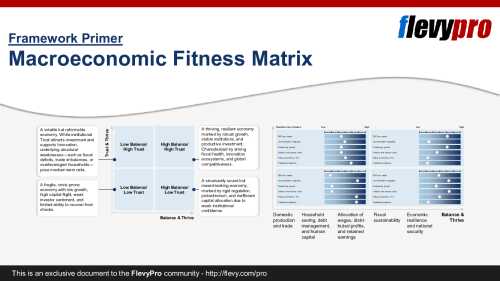
Geopolitical tensions, protectionist policies, and trade fragmentation are reshaping the global economy. Tariffs and retaliatory tariffs have not only disrupted supply chains but also eroded public trust in governments, institutions, and the multilateral trading system.
In a post-globalization [read more]
Readers of This Article Are Interested in These Resources
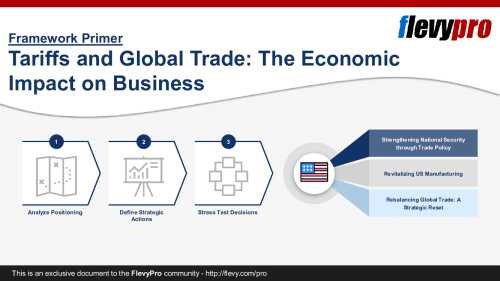
The recent wave of tariff measures and retaliatory trade actions is reshaping the global economic landscape.
These shifts have introduced deep uncertainty across multiple dimensions--cost structures, consumer demand, cross-border trade, and supply continuity. Government responses have diverged [read more]
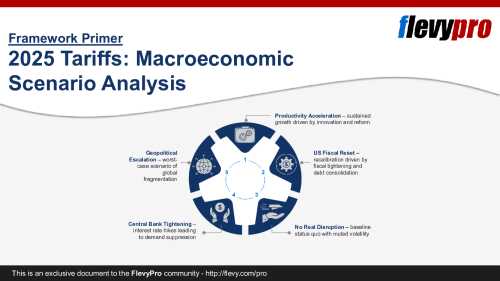
The global economy is entering a period of persistent instability.
In 2025, tariff wars, monetary tightening, and geopolitical tensions are converging to reshape the macroeconomic environment--posing serious challenges for executives trying to chart a long-term course.
Leaders cannot control [read more]
Global tariff uncertainty has made pricing a central dilemma for industrial businesses. Cost increases arrive with no universal formula, and leaders must adjust prices without losing customers or ceding ground to rivals.
Three questions dominate the debate: whether to pass costs through visibly [read more]
Developed by ex-Bain, Deloitte, and BCG partners and validated in thousands of Fortune 500 engagements, this is the only blueprint that combines tariff impact modeling, global trade strategy frameworks, and ROI-driven competitiveness playbooks into one integrated executive toolkit. Built on [read more]
 For most industrial businesses, pricing used to be a periodic exercise. Costs moved gradually and annual increases followed inflation. Tariff volatility has broken that rhythm. Duties now appear, escalate, pause, and reverse with little warning, and each shift lands directly on the cost of components and materials.