Editor's Note: Take a look at our featured best practice, Supply Chain Resilience (23-slide PowerPoint presentation). Supply Chain "resilience" is the Supply Chain's ability to respond and recover quickly to potential disruptions. It can return to its original situation or grow by moving to a new, more desirable state in order to increase customer service, market share, and financial performance.
Resilience is [read more]
* * * *
For decades, Supply Chain Management meant efficiency. Lean inventories, Just-in-Time (JIT) delivery, and concentrated offshore production squeezed cost out of every link, and low cost was treated as synonymous with competitiveness. Then 5 years of cascading disruption, a global pandemic, the Russia–Ukraine war, climate shocks, and volatile trade policy, shattered the underneath assumption that a lean, efficient Supply Chain is automatically a resilient one.
The impact of that assumption is now quantifiable. A single prolonged shock to production can wipe out 30 to 50% of one year’s EBITDA, and over a decade the cumulative toll of disruptions can erase half a year’s earnings or more. Factory shutdowns, port congestion, sudden input shortages, and rising raw material costs have rippled across every sector, and the ad hoc fixes that once restored predictability no longer do. Disruption has become a permanent fixture on the CEO agenda, and losses of this magnitude demand structural redesign, not seasonal adjustment.
The 3 Stages of Supply Chain Resilience framework maps the path out. It describes stages of maturity that carry organizations from reactive disruption management to durable, structural resilience:
Firefighting
Integrating & Streamlining Operations
Achieving Structural Resilience
The stages are cumulative rather than sequential: firefighting never fully disappears, but as organizations advance, Leadership attention shifts toward the costlier, more demanding investments that produce lasting strength. Let’s examine the first 2 stages more closely, for now.
Stage 1: Firefighting
Every disrupted Supply Chain starts here, and there is no shame in it. Firefighting is the set of short-term responses aimed at restoring predictability the moment a disruption hits: expediting delivery services to meet demand, making emergency spot purchases of scarce components to keep production running, and reallocating available inventory and capacity to the highest-priority customers and products.
These tactics have real value. They keep revenue flowing when the alternative is stopped lines and empty shelves, and they often surface gaps in the Supply Chain that no one had previously noticed. The limits, however, are just as real. None of these measures is fundamentally new, none of them builds resilience, and the suppliers absorbing expedite requests and emergency orders are themselves overstretched, which means their willingness to keep accommodating heroics has a shelf life.
Stage 2: Integrating & Streamlining Operations
The second stage is where the posture changes, shifting the organization from reacting to disruptions toward anticipating and absorbing them. Three steps carry the transition.
Create a nerve center. The nerve center is a standing, cross-functional team that consolidates the organization’s proactive responses, managing everything from distressed suppliers to financial stress-testing under multiple scenarios. A dedicated team with clear disruption-response ownership, decision authority, and accountability helps maintain a fixed operating cadence that keeps efforts connected. Decision-making tools such as situation reports covering active scenarios and the actions taken against them and establishing an early-warning system that monitors shocks and sanctions, track how suppliers and customers are responding and prepare the organization for cyber threats. The payoff is a single source of truth and a repeatable operating rhythm.
Simulate and plan for supply-and-demand disruptions. The next step is pressure testing the organization’s network. Leadership diversifies logistics, ordering components early and securing capacity on alternative routes ahead of need. It plans for higher input and transport costs and budgets accordingly. It reviews essential inventories, runs simulations of regional demand shifts to avoid overproduction, analyzes vulnerabilities across the full value chain, and puts safeguards in place, such as backup suppliers and flexible contracts.
Reevaluate inventory strategies. Relying solely on JIT inventory with no backup stock proved dangerous in the pandemic and the risks compound. The remedy is visibility and buffers: planning for shortages hidden deep in the Supply Chain, mapping not just direct suppliers but their suppliers using spending data and network analysis, and ranking suppliers by importance and vulnerability so protection flows to the relationships that matter most.
Case Study
After severe COVID-19 disruptions and raw material shortages, a global telecom manufacturer chose to build end-to-end resilience rather than simply hold more inventory. It rewrote supplier contracts to maximize agility and transparency, expanded its supplier base while reducing concentration in any single source, and adopted a dual-source, dual-design strategy, engineering 2 designs for the same product as the highest protection against input shortages. The added R&D expenditure was offset by lower inventory-holding costs, and a risk-based sales model was piloted to test feasibility. Designing resilience in upfront let the company expand its supplier base while lifting both sales volume and gross margin, proof that resilience and commercial performance are complements, not trade-offs.
FAQs
Is firefighting a failure of Supply Chain Management?
No, it is a necessary capability and the natural first response to any shock. The failure is remaining there: firefighting treats symptoms, and organizations that rely on it indefinitely carry the same fragility into every subsequent disruption.
What makes a nerve center different from a normal crisis team?
Permanence and scope. A crisis team assembles after an event and disbands; a nerve center is a standing, cross-functional body with decision authority, a fixed cadence, and an early-warning mandate, working proactively rather than post hoc.
Does moving beyond Just-in-Time mean abandoning lean principles?
It means qualifying them. JIT remains efficient in stable conditions; the reset adds selective buffers, multi-tier visibility, and backup sources where vulnerability analysis shows the exposure justifies the carrying cost.
Why do organizations need to map their suppliers’ suppliers?
Because the most damaging shortages hide in tiers beyond direct visibility. A first-tier supplier may look healthy while depending on a single fragile source two tiers down, and spending data and network mapping expose those hidden concentrations.
How should leaders justify resilience investments that may sit unused?
As insurance priced against quantified exposure. With a single shock able to erase 30 to 50% of a year’s EBITDA, safety stocks, dual sources, and simulation capabilities are cheap relative to the earnings they protect.
Concluding Thoughts
The first 2 stages of Supply Chain Resilience trace a deliberate handoff: firefighting buys the time, and integration spends that time building the coordination, foresight, and inventory discipline that make the next shock survivable rather than existential. The third stage, structural resilience, goes further still, redesigning the Supply Chain itself through digital twins, what-if scenario testing, deeper supplier data sharing, and ringfenced resilience teams, and it deserves its own detailed treatment.
What the progression makes clear is that resilience is not a project with an end date. It is a maturity that compounds, stage by stage, into a Supply Chain that protects earnings while competitors absorb losses. Disruptions now recur too often and too violently to ignore, and the organizations that engineer resilience into their Supply Chains will be the ones left standing when the next shock arrives.
You can download in-depth presentations on this and hundreds of similar business frameworks from the FlevyPro Library. FlevyPro is trusted and utilized by 1000s of management consultants and corporate executives.
For even more best practices available on Flevy, have a look at our top 100 lists:
This presentation is a comprehensive collection of Key Performance Indicators (KPI) related to Supply Chain Management (SCM). A KPI is a quantifiable measure used to evaluate the success of an organization, employee, or process in meeting objectives for performance.
KPIs are typically [read more]
Readers of This Article Are Interested in These Resources
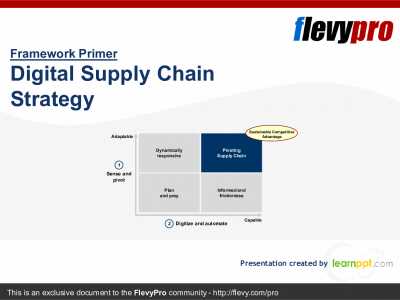
In today's Digital Age, organizations are faced with the changing nature of the demand curve and the element of uncertainty in the Supply Chain. For Operations Teams, the challenge and Competitive Advantage has become: How well we respond and execute against ongoing uncertainty.
With the world [read more]
This presentation has 32 slides in all and covers the following topics:
Why PFEP - Benefits
Develop an Implementation Plan
Create a future state VSM
Plan For Every Part - Implementation
Step 1: Create PFEP Database - Current State (Part, Container, Shipping, Supplier, Consumption, Part [read more]
Objective of the Presentation:
To understand and explore opportunities in supply chain optimization solutions in manufacturing by analysing overall demand trends, identifying potential end-user use cases, company profiling, and benchmarking major players in the market
Sections included: [read more]
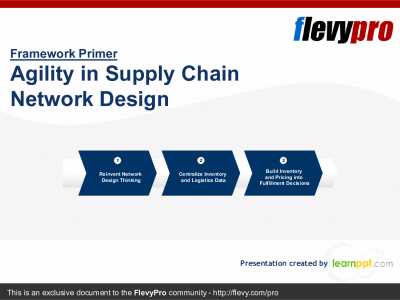
Online retailing has changed. Before, e-commerce companies fulfilled consumer demand from a small number of large-scale warehouses that carried similar catalog of items. Inventory for low-volume products were maintained in a few locations as possible while maintaining service levels that met [read more]
 For decades,