Editor's Note: Take a look at our featured best practice, Designing Operational Risk Management (ORM) Framework (48-slide PowerPoint presentation). Operational Risk is the risk of loss resulting from inadequate or failed internal processes, people, and systems or from external events. Operational Risk Management (ORM) is the management function of identifying, analyzing, and responding to these operational risks. ORM involves the [read more]
* * * *
Operational risk in asset-intensive industries is rarely a single technical problem. It develops when equipment condition, work quality, safety exposure, and compliance evidence are not managed from the same practical view. For leadership, the challenge is to see risk early enough to act before it affects people, production, or regulatory standing.
Modern asset maintenance management software can help teams keep repair history, inspection records, planned work, and asset condition organized around the equipment itself. This gives maintenance leaders a clearer basis for deciding which issues need attention before they grow into larger operational problems. EHS regulatory compliance software supports the safety and compliance side of the same risk picture. It helps teams manage audits, corrective actions, incident records, and evidence needed for internal review or external inspection.
The greater opportunity is not just the software itself, but the shared discipline it can create among maintenance, safety, and compliance teams.
Why Operational Risk Needs a Shared View
Asset-intensive organizations rely on equipment, facilities, and infrastructure that carry more than technical value. The condition of an asset can affect uptime, worker safety, environmental exposure, and the quality of the records used during review. When those connections are not visible, teams can make reasonable decisions from incomplete information.
Risk becomes harder to control when maintenance history, safety observations, and compliance evidence are kept apart. A repair can look routine in one system while raising a safety concern in another. An inspection can appear complete while the supporting work remains unclear. These gaps make it harder for leaders to see the full consequence of a delay, defect, or unresolved finding.
A shared view brings the discussion back to the asset and the risk attached to it. Teams can review condition, recent work, open concerns, and supporting evidence from a more reliable record. That reduces guesswork and helps leadership make decisions with better timing, clearer ownership, and less dependence on memory.
Maintenance Quality Shapes Safety Performance
Reliable maintenance has a direct effect on safety. When equipment is predictable, workers can follow planned procedures with more confidence. When equipment fails unexpectedly, people are more likely to work under time pressure and with less room for careful preparation.
Planned maintenance gives the organization more control over the work environment. The team can schedule access, prepare parts, confirm isolation steps, and review the job before it begins. That kind of preparation is harder during an urgent repair, especially when production pressure is rising.
Safety teams gain value from maintenance records that explain the condition of the asset clearly. Maintenance teams gain value from safety observations that reveal how equipment behavior affects the people using it. When both teams use the same evidence, the organization can prevent more risk instead of reacting after conditions deteriorate.
Compliance Depends on Work That Can Be Proven
Compliance is not only about doing the right work. The organization also needs to prove that the work was done, that it was done on time, and that the result was reviewed properly. Weak records can create problems even when the original task was completed.
This is where field discipline and documentation meet. A technician’s notes should explain what was found and how the issue was corrected. An inspection record should be clear enough for another qualified person to understand the decision later. A corrective action should show the change that reduced risk, not only the date it was closed.
Strong records help during audits, but their value is broader than audit readiness. They allow teams to study recurring issues without relying on memory. They also help leadership see where risk controls are working and where the process needs more attention.
Risk Prioritization Should Follow Consequence
Every organization has more maintenance work than available time. Treating every task with the same urgency can waste resources and leave higher-risk work waiting too long. A better approach links priority to consequence.
Consequence depends on what could happen if the asset fails or the control breaks down. Equipment tied to worker protection, environmental control, customer delivery, or regulatory obligations deserves a different level of attention from equipment with limited operational effect. That distinction gives leaders a stronger way to allocate people and budget.
This does not mean lower-risk work can be ignored. It means the organization needs a method for deciding what should move first. When maintenance data is connected to safety and compliance context, priorities become easier to defend and easier to explain.
Corrective Action Needs More Than Closure
A corrective action process can look healthy on paper while still leaving risk in place. The task may be closed, but the underlying cause may remain. This happens when teams are measured by completion rather than by the quality of the fix.
A useful corrective action should change the condition that created the risk. That may require an engineering review, a process adjustment, a better inspection method, or a change in how work is scheduled. The right response depends on the asset and the consequence attached to the finding.
Ownership is also important. Each action needs one accountable person who has the authority to move the work forward. Delays are easier to manage when the reason is visible and the next step is clear. Without that clarity, risk can remain open even after everyone agrees that it should be fixed.
Governance Keeps the System Honest
Digital workflows only help when the organization uses them with discipline. Data quality, role ownership, review frequency, and escalation rules need to be clear. Otherwise, maintenance, safety, and compliance systems can become separate places where information is stored without changing decisions.
Governance should support the people doing the work.
The best programs respect human judgment while improving the evidence behind it. Experienced workers still know when equipment sounds wrong, when a process feels unsafe, and when a repair deserves closer review. A stronger system captures that knowledge, connects it to the asset record, and gives leadership a clearer path to act.
Operational risk management improves when teams stop treating maintenance, safety, and compliance as separate conversations. The work is connected in the field, so the management process should reflect that connection. With better visibility, clearer ownership, and stronger records, asset-intensive organizations can protect people, assets, and performance with far less uncertainty.
This Excel workbook captures the identification and assessment of Operational Risks within the context of projects. It allows you to document preventative/corrective actions and has a risk questionnaire.
Do You Want to Implement Business Best Practices?
You can download in-depth presentations on Operational Risk and 100s of management topics from the FlevyPro Library. FlevyPro is trusted and utilized by 1000s of management consultants and corporate executives.
For even more best practices available on Flevy, have a look at our top 100 lists:
These best practices are of the same as those leveraged by top-tier management consulting firms, like McKinsey, BCG, Bain, and Accenture. Improve the growth and efficiency of your organization by utilizing these best practice frameworks, templates, and tools. Most were developed by seasoned executives and consultants with over 20+ years of experience.
Readers of This Article Are Interested in These Resources
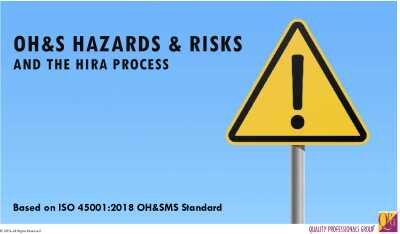
A Course in Occupational Health & Safety (OH&S) Hazards & Risks including the Hazard Identification & Risk Assessment (HIRA) Process
(Based on the expectations & requirements of ISO 45001:2018, an International Standard on OH&S Management System)
The knowledge on identification of [read more]
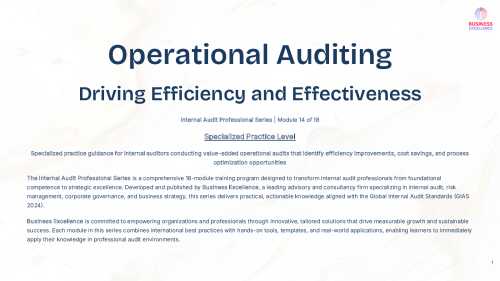
The Internal Audit Professional Series is a comprehensive 18-module training program designed to transform internal audit professionals from foundational competence to strategic excellence. Developed and published by Business Excellence, a leading advisory and consultancy firm specializing in [read more]
Curated by McKinsey-trained Executives
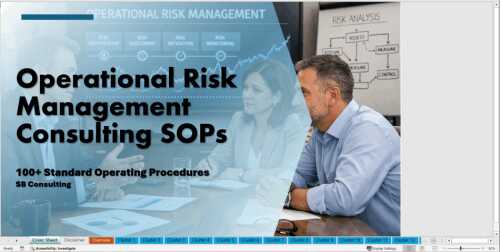
🚨 100+ OPERATIONAL RISK MANAGEMENT CONSULTING SOPs 🚨
THE COMPLETE ENTERPRISE ORM OPERATING SYSTEM BUILT TO ELIMINATE RISK BLIND SPOTS, PASS AUDITS WITH CONFIDENCE & INSTALL REAL GOVERNANCE ACROSS YOUR ORGANIZATION
💣 WHY MOST "RISK [read more]
ISO 31000 Operational Risk Management Implementation Playbook for Nigerian Telec
64 professional files (6 PDFs + 58 Excel workbooks) | 349+ spreadsheet tabs | 2,730+ rows of structured content | 11 organised folders
Enterprise risk management works when it is embedded in how the [read more]
 Operational risk in asset-intensive industries is rarely a single technical problem. It develops when equipment condition, work quality, safety exposure, and compliance evidence are not managed from the same practical view. For leadership, the challenge is to see risk early enough to act before it affects people, production, or regulatory standing.