 Strategy frameworks are exceptionally good at one thing: defining direction. The Balanced Scorecard connects financial performance to customer, process, and learning objectives. Hoshin Kanri cascades strategic priorities from the executive layer to the operational layer through a structured catchball process. McKinsey’s 7-S Framework diagnoses the organizational conditions required for strategy to take hold.
What most of these frameworks were not designed to do is answer the question that matters most in week six of a quarter: is the work being done this week connected to the strategic priority agreed in the planning session?
That gap – between strategic direction and weekly execution – is where OKRs have found their place in the management toolkit.
The Execution Gap in Strategy Frameworks
The strategy execution literature has documented the same failure mode for decades. Kaplan and Norton’s research on Balanced Scorecard implementation found that the majority of organizations failed not because their strategies were wrong but because execution broke down between the leadership layer and the operational layer. The framework diagnosed the right priorities. The organization failed to sustain the behaviors required to achieve them.
Hoshin Kanri addresses this more directly through its X-matrix and catchball process – but even organizations running rigorous Hoshin programs often find that the connection between annual policy deployment and weekly team behavior is thinner than the methodology implies. The cascade exists on paper. The daily work hasn’t changed.
OKRs don’t replace these frameworks. They operate at a different level of the strategy stack – specifically at the level where quarterly priorities need to translate into observable, measurable weekly behavior. That translation is precisely what most strategy frameworks leave to assumption.
What OKRs Add to an Existing Strategy System
For organizations already running a Balanced Scorecard, Hoshin Kanri, or similar framework, OKRs function as the execution cadence layer – the mechanism that connects the strategic themes and objectives defined at the framework level to the specific, time-bound commitments teams make for the current quarter.
The relationship is complementary rather than competitive. The Balanced Scorecard defines the strategic perspectives and long-term performance targets. OKRs define what specific outcomes the organization is committing to this quarter in service of those targets, with clear ownership, a weekly review cadence, and an explicit scoring mechanism that forces honest assessment rather than optimistic reporting.
For consulting practitioners advising clients on strategy execution, this layered approach resolves a common implementation challenge: the strategic planning process produces excellent documentation but insufficient behavioral change at the team level. Adding a quarterly OKR cycle to an existing strategy framework gives the organization a forcing function – a regular moment where every team must articulate, in specific and measurable terms, how their work this quarter connects to the strategy.
The Data on What Actually Drives Execution
According to research by OKRs Tool, which draws on benchmark data from over 550 organizations actively running OKR programs, three structural variables consistently separate high-performing organizations from those that fail to translate strategy into results.
The first is check-in frequency. Teams reviewing progress weekly complete 43% more objectives than those reviewing monthly or quarterly. This finding has direct implications for how strategy review cadences should be designed – the monthly leadership review that characterizes most Balanced Scorecard implementations is too infrequent to catch execution drift before it compounds.
The second is ownership clarity. 50% of all key results across organizations have no named owner – a structural failure that no amount of strategic clarity can compensate for. The cascade from strategic theme to individual accountability is where most execution systems break down, and where explicit OKR ownership rules provide the most leverage.
The third is mid-cycle adaptation. 93% of organizations modify goals after the cycle starts – not as a sign of weak planning, but as evidence that effective execution requires the ability to respond to new information without abandoning the strategic direction. The 7% of off-track goals that are simply abandoned without revision or escalation represent the most significant execution failure mode in the dataset.
Integrating OKRs With Existing Strategy Frameworks
For consulting practitioners advising on strategy execution, the integration question is less about which framework to use and more about which layer of the strategy stack each framework is best suited to serve.
At the strategic direction layer, frameworks like the Balanced Scorecard, Hoshin Kanri, and McKinsey’s strategic planning methodologies remain the most rigorous tools for defining where the organization is trying to go and what it will take to get there. These frameworks excel at connecting strategic intent to organizational capability, financial performance, and customer outcomes.
At the execution cadence layer, OKRs provide the quarterly operating rhythm that translates strategic priorities into specific commitments, visible progress, and honest end-of-cycle scoring. The OKR cycle – set, track weekly, score, retrospect, reset – is the operational complement to the strategic frameworks that define what the organization is trying to achieve.
The organizations generating the strongest strategy execution results in 2026 are running both layers deliberately: a rigorous strategic planning process that produces clear priorities, and a quarterly OKR cycle that holds the organization accountable to making measurable progress against those priorities every week.
What This Means for Strategy Execution Practitioners
For consultants working on strategy deployment and execution engagements, OKRs represent a practical addition to the implementation toolkit – not a replacement for established frameworks, but a cadence mechanism that addresses the execution gap those frameworks typically leave open.
The implementation considerations worth addressing with clients are straightforward. OKR cycles should be aligned to the strategic planning calendar so quarterly objectives derive directly from the strategic priorities defined in the annual planning process.
Ownership rules should be explicit – every key result requires one named owner before the cycle starts, regardless of how the strategic framework defines accountability at higher levels. And the check-in cadence should be weekly and asynchronous by default, removing the friction that causes review cycles to slip toward monthly in practice.
The frameworks in the Flevy library provide the strategic architecture. The OKR cycle provides the execution engine. Used together, they close the gap between the strategy that gets documented in the planning session and the behavior that actually determines whether it gets delivered.
Do You Want to Implement Business Best Practices?
You can download in-depth presentations on Objectives and Key Results and 100s of management topics from the FlevyPro Library. FlevyPro is trusted and utilized by 1000s of management consultants and corporate executives.
For even more best practices available on Flevy, have a look at our top 100 lists:
These best practices are of the same as those leveraged by top-tier management consulting firms, like McKinsey, BCG, Bain, and Accenture. Improve the growth and efficiency of your organization by utilizing these best practice frameworks, templates, and tools. Most were developed by seasoned executives and consultants with over 20+ years of experience.
Readers of This Article Are Interested in These Resources
Excel workbook
Curated by McKinsey-trained Executives
🚀 POST-MERGER INTEGRATION (PMI) OKRs & BENCHMARKS LIBRARY
The Ultimate Strategic Integration Performance Management System for Accelerating Synergies, Aligning Organizations, Reducing Integration Risk, and Maximizing Deal Value
🚀 ALIGN
[read more]
Excel workbook
Curated by McKinsey-trained Executives
🚀 CHIEF STRATEGY OFFICER (CSO) OKRs LIBRARY
The Ultimate Strategic Leadership System for Driving Enterprise Growth, Strategy Execution, Transformation, Innovation, Competitive Advantage, and Long-Term Value Creation
🚀 ALIGN STRATEGY •
[read more]
140-slide PowerPoint presentation
Introducing the Ultimate Benchmarking and Objectives & Key Results (OKRs) Training Kit: Unlocking Success in Business Performance
Are you ready to take your business performance to new heights? Are you looking for proven strategies to optimize your organization's operations and achieve
[read more]
17-slide PowerPoint presentation
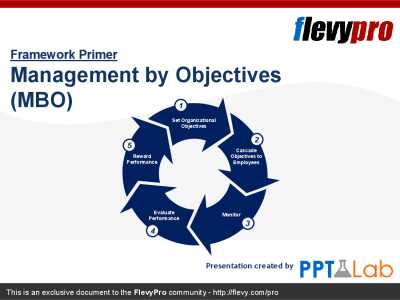
Management by Objectives (MBO), developed by Peter Drucker, relies on the defining of objectives for each employee and then comparing and directing their performance against the objectives which have been set. The goal to increase the performance of the organization by matching organizational goals
[read more]