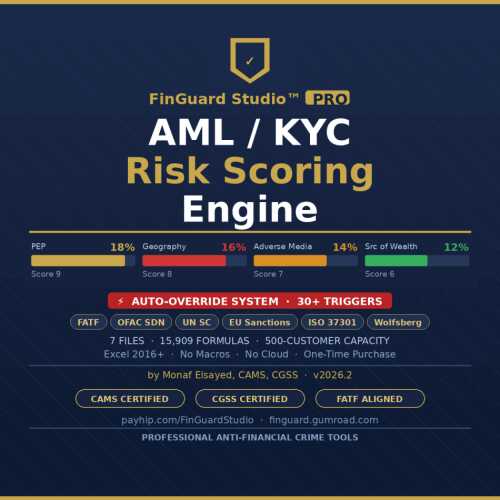
Editor's Note: Take a look at our featured best practice, Anti-Money Laundering AML and Regulatory Compliance Playbook (Excel workbook). AntiMoney Laundering AML and Regulatory Compliance Playbook
Your AML programme faces escalating regulatory expectations, rising transaction volumes, and increasing sophistication of financial crime. Manual processes create delays in suspicious activity detection, and compliance gaps expose the [read more]
* * * *
 St. Louis is a city where families, professionals, and business owners work hard to build financial security and plan for the future. As more financial transactions move online, residents increasingly rely on digital platforms for banking, investing, shopping, and communication. While these tools offer convenience, they have also created new opportunities for scammers who exploit technology to target unsuspecting individuals. The consequences can be immediate and far-reaching, leaving victims facing financial uncertainty, emotional distress, and difficult questions about how to recover what was lost.
In many cases, the speed of a response can significantly influence the options available and the likelihood of preserving critical evidence. Understanding the steps that may help recover funds more quickly is, therefore, an important part of protecting one’s financial interests after an online scam. For victims exploring recovery strategies, lessons drawn from pig butchering recovery efforts often highlight the value of prompt action, thorough documentation, and informed legal guidance.
Act Immediately to Stop Further Loss
Scammers often push for an extra transfer, framing it as a fee, a tax, or a final step to release funds. Resources on pig butchering recovery describe how that pressure can intensify once a person tries to withdraw. Ending contact, blocking numbers, and refusing new links helps stop further leakage while the next calls and reports begin.
Secure Accounts and Devices
Stolen access often spreads from one login to the next through reused passwords or intercepted codes. Start with email, then banking, then messaging, because email resets control of many other accounts. Turn on multi-step sign-in where available and remove unknown devices from account settings. A device scan for remote tools, strange browser add-ons, or unfamiliar apps can prevent follow-on takeovers.
Preserve Evidence before It Disappears
Banks and investigators move faster when proof is complete and time-stamped. Save screenshots of chats, usernames, profile links, receipts, wallet addresses, transaction identifiers, and any demand for extra payments. Download message histories when possible and keep original files, not edited copies. Create a brief timeline with dates, times, and actions to reduce back-and-forth questions.
Call the Bank or Card Issuer Fast
Some transfers can be recalled only within narrow windows, so speed matters. Ask for the fraud team and state that the payment was authorized under deception, then provide the destination details. Request a hold on pending items and ask whether wires, transfers, or card charges need separate dispute steps. Write down the case number, the representative’s name, and the exact guidance given.
Notify Payment Apps and Money Services
Scams often route money through payment apps, gift cards, or money transfer services, each with its own process. Contact support using official help pages, then share a single packet, receipts, confirmation screens, and chat extracts. For gift cards, keep store receipts, card numbers, and activation details. Delay can matter because balances may be spent or resold quickly, leaving less to claw back.
Contact Crypto Exchanges and Wallet Providers
Crypto transfers are traceable, but reversals depend on quick coordination and where assets land. Provide the exchange with transaction identifiers, wallet addresses, and timestamps, along with screenshots showing the request. If a hosted platform holds the receiving wallet, a freeze may be possible under policy or legal demand. When wallet keys were exposed, move the remaining assets to a new wallet and lock down seed storage.
File Reports That Create a Trackable Record
A report trail helps connect a single loss to larger cases and supports disputes. Local police reports can document the event for banks and insurers. In the United States, a complaint to the Internet Crime Complaint Center and a report to the Federal Trade Commission add data used for wider tracking. Reuse the same timeline and evidence set each time to keep details consistent.
Watch for “Recovery” Follow-Up Scams
After a loss, many people are targeted again by strangers claiming they can recover money for a fee. Red flags include upfront payments, pressure to act immediately, and requests for remote access to a phone or computer. Some impersonate investigators, exchanges, or law firms using copied logos and fake email domains. Keeping contact limited to verified institutions, using official numbers, lowers repeat risk.
Protect Identity and Credit
Scammers may collect photos of identification, bank details, or personal data that can fuel later identity fraud. Review credit reports for new accounts, address changes, or hard inquiries. Consider a fraud alert or a credit freeze if sensitive details were shared. Monitor statements for small test charges that signal account probing. If tax or identification numbers were exposed, additional identity safeguards might be needed.
Conclusion
Do You Want to Implement Business Best Practices?
You can download in-depth presentations on Fraud and 100s of management topics from the FlevyPro Library. FlevyPro is trusted and utilized by 1000s of management consultants and corporate executives.
For even more best practices available on Flevy, have a look at our top 100 lists:
These best practices are of the same as those leveraged by top-tier management consulting firms, like McKinsey, BCG, Bain, and Accenture. Improve the growth and efficiency of your organization by utilizing these best practice frameworks, templates, and tools. Most were developed by seasoned executives and consultants with over 20+ years of experience.
Readers of This Article Are Interested in These Resources
54-slide PowerPoint presentation
ISO 37001:2016 is an international standard designed and formulated to help organizations implement a robust Anti-Bribery Management Systems (ABMS).
The standard specifies a series of measures to help organizations prevent, detect and address bribery. It is designed to help your
[read more]
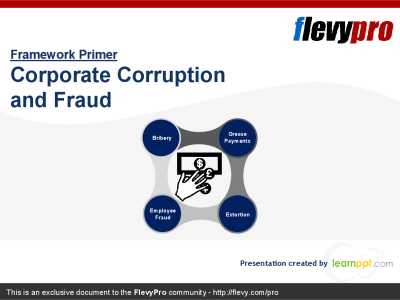
24-slide PowerPoint presentation
Markets today offer rewarding opportunities for organizations in new territories. But these opportunities are not devoid of the perils of encountering new risks concerning corporate corruption and fraud.
To contest the danger of denting their reputation and results, senior leaders must strive
[read more]

Excel workbook
AI for Anti Money Laundering Playbook
Regulatory enforcement actions for AML failures have reached billions in fines. If your transaction monitoring is not tuned, your KYC is not risk-based, and your SAR process is not documented, you are on borrowed time.
The average AML fine exceeds $10
[read more]
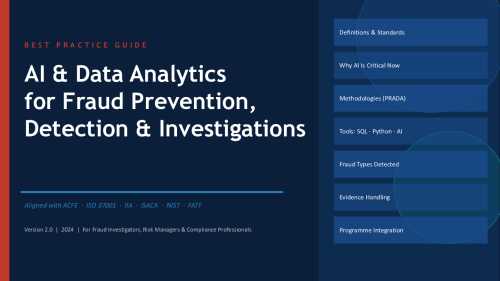
57-slide PowerPoint presentation
In an era where fraudsters wield AI-powered deepfakes, synthetic identities, and automated bots at machine speed, traditional manual investigations are no longer enough. Organizations lose billions annually to asset misappropriation, corruption, financial statement fraud, and sophisticated money
[read more]