 Many business owners have encountered the same situation. You have a company where every detail is well-thought-out. You know where your customers come from, what they want to see, and how to sell your product. But then a competitor three times smaller than you appears on the horizon and generates a huge number of sales. It seems, what could you possibly do wrong?
The key to data-driven businesses isn’t having larger budgets than you. Nor is it having a more unique product. They simply make fewer wrong moves and decisions.
Data-Driven as the Essential Term in Practice
Start to cut through the buzzword layer first. Digital transformation gets thrown around so loosely it’s almost meaningless. Companies buy dashboards, hire analysts, subscribe to tools. Then they keep making decisions based on what the CEO thinks feels right.
Being genuinely data-driven businesses means something more specific. Your decision making process is anchored in verified signals, not assumptions. It means when you choose between two campaign directions, two target segments, you have something to look at beyond opinion.
That doesn’t require a massive analytics infrastructure. It requires discipline and the right inputs.
The data-driven businesses doing this well tend to share a few traits:
- They treat market research as ongoing, not a one-time project.
- They define what “success” looks like before launching anything.
- They build data strategy into planning, not as an afterthought.
- They have a short feedback loop between action and measurement.
None of that is revolutionary. Most of it is obvious. And yet most companies don’t do it consistently.
The Secret Competitive Advantage for You
Here’s what’s underappreciated. The real competitive advantage of data-driven businesses isn’t that they make brilliant decisions. It’s that they eliminate a huge category of bad ones.
Think about how many resources get burned on such things:
- campaigns with the wrong targeting audience,
- products built for demand that doesn’t exist,
- pricing set without understanding what competitors charge in specific markets.
These aren’t dramatic failures. They’re slow bleeds.
Predictive analytics and competitive intelligence solve different parts of this problem. Predictive models help you anticipate what your own customers will do next. Competitive intelligence tells you what the market looks like outside your own walls.
Both matter. And they work better together.
A retailer might know that its best customers are starting to churn and that a competitor has just lowered prices in this segment. This way, the retailer can react more appropriately than if it knew only one of these two factors. This is the real work of market analytics. It’s not stored in a report that no one opens.
Data-driven Businesses: How Market Research Has Changed
Traditional market research meant surveys, focus groups, maybe some industry reports. Useful, but slow and expensive. By the time you had findings, the market had moved.
The shift that’s happened over the last decade is that a huge amount of competitive signal is now publicly available. You may find pricing, positioning, messaging, product changes, reviews, and traffic patterns. The challenge isn’t access. It’s collection and analysis at scale.
This is where the infrastructure matters. Companies do serious competitive intelligence work now:
- pull data from multiple markets,
- monitor how competitor pages change over time,
- track regional pricing variations.
That kind of research requires hitting hundreds or thousands of URLs from different locations. So, teams use tools like residential proxy networks to get clean, geo-accurate data without getting blocked or served cached results.
It’s not glamorous. But it’s the difference between knowing your competitors’ prices in Germany and thinking they’re the same as in the UK.
Where Most Companies Miss Out
Business performance gaps between companies in the same industry are rarely about product quality. More often, they come down to how well each company understands three things:
- What their customers actually want vs. what they think they want. Customer insights from behavioral data almost always contradict assumptions made in regular meetings. The feature everyone internally believed was the main selling point? Turns out users barely touch it. The checkout step nobody flagged? That’s where 30% of orders die.
- Where their operational bottlenecks are. Operational efficiency gains from data analysis are often the fastest wins available. Not because the problems are hidden but because nobody looked with actual numbers attached.
- What the competitive landscape actually looks like right now. Markets move. Competitor positioning shifts. New entrants come in with different pricing logic. If your understanding of the competitive landscape is six months old, you’re flying with outdated maps.
Understanding these three points can give you momentum for growth. But you need to collect and then analyze the data.
Strategic Planning without Expensive Guessing
Strategic planning cycles in most companies usually looks like this:
- annual offsite,
- slide deck,
- five strategic priorities,
- action plans.
Then nine months later, half the priorities quietly disappeared because they weren’t grounded in anything real.
Enterprise analytics changes the quality of those conversations. Not by making them longer or more complicated. If anything, good data makes strategic discussions sharper because you can quickly eliminate options that the numbers rule out.
The companies growing fastest in the current digital economy aren’t necessarily running the most sophisticated models. They’re asking better questions and then actually finding out the answers before committing resources.
Benchmarking is underused here. Most data-driven businesses know their own metrics reasonably well. Fewer know how those metrics compare to direct competitors or industry medians. That context changes everything. A 2.3% conversion rate looks different depending on whether the category average is 1.1% or 4.8%.
Build a Data Strategy That Actually Works
This is where a lot of business growth initiatives fall apart. Companies invest in data infrastructure, set up analytics platforms, and generate reports. Then, the reports sit in inboxes.
A few things that separate working data strategies from shelf-ware:
- Start with decisions, not data. What decisions does your team make regularly where better information would change the outcome? Start there. Don’t start by collecting everything and hoping insights emerge.
- Make the feedback loops short. If it takes three weeks to get an answer to a question, people stop asking questions. The goal is same-day or next-day access to the metrics that matter most.
- Separate monitoring from analysis. Dashboards tell you what happened. Analysis tells you why and what to do about it. Both are necessary; mixing them up creates noise.
- Tie metrics to someone’s actual job. A metric that nobody is accountable for will drift and eventually be ignored. Every key number should have a person whose responsibility it is to understand it and act on it.
A data strategy only creates value if it connects to decisions someone actually makes. That sounds obvious, but the implementation is harder than it sounds.
Missed Growth Opportunities: Notice while Others Ignore Them
Growth opportunities in saturated markets almost always come from information asymmetry. So, you know something your competitors don’t, or you act on something they’re ignoring.
That information advantage doesn’t have to be exotic. Sometimes it’s as basic as:
- Notice a search trend two months before it becomes obvious.
- Identify a geography where demand grows but supply hasn’t caught up.
- See that a competitor’s reviews are trending negative on a specific issue you can address.
None of this requires a data science team. However, it requires building the habit of systematic observation into how the business operates. So, treat market intelligence as a core function, not an occasional project.
The companies that outperform their competitors over time are those that have this approach ingrained into their daily operations. Not in a special analytics team working in isolation, but across product, marketing, sales, and ops. All pulling from the same picture of reality.
Conclusions: Place to Start
If you’re still struggling with this, here’s a concrete starting point. Pick one area where your employees solve problems intuitively. Good examples of such tasks include:
- selecting priority content topics,
- determining which markets to focus on for paid advertising,
- defining the target customer segment for the next quarter.
Then, think about what data will help you solve these problems. Find a way to obtain this data quickly.
The process is as follows: task, data type, collection, and feedback. That’s it. Once the first task is completed, the second will follow, and so on. Ultimately, you’ll have a real data strategy.
Data-driven businesses don’t start by completely disrupting and rebuilding all processes at once. Companies first find a solution to one problem and then scale the result.
Do You Want to Implement Business Best Practices?
You can download in-depth presentations on Data Governance and 100s of management topics from the FlevyPro Library. FlevyPro is trusted and utilized by 1000s of management consultants and corporate executives.
For even more best practices available on Flevy, have a look at our top 100 lists:
These best practices are of the same as those leveraged by top-tier management consulting firms, like McKinsey, BCG, Bain, and Accenture. Improve the growth and efficiency of your organization by utilizing these best practice frameworks, templates, and tools. Most were developed by seasoned executives and consultants with over 20+ years of experience.
Readers of This Article Are Interested in These Resources
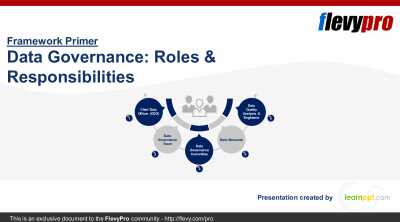
24-slide PowerPoint presentation
Data standardization, precision, and security aren't the sole dominion of folks working within the IT department. These tasks involve participation of a number of stakeholders from across the organization.
Incoherent data creates hurdles in Data Analytics and business operations. Data
[read more]
38-slide PowerPoint presentation
This is a comprehensive document that details how an enterprise wide shared services model for data management could transform IT business synergy, while creating increased ROI. The strategy document details:
1. Common Issues when adequate data architecture & governance processes are not in
[read more]
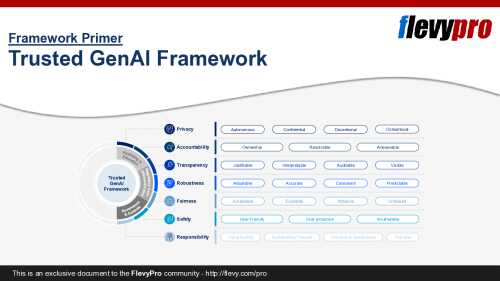
29-slide PowerPoint presentation
Many organizations approach Generative AI adoption in a fragmented manner, deploying tools rapidly without establishing the governance, controls, and operating models required for responsible scale.
Sustainable GenAI adoption requires a structured enterprise approach that aligns technology
[read more]
23-slide PowerPoint presentation
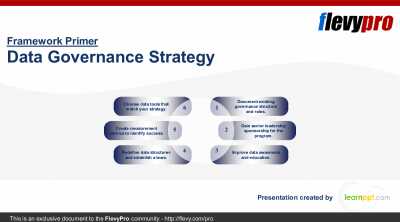
Data Governance is all about overseeing the accessibility, practicality, reliability and safety of enterprise data. Data Governance safeguards data uniformity, dependability, and fair use.
In data-driven organizations, the importance of Data Governance is supreme to generate value. For
[read more]