The postponement strategy is based on the following two basic principles of demand forecasting.
The accuracy of forecast demand decreases with an increase in the time horizon. The farther the time window for which the demand is being forecasted, the more inaccurate it will be. This effect can be shown as a funnel: as time extends farther into the future, the forecast error grows, showing that the forecast demand will have larger and larger variations as time periods progress into the future.
Demand projections for a product group are generally more accurate than projections for individual products. For example, it is much easier to forecast the total demand for LCD TVs than it is for an individual TV of a specific brand, model, screen size, resolution, and color contrast ratio.
The postponement strategy leverages the above characteristics of demand forecasting. It dictates that the firms should postpone the creation or delivery of the final product as long as possible. For retailers, this takes the shape of postponing the delivery of the final product to its destination, while for assemble-to-order manufacturers this means postponing the final assembly of the product. For manufacturing scenarios like build-to-stock, the postponement strategy may drive pushing the packaging or final assembly of the products, allowing the manufacturer to personalize, configure finished products to customer orders, and change the final product mix to suit any changes in demand.
The postponement strategy effectively reduces inventory obsolescence and takes out the risk and uncertainty costs associated with having undesirable products, but it requires an integrated and agile supply chain to ensure that the latest demand forecasts can be frequently created and propagated through the supply chain to produce or allocate the right products for their customers.
While postponement is conventionally thought of as a supply chain strategies, a little thinking will dispel this notion. Postponement is not an absolute choice, it is an imperative forced by the type of industry, assortment, and demand patterns. For example, a postponement strategy for delivering supplies to a trauma center or cereal to a grocery store are just not practical choices, even though it may allow for delivery of specific medical kits optimal for the type of trauma or the correct size of cereal packages in response to the actual demand. Therefore, medical supplies manufacturer cannot select postponement as their supply chain strategy any more than a grocer can postpone delivering their cereal. However, in few situations the production and demand patterns may allow postponement to become a business option, in which case, the supply chain must be designed to support that choice – an example is Avon.
Avon declined to label their bottles themselves for a long time, viewing this as additional cost and complexity. However, after developing an end-to-end supply chain visibility, Avon saw the opportunity in postponing the creation of its final product by placing the labels in the desired target language. It successfully deployed an idea that had been pushed out earlier, after understanding that this allowed them to postpone the production of final finished goods and better align their supplies to the end-demand without tremendously increasing their inventory. The situations in which postponement may be an explicit choice to be made for a supply chain are limited, but may become real options for specific categories of products or sales channels of a company.
Dell has mastered the art of postponement for their custom-designed machines for individual consumers. When Dell started, this was not necessarily the case in the industry, however, Dell invented a new business model and leveraged postponement as a business model – not as a supply chain strategy – though, it then designed their supply chain to support this business model.
This deck was developed to support supply chain visioning and strategic diagnostics. It provides checklists of key questions to ask in formulating a supply chain strategy, core frameworks, tools and techniques that facilitate the strategic thinking process.
See also "Supply Chain Performance and [read more]
Do You Want to Implement Business Best Practices?
You can download in-depth presentations on Supply Chain Management and 100s of management topics from the FlevyPro Library. FlevyPro is trusted and utilized by 1000s of management consultants and corporate executives.
For even more best practices available on Flevy, have a look at our top 100 lists:
These best practices are of the same as those leveraged by top-tier management consulting firms, like McKinsey, BCG, Bain, and Accenture. Improve the growth and efficiency of your organization by utilizing these best practice frameworks, templates, and tools. Most were developed by seasoned executives and consultants with over 20+ years of experience.
Readers of This Article Are Interested in These Resources
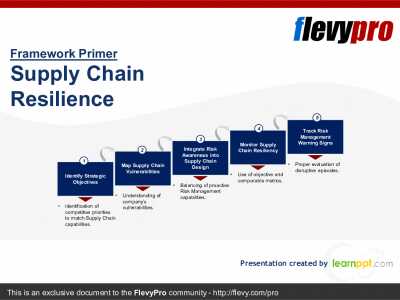
Supply Chain "resilience" is the Supply Chain's ability to respond and recover quickly to potential disruptions. It can return to its original situation or grow by moving to a new, more desirable state in order to increase customer service, market share, and financial performance.
Resilience is [read more]
This document provides a collection of 100+ Key Performance Indicators (KPIs) related to the Supply Chain functions listed further below.
Keeping in mind that each organization is different, the enclosed KPIs are intended as a general reference and their relevance depends on the specific [read more]
The purpose of the 4 Stage Model is to provide a high-level qualitative assessment of an organizations practices and processes. The model aligns with the Supply Chain Council's SCOR model and is broken down into Plan, Source, Make and Deliver. Within each of these major processes are a series of [read more]
Supply Chain Performance & Metrics document gives an overview of key performance metrics used to measure the operating effectiveness of a supply chain. The metrics are categorized for each stage of the supply chain with definition provided at the back of the document.
The objective of this [read more]
 obsolescence and takes out the risk and uncertainty costs associated with having undesirable products, but it requires an integrated and