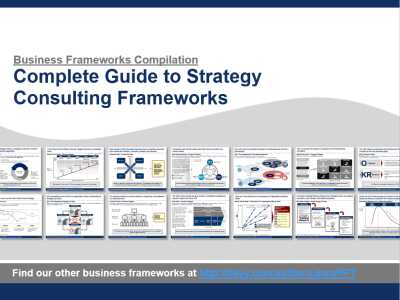
Editor's Note: Take a look at our featured best practice, Complete Business Frameworks Reference Guide (407-slide PowerPoint presentation). This is a very comprehensive document with over 400+ slides--covering 58 common management consulting frameworks and methodologies (listed below in alphabetical order). A detailed summary is provided for each business framework. The frameworks in this deck span across Corporate Strategy, [read more]
* * * *
Today, a quiet transformation is taking place in the conference rooms and home offices of every industry. Strategy documents that once took consultants weeks to produce, filled with market analyses, competitive positioning maps, and execution roadmaps, are being churned out in a fraction of the time. AI is not replacing the strategic thinking that goes into these documents. It’s eliminating the friction that makes it slow. If you’re a consultant, founder, or analyst and haven’t gotten serious about embedding AI into your document workflow, you’re probably leaving both time & quality on the table.
That said, using AI well for this kind of work isn’t just about pasting a prompt into a chatbot and hitting enter. The difference between a mediocre AI-assisted strategy doc and a genuinely impressive one comes down to preparation, structure, and editing. Tools like Smodin.io/writer sit at a useful intersection here – supporting the drafting phase when there is a need to turn rough strategic thinking into coherent, well-structured prose quickly, particularly when working across multiple document sections simultaneously.
Why Structure Has to Come before the Prompt
One of the most common mistakes professionals make when using AI for strategy documents is jumping straight into generation mode without a clear skeleton in place. One cannot just say “write me a competitive strategy document for my SaaS company” and expect something boardroom-ready. The output will be generic, loosely organized, and – critically – misaligned with the frameworks stakeholders actually expect to see.
Before opening any AI tool, the document’s purpose, audience, and scope should be defined.
Is the document a board growth strategy at an early stage?
Corporate development team market entry analysis?
Digital Transformation roadmap for an operations committee?
Each of these requires a fundamentally different structure, depth, and tone.
Leverage Proven Frameworks from Platforms Like Flevy
That’s where platforms such as Flevy come into their own, not just as a convenient resource. Flevy offers thousands of consulting-grade frameworks and templates, including the McKinsey 7-S Model, BCG Experience Curve, Balanced Scorecard templates, Porter’s Five Forces analyses, and more. These are not your typical slideshows. Many are started by ex-McKinsey, BCG, Deloitte, and Accenture consultants and reflect the real structural logic that top-tier strategy work is based on.
The smart workflow is to pull the right framework from Flevy first, understand its components, and then use that structure as the prompt blueprint. If working with a Capabilities-Driven Strategy framework, for example, AI prompts should map directly to its phases, assessing the current capability set, identifying the gap relative to market demands, and building an execution path. When AI knows exactly what each section needs to contain, the output quality improves significantly. The task is not asking it to invent the structure; it is asking it to fill a container that has already been shaped.
How to Prompt AI for Strategy Depth, Not Just Length
This is where most people don’t do as well. The more general the prompt, the more general the content. Specificity is the source of depth. An effective way to rephrase the question of “what is our competitive landscape?” is: “Analyze the competitive dynamics in the mid-market cloud ERP space using Porter’s Five Forces framework, with an emphasis on supplier concentration, switching costs, and the threat from new vertical-specific cloud ERP players in 2025-2026.”
That is such detail in one fell swoop. It provides a reference to a well-known analytical model. It makes the industry context more specific and prevents the AI from making broad industry generalizations. And it indicates the most important variables for the specific strategic question.
Another technique that works well is layered prompting. Draft the executive summary section first, then use that output as context when prompting the market analysis section. Feed each completed section back as background for the next. This creates internal consistency across the document – something that’s easy to lose when prompting each section in isolation.
The Role of Internal Data and Client Context
No AI tool can know a client’s specific market position, internal constraints, or organizational culture, and that’s where human input remains non-negotiable. The highest-quality AI-assisted strategy documents treat AI as a structural and linguistic engine while treating internal data and expert judgment as the fuel.
But it is important to get relevant data. So, that means giving AI the real numbers from the market research, a client’s current revenue performance, or the operational bottlenecks a team has identified. Tools such as Claude, which perform well with large context windows, are especially adept at ingesting 40-50 pages of background material and synthesizing it into structured strategic content. According to research, actively using GenAI nearly doubled over the past year, to 22% in 2025, compared to 12% in 2024. More than 60% also said GenAI should be actively used for work in their industry. That finding is worth sitting with for a moment.
The Editing Step Nobody Takes Seriously Enough
Here’s the hard truth: AI-generated strategy content almost always needs a meaningful editing pass, and not just a quick proofread. The structural logic might be sound, but the strategic voice – the confident, precise, senior-consultant-level tone that makes executives trust a document – rarely comes through on the first AI draft.
When editing AI-assisted strategy documents, three things should be examined specifically.
First, unsubstantiated claims. AI can say things that sound confident about market trends or competitive dynamics that aren’t based on real research. Each data point needs to be flagged and validated.
Second, vague recommendations. A strategy document that says “the company should consider investing in digital capabilities” is useless. It needs to specify what investment, in what area, with what expected outcome, and by what timeline. Every recommendation should be pushed down to that level of specificity.
Third, structural redundancy. AI tends to restate the same point across sections in slightly different language. A tight strategy document ensures each section performs distinct analytical work.
It is also during the editing stage that the client’s voice, terminology, and organizational style are added to the document, giving it a personalized feel and less of a template effect. That’s the human layer that makes a document that goes to the file, a document that influences decisions.
Putting It All Together: A Practical Workflow
The AI-assisted strategy documents follow a process that is similar to the following. It begins by first finding the appropriate framework on Flevy and then outlining the sections of the document. Then there’s the research and collection of the particular data, facts and client context that will support the analysis. The detailed prompts are then created for each section: specific, framework, data-informed, and drafts are created in turn, and each is used as input to the next. Finally, a complete editing pass is done on claims, precision, and voice.
This workflow doesn’t eliminate strategic thinking. It compresses the mechanical work – the first drafts, the structural scaffolding, the section transitions – so that strategic thinking gets more time and space. That is the actual value proposition here. Not faster documents for their own sake, but more time spent on the judgment calls that actually matter to clients.
This document provides a holistic approach for undertaking strategic planning. While covering the traditional strategic planning approach, the document touches on adaptations that may be used in an unpredictable environment.
Contents:
1. Strategic Planning Overview
- Key questions and [read more]
Do You Want to Implement Business Best Practices?
You can download in-depth presentations on Strategy Frameworks and 100s of management topics from the FlevyPro Library. FlevyPro is trusted and utilized by 1000s of management consultants and corporate executives.
For even more best practices available on Flevy, have a look at our top 100 lists:
These best practices are of the same as those leveraged by top-tier management consulting firms, like McKinsey, BCG, Bain, and Accenture. Improve the growth and efficiency of your organization by utilizing these best practice frameworks, templates, and tools. Most were developed by seasoned executives and consultants with over 20+ years of experience.
Readers of This Article Are Interested in These Resources
Frameworks are powerful tools Strategy Consultants leverage to address their clients' business issues in an organized, thorough, and efficient fashion.
In this presentation, we provide primers to 20 consulting frameworks used by Strategy Consulting firms. These frameworks have been categorized [read more]
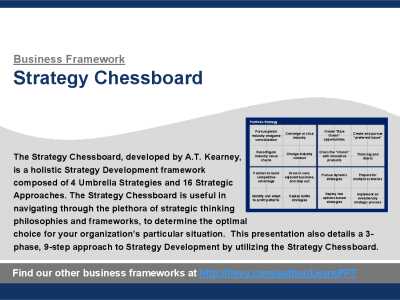
The Strategy Chessboard is a holistic Strategy Development framework developed by A.T. Kearney. It first presents a 2X2 of 4 Umbrella Strategies:
1. Position and Conquer (e.g. Porter's Five Forces, Profit Patterns, Art of War)
2. Redefine the Industry (e.g. Consolidation Curve, Value Chain [read more]
This document provides and overview of over 20 commonly used consulting frameworks. Divided into three sections:
1. Industry Analysis
2. Company Analysis
3. Prioritisation
The objectives of this document are to:
Develop familiarity with common industry / business analysis [read more]
This deck is a collection of best-in-class strategy analytic templates.
The templates have been categorized into the following topics: Supply side, Demand side, Customer, Operation, Supply chain, Strategy, Financial analysis/modeling.
The deck uses analysis templates in the financial services [read more]
 Today, a quiet transformation is taking place in the conference rooms and home offices of every industry. Strategy documents that once took consultants weeks to produce, filled with market analyses, competitive positioning maps, and execution roadmaps, are being churned out in a fraction of the time. AI is not replacing the strategic thinking that goes into these documents. It’s eliminating the friction that makes it slow. If you’re a consultant, founder, or analyst and haven’t gotten serious about embedding AI into your document workflow, you’re probably leaving both time & quality on the table.