Editor's Note: Take a look at our featured best practice, Employee Engagement Culture (17-slide PowerPoint presentation). Improving Employee Engagement is a priority in most Talent and HR Strategies. This presentation provides a 5-step approach to building a culture of Employee Engagement. This processed was developed by Aon Hewitt based on the Aon Hewitt Top Companies for Leaders study.
Best practices from the [read more]
* * * *
Employee engagement usually becomes a serious topic when a company starts noticing small but costly shifts in the workplace. Good people seem less energized. Managers spend more time putting out fires. Turnover risk grows, even among employees who once looked steady and committed. At that point, leaders often start searching for employee engagement solutions that can help them restore focus, morale, and stability.
The challenge is that engagement cannot be fixed with slogans, surveys alone, or a single HR initiative. It grows from everyday work conditions that shape how employees feel when they log in, show up, speak with their manager, and measure their future with the company. Clear expectations, fair treatment, useful feedback, trust in leadership, and real growth opportunities all play a part. When those pieces are missing, teams can stay in place physically while checking out mentally.
What Employee Engagement Really Means
Employee engagement is stronger than simple job satisfaction. A satisfied employee may like the paycheck, the office, or the schedule and still give the minimum. An engaged employee brings attention, effort, and care to the work. Gallup’s description centers on involvement and enthusiasm, which is why engagement connects so closely to performance and retention.
You can usually spot engagement without reading a survey report. Engaged people ask smart questions. They fix small issues before those issues spread. They care about customers, coworkers, quality, and deadlines. They feel that their role matters and that good work gets noticed. That picture lines up with Gallup’s Q12 model, which starts with very basic needs such as knowing what is expected and having the tools to do the job well.
Why Engagement Drops Faster Than Leaders Expect
Engagement often slips for ordinary reasons, not dramatic ones. Goals get muddy. Workloads swell. Recognition is rare. Career talks vanish. Managers get buried in admin work and stop coaching. Gallup’s recent reporting points to falling scores in clear expectations, feeling cared for at work, and having someone encourage development. Those are everyday basics, which makes the drop more serious.
A healthy workplace matters here, too. The World Health Organization notes that safe, healthy work can support mental health by giving people purpose, confidence, structure, and positive relationships. The reverse is true as well. When the work setting feels chaotic, unfair, hostile, or emotionally draining, people protect themselves by pulling back. That pullback often shows up long before a resignation letter does.
The Manager Has More Influence Than Most Companies Admit
If a company wants better engagement, it has to look hard at frontline management. Gallup has long reported that managers account for 70% of the variance in team engagement. That figure is large for a reason. Managers set priorities, shape workload, give feedback, handle conflict, and decide if employees feel seen or ignored during the workweek.
The strongest managers do a few things well and do them often. They make goals clear. They connect daily tasks to team results. They correct problems early, before frustration hardens. They talk with employees often enough that feedback does not feel like an annual surprise. They help people use their best skills more often, which Gallup ties closely to engagement.
Human connection matters too. Gallup’s work on relationships at work shows that trust and close peer ties support a stronger employee experience. That does not mean every office needs forced fun or fake cheer. It means people do better when work includes respect, support, and at least a few relationships that feel real. Teams rarely stay fully engaged in a cold, transactional setting.
Work Design Matters More Than Perks
Perks get attention because they are visible. Work design carries more weight because employees live inside it every day. A role with fuzzy ownership, weak tools, constant interruptions, and no time for focused work will wear people down, even if the company offers snacks, swag, or a polished office. Gallup’s framework places basic job clarity and proper materials near the start for good reason. People need solid footing before they can bring energy to the work.
Recognition matters here as well, especially when it is specific and timely. SHRM points to recognition as a strong engagement driver, and Gallup’s research has long tied praise and encouragement to stronger commitment. The key is quality. Generic applause feels empty. Useful recognition tells people what they did well, why it mattered, and what strong work looks like on that team.
Fairness shapes engagement, too. Employees notice who gets heard, who gets stretched, who gets promoted, and who keeps getting interrupted or passed over. If those signals feel off, people stop giving extra effort. Leaders sometimes look for a communication fix when the real issue is poor work design, uneven management, or low trust in how decisions get made. SHRM’s recent culture research makes a similar point: the workplace climate has a direct effect on performance, morale, and turnover.
How to Measure Engagement without Killing Trust
Most companies use surveys, and surveys can help. Gallup’s Q12 remains one of the best-known tools because it focuses on practical conditions tied to team performance. SHRM also notes that engagement surveys are useful for tracking commitment, motivation, purpose, and employee sentiment over time. The problem starts when leaders treat measurement as the finish line. Employees notice fast when a survey creates noise and nothing else.
A better approach mixes survey data with real conversations. Stay interviews, manager one-on-ones, small group discussions, retention patterns, internal mobility, and absenteeism trends can show what a survey misses. Numbers tell you where to look. Conversations tell you what life feels like inside the role. Both matter if you want a truthful picture.
Trust depends on follow-through. Share the main themes. Admit what leadership heard. Name two or three changes that will happen first. Then report back. Employees do not expect every complaint to disappear in a month. They do expect visible action. Once that pattern becomes normal, participation and candor usually improve because people can see that feedback leads somewhere.
A Practical Plan to Improve Engagement
Start with the basics in the first 30 days. Look at turnover, absenteeism, open roles, performance gaps, and survey data if you have it. Then talk to managers and employees. Ask simple questions: What slows good work down? What feels unclear? Where do people get stuck? What makes a good day here? This first step works best when leaders listen for patterns instead of defending old decisions. That focus matches Gallup’s view that clarity and support are foundational employee needs.
In the next 30 days, tighten manager habits. Set clearer weekly priorities. Hold short one-on-ones that cover workload, blockers, progress, and growth. Ask managers to give more specific recognition and faster feedback. Coach them to spot signs of overload before performance drops. Since managers shape a large share of engagement outcomes, this is usually the fastest place to see movement.
In the following 30 days, fix what employees deal with every day. Clean up role confusion. Remove low-value tasks. Improve access to tools and information. Create a fairer path for growth, learning, and internal opportunity. Keep the plan visible and small enough to execute well. Employee engagement improves when work becomes clearer, support gets stronger, and leaders prove that speaking up leads to change. That kind of progress tends to last because employees can feel it in the flow of a normal week.
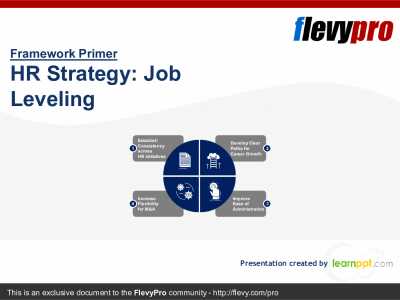
Job Leveling is a disciplined approach to gauge the value of work for individual positions across the organization. It entails ascertaining the nature of work done by each position, authority levels, and the effect of each job on business results.
Jobs that are configured inadequately bread [read more]
Do You Want to Implement Business Best Practices?
You can download in-depth presentations on Employee Management and 100s of management topics from the FlevyPro Library. FlevyPro is trusted and utilized by 1000s of management consultants and corporate executives.
For even more best practices available on Flevy, have a look at our top 100 lists:
These best practices are of the same as those leveraged by top-tier management consulting firms, like McKinsey, BCG, Bain, and Accenture. Improve the growth and efficiency of your organization by utilizing these best practice frameworks, templates, and tools. Most were developed by seasoned executives and consultants with over 20+ years of experience.
Readers of This Article Are Interested in These Resources
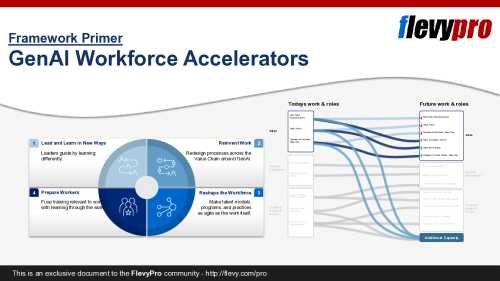
Generative AI (GenAI) is the most significant shift to work since the industrial revolution--and the Trifecta of Opportunities it unlocks (the economic, business, and people upsides) is the strategic objective. This presentation moves from the opportunity to the path: how leaders capture [read more]
In the face of the COVID-19 pandemic, Strategic Workforce Planning has emerged as the key to organizations effectively managing and adapting to unforeseen disruptions.
HR leaders excel in conducting Workforce Planning at the business unit level, but face challenges when it comes to incorporating [read more]
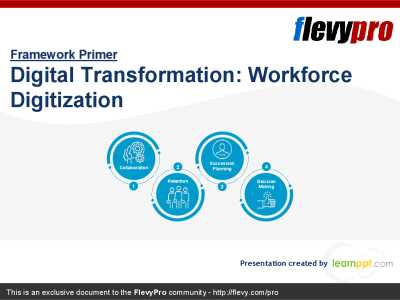
The approaching Age of Automation, together with the impending penetration of digital technology into the labor force, threatens to destabilize crucial aspects of how employees work by. It undermines the stability companies depend on to be agile.
Executives can re-solidify their companies even [read more]
This guide is a basic introduction to performance management, the process, setting objectives, providing feedback, the performance discussion between manager and employee. It is geared to small and mid-sized companies who want to provide a process that is clear and easy to use for managers.
This [read more]
 Employee engagement usually becomes a serious topic when a company starts noticing small but costly shifts in the workplace. Good people seem less energized. Managers spend more time putting out fires. Turnover risk grows, even among employees who once looked steady and committed. At that point, leaders often start searching for