Editor's Note: Take a look at our featured best practice, How to Build a Target Operating Model (TOM) (35-slide PowerPoint presentation). With recent developments and challenges, such as the impact of COVID-19, the extent of organisation flux is predicted to rapidly increase, such that many organisations are likely to be in a nearly permanent state of organisational flux. We can characterize organisational flux as the continuous [read more]
* * * *
Strategy defines the intent. It articulates priorities, allocates capital, and sets the trajectory for long-term success. It is a system of choices designed to shape the future. But Strategy alone does not deliver results. The real challenge begins after the boardroom leaves the table.
Execution determines whether the Strategy remains theory or becomes reality. Most strategies fail not due to flawed thinking, but due to weak execution. This is where Operating Models matter. They translate strategic direction into the day-to-day routines, roles, and systems that get real work done.
An Operating Model defines how the organization delivers value. It covers processes, structures, systems, governance, and decisions. It shows how capabilities are deployed across teams, locations, and partners. It defines how work is performed, how accountability is assigned, and how outcomes are measured. Without a strong Operating Model, even the best strategies collapse into local optimizations and siloed priorities.
This is why the Operating Model Canvas (OMC) was created—to give leadership a structured, actionable view of how to operationalize Strategy at scale.
Why the Operating Model Matters
Most organizations do not struggle with defining Strategy. They struggle with making it real. The gap lies in how Strategy gets translated into day-to-day work. Without clarity on who does what, where, and with what systems, teams guess. Functions optimize for their own metrics. Priorities drift.
An Operating Model serves as a blueprint for execution. It removes guesswork. It defines the critical processes, decision rules, roles, technologies, and partnerships required to deliver the value proposition. It forces alignment between strategic intent and real-world operations.
Strong Operating Models enable consistent execution, fast Decision-making, and measurable results. They provide the structure for scaling, adapting, and improving delivery across units. They allow executives to manage complexity without losing visibility.
The Operating Model Canvas: A Blueprint for Delivery
The Operating Model Canvas is a one-page framework that maps how the organization creates value. It was developed by Andrew Campbell and colleagues to give operational leaders a structured tool to bridge the gap between Strategy and Execution. It complements other tools like the Business Model Canvas, but it serves a different purpose.
Where the Business Model Canvas focuses on market opportunity, customer segments, and Value Creation logic, the Operating Model Canvas focuses on delivery. It answers the question: How will we actually deliver this Strategy, consistently, at scale?
The OMC is especially valuable for established organizations, Transformation initiatives, Post-Merger Integrations, and scale-ups. It is less about discovering new markets and more about designing for reliable, repeatable execution.
The Operating Model Canvas: Key Dimensions
The OMC is organized around 6 core dimensions. These are the essential levers required to deliver the Strategy. The acronym POLISM makes them easier to remember:
Processes – The end-to-end work that delivers value, from demand to fulfillment.
Organization – The people, roles, structure, and decision rights that execute the processes.
Locations – The physical or virtual sites where work occurs.
Information – The data, systems, and analytics used to inform decisions and enable execution.
Suppliers – The external partners and inputs critical to value delivery.
Management System – The governance, KPIs, planning, and performance routines that steer execution.
Each dimension is a lens through which to examine, design, and manage how work gets done. The value of the OMC is not just the map—it is the clarity it brings when all dimensions are reviewed together.
Let us examine the first two dimensions of OMC in more detail. These are often the most neglected and the most impactful.
Processes
The Processes dimension defines how work moves from initiation to completion. It identifies the critical flows that matter most—order to cash, concept to launch, demand to delivery. It also exposes bottlenecks, handoff risks, failure points, and variation.
Key design questions include:
Which processes are core to delivering the strategy?
Who owns each process?
What are the inputs, outputs, and controls?
What metrics define performance?
Designing processes requires more than drawing flowcharts. It requires assigning clear ownership, aligning SLAs with customer expectations, and defining standards for performance and compliance. The goal is not process mapping. The goal is process control.
Organization
The Organization dimension defines the people system that runs the processes. It includes structure, roles, decision rights, spans of control, reporting lines, and governance forums. It connects leadership intent to frontline execution.
Key questions include:
What structure enables coordination and accountability?
Who owns key decisions, and how are escalations handled?
How are roles defined, staffed, and measured?
What behaviors and Leadership practices are expected?
Designing the organization is not just about hierarchy. It is about making decision rights explicit, clarifying who does what, and aligning teams to outcomes. It is about enabling execution, not just describing functions.
Together, these two dimensions form the operating core. They must be coherent. A well-designed process cannot succeed if no one owns it. A strong team will underperform if processes are fragmented or redundant.
Case Study
A global consumer services organization faced persistent execution issues across its regional operations. Strategy was clear—expand into new markets, digitize the customer experience, and standardize service delivery. However, execution lagged. Projects stalled. Regional leaders implemented changes inconsistently. KPIs drifted.
The leadership team deployed the Operating Model Canvas to rebuild execution discipline. They focused on two critical value streams: onboarding new customers and resolving service requests.
In the Processes dimension, the team mapped the end-to-end workflows, identified process variants by region, and defined standardized SLAs. They exposed handoffs and inserted clear decision gates.
In the Organization dimension, roles were clarified. RACI matrices were introduced. Governance forums were reset with fixed cadences and data-backed dashboards.
The OMC exercise did not add complexity. It removed ambiguity. Within two quarters, service response times improved by 22 percent, escalation volume dropped, and new market onboarding was cut from 10 weeks to 6.
FAQs
What is the difference between the Business Model Canvas and the Operating Model Canvas?
The Business Model Canvas is used for high-level design of value creation and capture. It is ideal for early-stage ventures or innovation. The Operating Model Canvas is used to design execution. It defines how work is performed across functions to deliver the strategy.
How detailed should an OMC be?
Start at a high level. Focus on the major flows, decisions, and roles that drive value. Use workshops to refine each dimension. The goal is clarity, not exhaustive documentation.
Can the OMC be used across multiple business units?
Yes. Each business unit can have its own OMC, tailored to its strategy. Shared services or enterprise functions can also be mapped using the OMC structure.
How does OMC help with Transformation?
OMC clarifies what needs to change, who owns it, and how it connects to outcomes. It enables leaders to design the future state Operating Model in a structured, measurable way.
Who should lead an OMC effort?
Ownership should sit with the COO or a Strategy-Operations lead. HR, Finance, and IT are key partners. Execution requires sponsorship from top Leadership and engagement across all levels.
Final Thoughts
Execution is not accidental. It is designed. The Operating Model Canvas brings that design into focus. It connects Strategy to action. It aligns roles, systems, and structures with intent. It exposes ambiguity before it becomes failure. And it allows organizations to scale performance with clarity and control.
In complex environments, alignment breaks unless it is made explicit. OMC provides the blueprint. It does not replace Leadership, but it enables it. It does not solve every execution problem, but it shows where to start. And that is often the difference between ambition and achievement.
If your Strategy is not delivering results, the problem is not the plan. The problem is the Operating Model. The OMC gives you a way to fix it at speed.
You can download in-depth presentations on this and hundreds of similar business frameworks from the FlevyPro Library. FlevyPro is trusted and utilized by 1000s of management consultants and corporate executives.
For even more best practices available on Flevy, have a look at our top 100 lists:
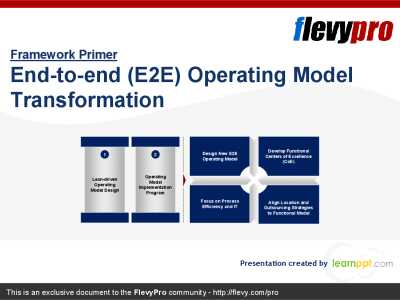
In many industries, executives have had their hands full staying competitive and surviving market downturns. This is done by making cuts, often silo by silo, and occasionally in ways that negatively affected customers.
It is time for organizations to rework their Operating Models in a new way, [read more]
Readers of This Article Are Interested in These Resources
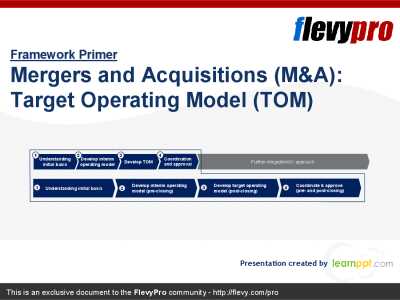
In an M&A situation, a fundamental question is what the Target Operating Model (TOM) of the resultant organization will look like. This framework addresses the topic of TOM Development in an M&A.
In formulating the Target Operating Model, there are 6 core areas that must be analyzed in an [read more]
Curated by McKinsey-trained Executives
🚀 How to Create Standard Operating Procedures (SOPs) – The Ultimate Business Guide to Scaling, Efficiency, and Profit
Stop Losing Time, Money, and Control -- Build SOPs That Actually Work
If your business depends on people remembering what [read more]
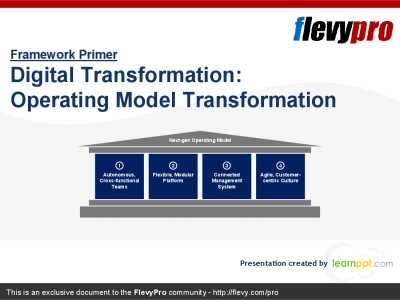
Lean Management plays a significant role in putting in place processes, capabilities, and tools to improve how businesses operate. But the Digital Age has increased both the opportunities for businesses who know how to react and the difficulty of getting it right.
Tasks performed by humans [read more]
More and more organizations are shifting a traditional Product-focused model to becoming a Customer-centric Organization. To do this without incurring debilitating costs from added process and organizational complexity, the organization must be build a true Customer-centric Organization by [read more]