Editor's Note: Take a look at our featured best practice, Internet of Things (IoT) Decision Framework (21-slide PowerPoint presentation). Internet of Things (IoT) products are more complex than typical products, since there a 5 layers of technology to consider, whereas other products may only have 2 or 3. With each additional layer, the complexity includes exponentially.
The IoT Decision Framework provides a structured approach [read more]
* * * *
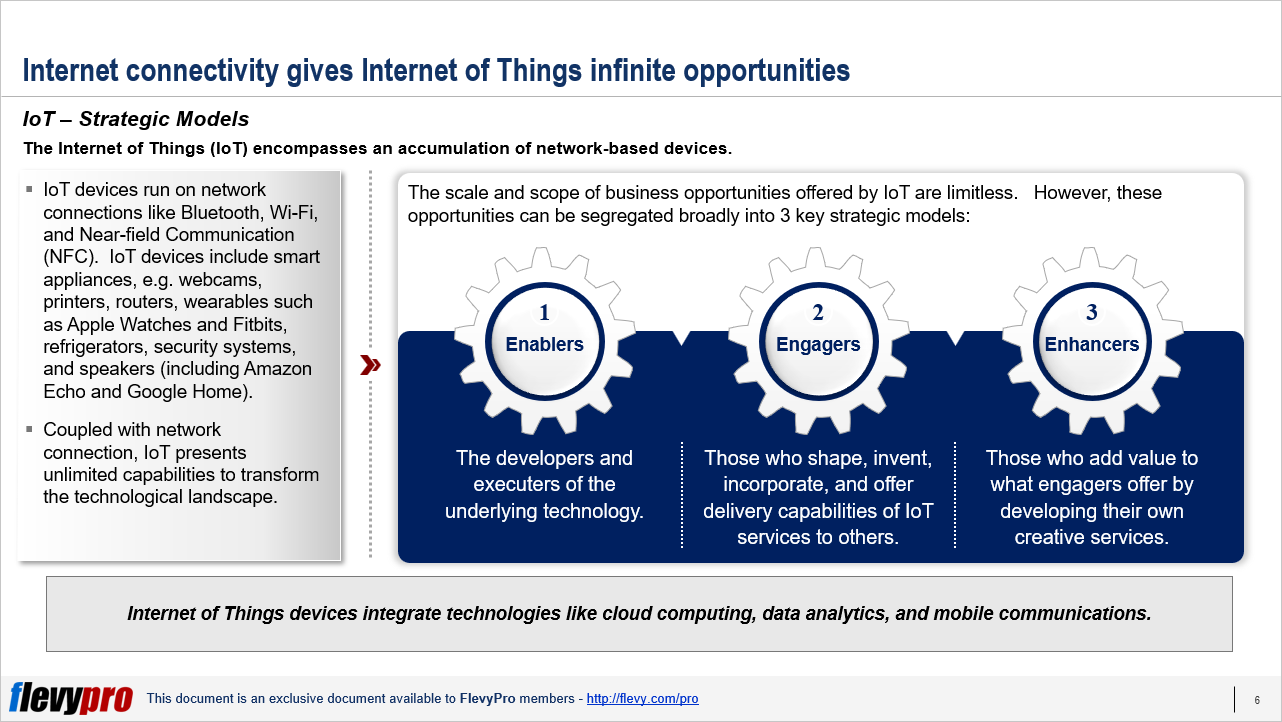
The Internet of Things (IoT) combines Innovation, outreach, and complexity. Despite the uncertainties in IoT industry, the technology offers unlimited opportunities to corporations. It encompasses an accumulation of network-based devices. IoT involves extending internet connectivity beyond standard devices. Embedded with technology, these devices can communicate and interact over the Internet. They can be remotely monitored and controlled.
IoT devices run on network connections like Bluetooth, Wi-Fi, and Near-Field Communication (NFC). IoT devices include smart appliances, e.g. webcams, printers, routers, wearables such as Apple Watches and Fitbits, refrigerators, security systems, and speakers (including Amazon Echo and Google Home).
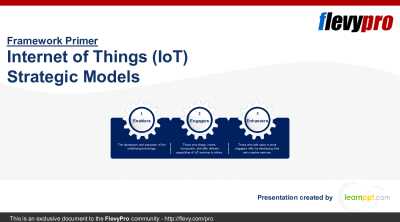
Organizations offering IoT products and services typically adopt one of the 3 Strategic IoT Models to capture sizable market share and succeed in the industry. The Strategic Models include:
Enablers
Engagers
Enhancers
Let’s talk about the IoT strategic models in detail.
Enablers
Enablers are technology-centric organizations—e.g. Cisco, Google, HP, IBM, and Intel—that develop and uphold key IoT infrastructure essential for Engagers to develop and offer individualized connected services.
The IoT value propositions offered by Enablers entail Endpoints, Hubs, and Network and Cloud services (for example infrastructure, hardware, devices, computing, database systems, software platforms). There is a huge market for such IoT offerings, which is growing at a steep pace. Some Enablers concentrate on specific business streams and models, e.g. Endpoints only.
For instance, Estimote creates small “beacons” that can be affixed to objects to transmit signals via Bluetooth to smartphones. These beacons can be used in settings such as retail stores by Engagers to gather data regarding items picked up by customers and time taken to make a purchase. Likewise, Intel, the semiconductors manufacturer, creates all-inclusive IoT systems—including chips and platforms integral to manufacture IoT services.
Engagers
Engagers use the IoT stack to provide innovative services. This Strategic Model is employed by various appliance manufacturers, automakers, insurance companies, and retailers. Engagers link the IoT with the market by employing endpoints, hubs, platforms, and other service offerings. They create services both for consumers and businesses.
Organizations adopting this Strategic Model compete in human-centered markets—e.g. smart home, connected cars, digital retail, intelligent factories, next-generation hospitals, and futuristic cities. Engagers present valuable location-based data to users in addition to gathering their browsing, movement, purchase history, and chat data.
Industry leading Engagers such as Apple and Google use their current capabilities to engage customers, deliver captivating customer experiences, and grab their attention towards their Integrating Hubs. By doing this, Engagers build lasting connections with the customers.
For instance, in the past Haier and Whirlpool (multinational appliance manufacturers) used to gather only the basic data of their washing machine buyers to manage warranties and to push new product offers. However, today their IoT enabled washing machines allow the manufacturers to collect useful insights regarding not only the machine usage—frequency, temperature gauge, detergent type, clothes type—but also offer personalized value-added services; reports on state of machine, need for repairs, water and energy conservation; and discount offers.
Enhancers
The Enhancers Strategic Model delivers enhanced, integrated, value-added IoT services by revamping and repackaging Engagers’ offerings. They partner with other corporations to develop and offer personalized product and service offerings, or even come up with new Business Models that have the ability to displace existing ones.
You can download in-depth presentations on this and hundreds of similar business frameworks from the FlevyPro Library. FlevyPro is trusted and utilized by 1000s of management consultants and corporate executives.
For even more best practices available on Flevy, have a look at our top 100 lists:
Until recently, most traditional companies could not adapt their established business models to participate in the so-called Sharing Economy. However, sensors and related technologies are changing that reality.
Sensors and the Internet of Things (IoT) are expected to connect 20 billion to 50 [read more]
Readers of This Article Are Interested in These Resources
Internet of Things (IoT) will soon become a differentiating factor in competition. Senior Leaders and Board Members are now required to take a systems approach. This systems approach will address the organizational challenges and risks the expansion of the digital domain will create.
Doing [read more]
Until recently, most traditional companies could not adapt their established business models to participate in the so-called Sharing Economy. However, sensors and related technologies are changing that reality.
Sensors and the Internet of Things (IoT) are expected to connect 20 billion to 50 [read more]
This document is a part of the Big Data Primer containing 7 chapters providing Overview of Big Data, its dimensions, ecosystem, applications, challenges & concerns, sentiment analysis and Gamification.
In the sixth chapter titled "Mobile Big Data and Internet of Things" following content is [read more]
The Internet of Things (IoT) encompasses an accumulation of network-based devices. IoT involves extending internet connectivity beyond standard devices. Embedded with technology, these devices can communicate and interact over the internet. They can be remotely monitored and controlled. [read more]