
This framework is developed by a team of former McKinsey and Big 4 consultants. The presentation follows the headline-body-bumper slide format used by global consulting firms.
Editor Summary
27-slide PowerPoint presentation by LearnPPT Consulting presenting a Connected Customer Strategy framework that defines 4 customer strategies—Fast Response, Personalized Recommendations, Proactive Recommendations, and Automatic Execution—and the 4 Rs Approach (Recognize, Request, Respond, Repeat).
Read moreThe deck contrasts traditional three-stage journeys (Recognize, Request, Respond), explains shortcomings of occasional interactions, and includes reusable slide templates. Target users include CMOs, chief customer officers, product managers, and CX leaders; sold as a digital download on Flevy.
Use this presentation when your organization needs to shift from occasional customer interactions to continuous, data-driven engagement—such as during digital transformation, competitive disruption, or when launching personalized experiences.
Chief Customer Officers designing end-to-end engagement programs that move beyond reactive service to continuous connection and repeat interaction.
Marketing executives building personalized and proactive campaign logic that leverages activity tracking and Data and Analytics to surface recommendations.
Product managers mapping automatic execution flows that remove customer friction and trigger responses based on recognized behavior.
The 4 Rs Approach (Recognize, Request, Respond, Repeat) reflects iterative customer-journey design practice emphasizing continuous engagement and feedback.
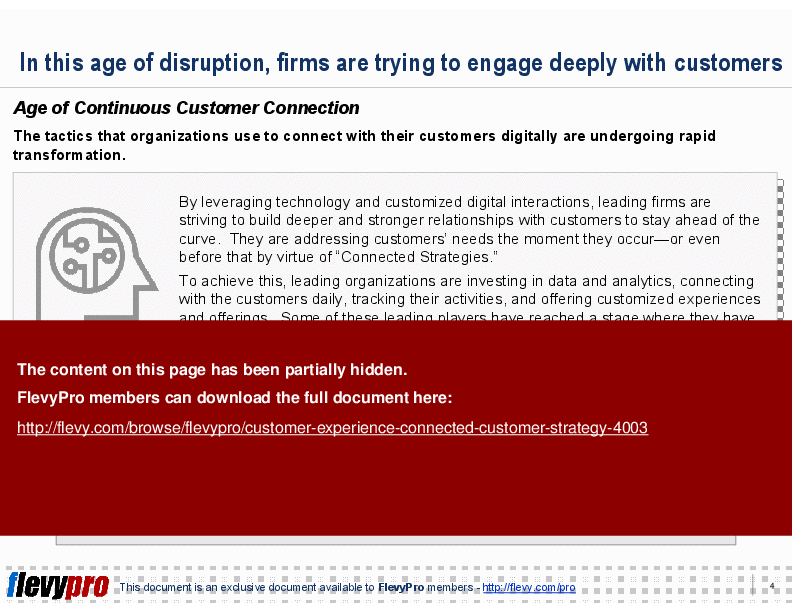
With each passing day, the tactics that organizations use to connect with their customers are undergoing rapid Transformation. By leveraging technology and customized digital interactions, leading firms are striving to build deeper and stronger relationships with customers to stay ahead of the curve.
To achieve this, leading organizations are addressing customers' needs the moment they occur—or even before that by virtue of "Connected Strategies." They are investing in Data and Analytics, connecting with the customers on a regular basis, tracking their activities, and offering customized experiences and offerings.
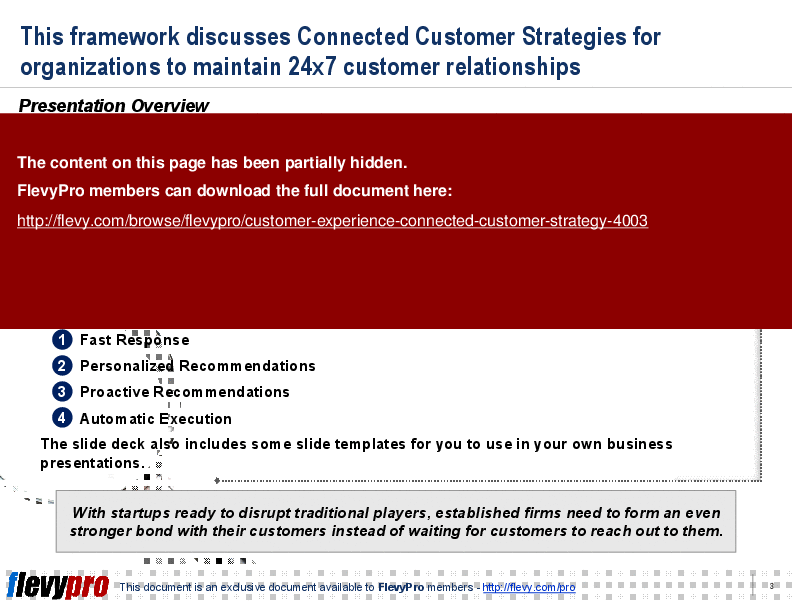
This presentation provides a detailed overview of the 4 distinct Connected Customer Strategies that are instrumental in developing exceptional and delightful Customer Journeys:
With startups ready to disrupt traditional players, established firms need to form an even stronger bond with their customers instead of waiting for customers to reach out to them.
The slide deck also includes some slide templates for you to use in your own business presentations.
This PPT dives deep into the nuances of the traditional customer journey, breaking it down into three critical stages: Recognize, Request, and Respond. It highlights the pitfalls of occasional interactions and emphasizes the need for continuous engagement to avoid customer dissatisfaction. The presentation outlines how traditional models fall short and why a shift towards a more connected strategy is imperative for modern businesses.
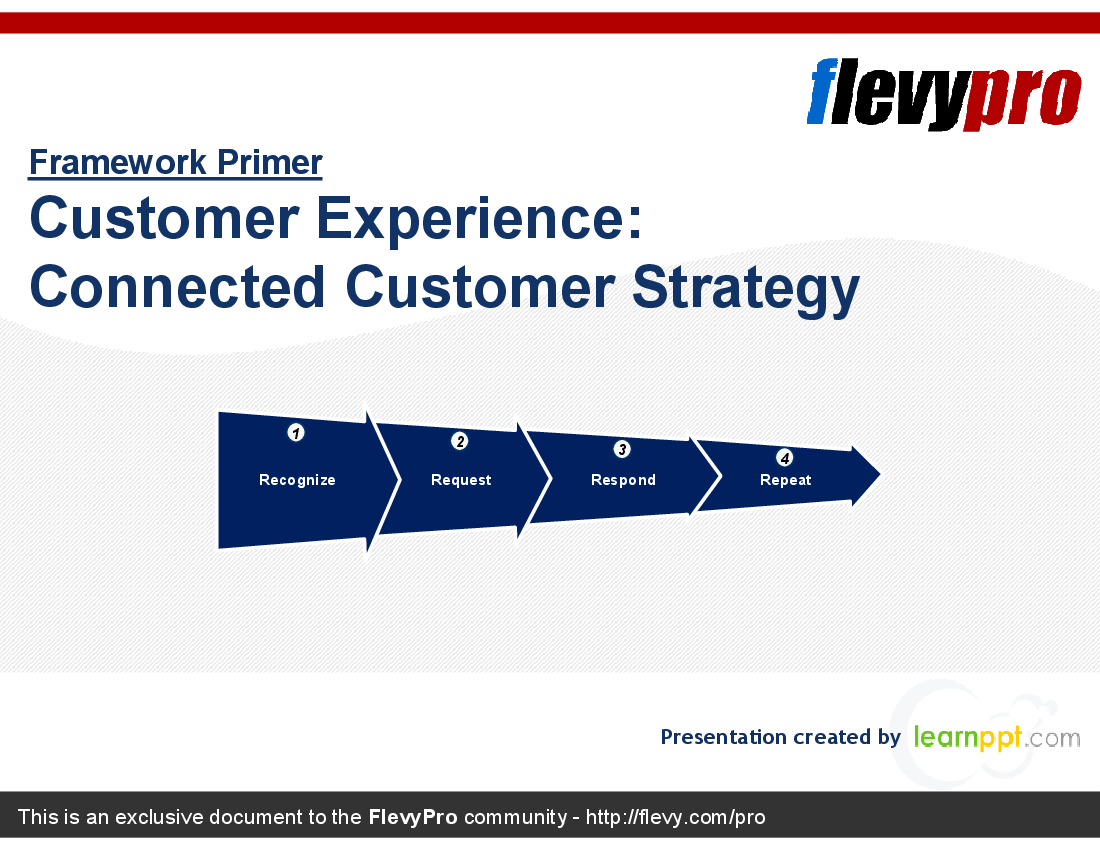
The framework also introduces the "4 Rs Approach"—Recognize, Request, Respond, and Repeat—providing a comprehensive template for organizations to follow. This approach ensures that companies not only meet, but anticipate customer needs, fostering loyalty and long-term relationships. The inclusion of practical templates and detailed strategy breakdowns makes this a must-have resource for any executive aiming to enhance their customer experience strategy.
What are the main types of connected customer strategies companies can adopt?
Connected customer strategies described in the overview are Fast Response, Personalized Recommendations, Proactive Recommendations, and Automatic Execution. Each strategy focuses on different timings and levels of automation in the customer journey, and the presentation explicitly outlines these 4 connected strategies.
How does the 4 Rs Approach organize customer journey activity?
The 4 Rs Approach structures customer engagement as a repeating loop: Recognize customer signals, Request interaction or permission, Respond with an offer or service, and Repeat to sustain the relationship. The approach is presented as a template for anticipating and fulfilling needs through continuous engagement using the Recognize, Request, Respond, Repeat loop.
Why do traditional customer journeys often lead to dissatisfaction?
The overview explains traditional journeys are often occasional rather than continuous, typically breaking into 3 stages—Recognize, Request, Respond—and failing to maintain engagement between interactions. This intermittent contact can leave needs unmet and cause dissatisfaction by not anticipating or addressing customer moments in time using the Recognize, Request, Respond sequence.
What capabilities support implementing proactive recommendations?
Implementing proactive recommendations requires investments in Data and Analytics, ongoing tracking of customer activities, and systems to surface customized experiences and offerings when relevant. The presentation links proactive recommendations to these capabilities and to developing customer journeys that anticipate needs using Data and Analytics and activity tracking.
What should I check in a CX strategy slide deck before buying for my team?
Buyers should verify the deck covers strategic options (e.g., Fast Response, Personalized, Proactive, Automatic), explains journey stages (Recognize, Request, Respond), provides a repeatable framework (4 Rs), and includes reusable slide templates. Flevy's Customer Experience: Connected Customer Strategy explicitly lists the 4 connected strategies and includes slide templates across 27 slides.
How important is Data and Analytics for personalized recommendations versus basic segmentation?
The overview states leading organizations are investing in Data and Analytics to track activities and deliver customized experiences; this suggests personalized recommendations rely on ongoing data collection and analytics rather than static segmentation. The presentation ties Personalized Recommendations to investments in Data and Analytics and activity tracking.
How can product teams incorporate Automatic Execution into features and flows?
Product teams can design flows that act without waiting for customer initiation by recognizing signals, issuing requests or prompts, and executing responses automatically. Automatic Execution is presented as one of 4 connected strategies that operationalize the Recognize→Request→Respond loop to remove friction and deliver timely experiences.
What structure and contents should I expect from a connected-customer strategy presentation?
Expect an explanation of why traditional three-stage journeys fall short (Recognize, Request, Respond), an outline of 4 connected strategies (Fast Response; Personalized, Proactive, Automatic), introduction of the 4 Rs Approach (Recognize, Request, Respond, Repeat), and practical slide templates—as packaged in a 27-slide deck.
This PPT slide outlines 4 key strategies under the Connected Customer Strategy: "Fast Response," "Personalized Recommendations," "Proactive Recommendations," and "Automatic Execution." "Fast Response" emphasizes timely customer engagement to enhance satisfaction and loyalty. "Personalized Recommendations" focuses on tailoring suggestions based on individual preferences, improving relevance and conversion rates. "Proactive Recommendations" advocates anticipating customer needs, differentiating businesses in competitive markets. "Automatic Execution" highlights the benefits of automating processes to streamline interactions, enhancing efficiency and reducing friction in the customer journey. These strategies are essential for businesses seeking to improve customer experiences and strengthen market position.
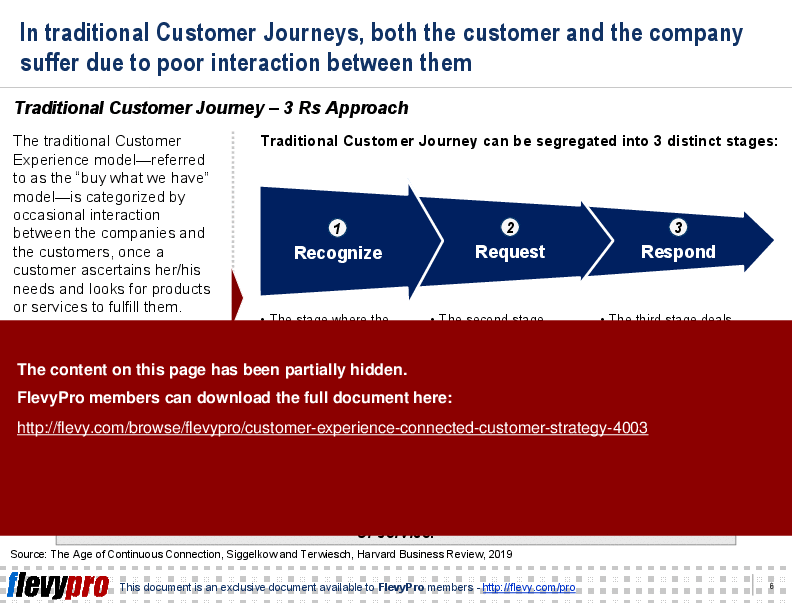
The traditional customer journey is segmented into 3 stages: Recognize, Request, and Respond, as outlined in the "3 Rs Approach." In the "Recognize" stage, customers become aware of their needs, necessitating clear identification of offerings. The "Request" stage involves customers actively seeking products or services, emphasizing the need for clarity in communication and product availability. The "Respond" stage focuses on product delivery and customer experience. A significant issue identified is the lack of meaningful interaction between customers and companies, often leading to a "buy what we have" mentality. Companies must rethink engagement strategies to enhance customer satisfaction and loyalty by developing a comprehensive understanding of customer needs and challenges.
The Repeat stage in the Connected Customer Strategy enhances the traditional customer journey phases: recognize, request, and respond. It transforms sporadic interactions into long-term relationships by leveraging insights from past engagements. Key characteristics include a deeper understanding of customers, enabling tailored offerings and customized solutions that meet specific needs. Companies refine their capabilities to align products and services with customer requirements. Anticipating future customer desires leads to increased satisfaction and loyalty. Learning at the population level allows organizations to analyze broader trends for product modifications. Attracting new customers and building trust are vital outcomes of a successful Repeat strategy. In today's digital landscape, integrating connected strategies into core operations is essential for maintaining relevance and achieving sustainable growth.
This framework is developed by a team of former McKinsey and Big 4 consultants. The presentation follows the headline-body-bumper slide format used by global consulting firms.
For $10.00 more, you can download this document plus 2 more FlevyPro documents. That's just $13 each.
ABOUT FLEVYPRO
This document is part of the FlevyPro Library, a curated knowledge base of documents for our FlevyPro subscribers.

FlevyPro is a subscription service for on-demand business frameworks and analysis tools. FlevyPro subscribers receive access to an exclusive library of curated business documents—business framework primers, presentation templates, Lean Six Sigma tools, and more—among other exclusive benefits.
The average daily rate of a McKinsey consultant is $6,625 (not including expenses). The average price of a Flevy document is $65.
Trusted by over 10,000+ Client Organizations
Since 2012, we have provided business templates to over 10,000 businesses and organizations of all sizes, from startups and small businesses to the Fortune 100, in over 130 countries.
"If you are looking for great resources to save time with your business presentations, Flevy is truly a value-added resource. Flevy has done all the work for you and we will continue to utilize Flevy as a source to extract up-to-date information and data for our virtual and onsite presentations!"
– Debbi Saffo, President at The NiKhar Group
"I have used FlevyPro for several business applications. It is a great complement to working with expensive consultants. The quality and effectiveness of the tools are of the highest standards."
– Moritz Bernhoerster, Global Sourcing Director at Fortune 500
"Flevy.com has proven to be an invaluable resource library to our Independent Management Consultancy, supporting and enabling us to better serve our enterprise clients.
The value derived from our [FlevyPro] subscription in terms of the business it has helped to gain far exceeds the investment made, making a subscription a no-brainer for any growing consultancy – or in-house strategy team."
– Dean Carlton, Chief Transformation Officer, Global Village Transformations Pty Ltd.
"I am extremely grateful for the proactiveness and eagerness to help and I would gladly recommend the Flevy team if you are looking for data and toolkits to help you work through business solutions."
– Trevor Booth, Partner, Fast Forward Consulting
"As a consultant requiring up to date and professional material that will be of value and use to my clients, I find Flevy a very reliable resource.
The variety and quality of material available through Flevy offers a very useful and commanding source for information. Using Flevy saves me time, enhances my expertise and ends up being a good decision."
– Dennis Gershowitz, Principal at DG Associates
"Flevy is our 'go to' resource for management material, at an affordable cost. The Flevy library is comprehensive and the content deep, and typically provides a great foundation for us to further develop and tailor our own service offer."
– Chris McCann, Founder at Resilient.World
"As an Independent Management Consultant, I find Flevy to add great value as a source of best practices, templates and information on new trends. Flevy has matured and the quality and quantity of the library is excellent. Lastly the price charged is reasonable, creating a win-win value for
the customer, Flevy and the various authors. This is truly a service that benefits the consulting industry and associated clients. Thanks for providing this service.
"
– Jim Schoen, Principal at FRC Group
"I have used Flevy services for a number of years and have never, ever been disappointed. As a matter of fact, David and his team continue, time after time, to impress me with their willingness to assist and in the real sense of the word. I have concluded in fact
that it is not at all just a repository of documents/resources but, in the way that David and his team manage the firm, it is like dealing with consultants always ready to assist, advise and direct you to what you really need, and they always get it right.
I am an international hospitality accomplished senior executive who has worked and lived during the past 35 years in 23 countries in 5 continents and I can humbly say that I know what customer service is, trust me.
Aside from the great and professional service that Flevy's team provide, their wide variety of material is of utmost great quality, professionally put together and most current.
Well done Flevy, keep up the great work and I look forward to continue working with you in the future and to recommend you to a variety of colleagues around the world.
"
– Roberto Pelliccia, Senior Executive in International Hospitality
Download our FREE Digital Transformation Templates
Download our free compilation of 50+ Digital Transformation slides and templates. DX concepts covered include Digital Leadership, Digital Maturity, Digital Value Chain, Customer Experience, Customer Journey, RPA, etc.
Download our FREE Digital Transformation Templates
Get Our FREE Product.
Download our free compilation of 50+ Digital Transformation slides and templates. DX concepts covered include Digital Leadership, Digital Maturity, Digital Value Chain, Customer Experience, Customer Journey, RPA, etc.









