Editor's Note: Take a look at our featured best practice, Design Thinking (225-slide PowerPoint presentation). DESIGN THINKING: MASTER FACILITATOR TOOLKIT (CERTIFICATION & TRAIN-THE-TRAINER)
Bridge the gap between strategic theory and frontline innovation. This exhaustive certification-level resource is a strategic discipline for solving the right problems in the right way. Designed for professional [read more]
Situations like this stimulate some organizations to partner with others. Fruitful partnerships comprise of having the appropriate people, processes, and organizational backing—in other words a whole ecosystem.
The Centralized Innovation Ecosystem is the most commonly used system across the globe. Key characteristics of this Innovation ecosystem include company acting as a Broker or Hub, creating separate relationships with each involved entity, entities involved not interacting with each other directly rather via the Broker.
Centralized Ecosystem Strategy hinges on containing precise, distinct problems and solutions. It is successful in mature industries.
In many situations, the conventional approach for Innovation Ecosystem Strategy development does not work.
The Adaptive Innovation Ecosystem is suited better for environments where requirements are fuzzy or industries are still maturing and need collaborations. Adaptive Innovation Ecosystem has the company acting as an Orchestrator, connecting entities that work together directly.
Adaptive Ecosystem Strategies are appropriate for circumstances where the problem and the solution are indeterminate or still being categorized.
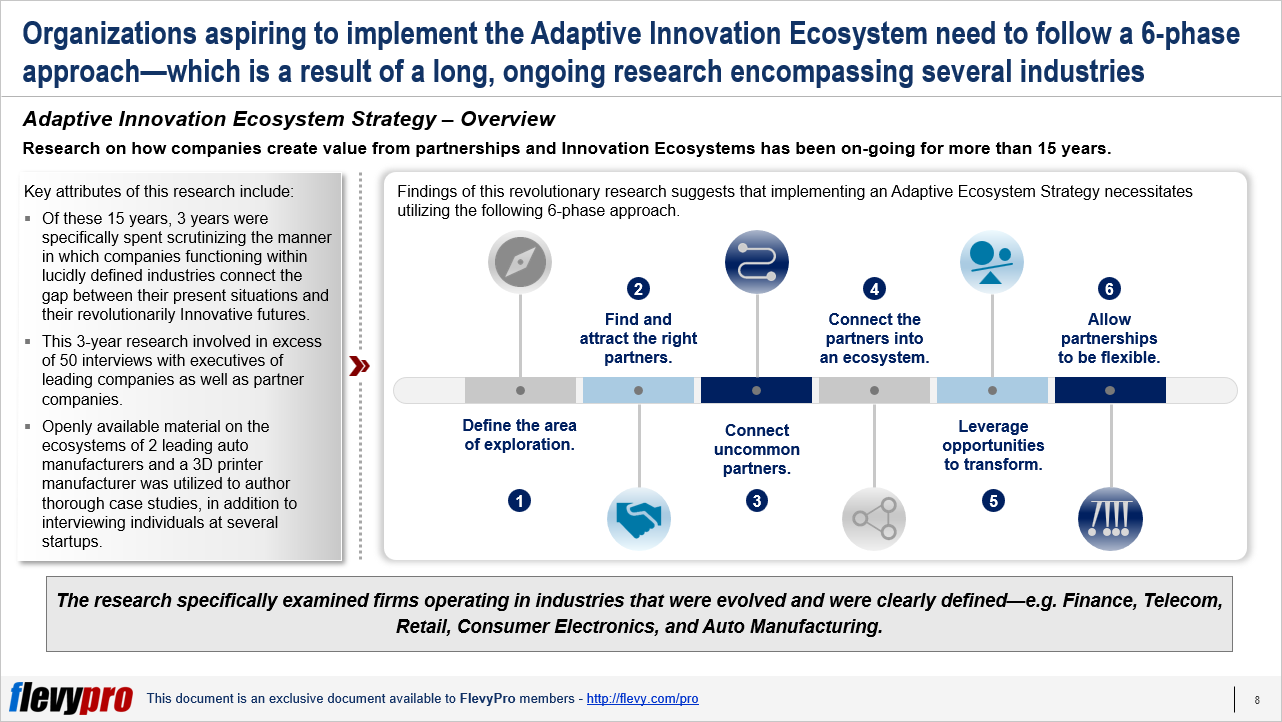
Research on how companies create value from partnerships and Innovation Ecosystems has been on-going for more than 15 years. Findings of this revolutionary research suggest that implementing an Adaptive Ecosystem Strategy necessitates utilizing the following 6-phase approach.
Define the area of exploration.
Find and attract the right partners.
Connect uncommon partners.
Connect the partners into an ecosystem.
Leverage opportunities to transform.
Allow partnerships to be flexible.
Let us delve a little deeper into details of the first 3 phases of this approach.
Define the Area of Exploration
Adaptive Innovation Ecosystems are deployed where the environment is ambiguous. It is, therefore, logical that the first step in an Adaptive Ecosystem Strategy should be to define the area that needs exploration.
In order to develop an Adaptive Innovation Ecosystem, it may be necessary for the Orchestrator to look beyond its industry to find partners. It may have to use unconventional ways of attracting them.
Experience has shown that partnering with uncommon entities have resulted in some of the most effective Adaptive Innovation Ecosystems Strategies.
Partnering entities are, at times, on the outer fringes of the industry or even outside the industry in which the said company operates. Challenge in this phase is ascertaining the competences needed for Innovation.
Connect Uncommon Partners
Centralized Innovation Ecosystems often operate on the basis that keeps partners separate from one another. Effectiveness of Adaptive Innovation Ecosystems is contingent on direct collaboration among partners. Orchestrators play the part of bringing these uncommon partners together. Bringing together uncommon partners can be demanding as many of the partners have never worked with one another. Also, there are few models for such collaboration.
Companies that have worked in Adaptive Ecosystems have come to the conclusion that, intrinsically, group effort do not go along a fixed pattern.
You can download in-depth presentations on this and hundreds of similar business frameworks from the FlevyPro Library. FlevyPro is trusted and utilized by 1000s of management consultants and corporate executives. Here’s what some have to say:
“My FlevyPro subscription provides me with the most popular frameworks and decks in demand in today’s market. They not only augment my existing consulting and coaching offerings and delivery, but also keep me abreast of the latest trends, inspire new products and service offerings for my practice, and educate me in a fraction of the time and money of other solutions. I strongly recommend FlevyPro to any consultant serious about success.”
– Bill Branson, Founder at Strategic Business Architects
“As a niche strategic consulting firm, Flevy and FlevyPro frameworks and documents are an on-going reference to help us structure our findings and recommendations to our clients as well as improve their clarity, strength, and visual power. For us, it is an invaluable resource to increase our impact and value.”
– David Coloma, Consulting Area Manager at Cynertia Consulting
“FlevyPro has been a brilliant resource for me, as an independent growth consultant, to access a vast knowledge bank of presentations to support my work with clients. In terms of RoI, the value I received from the very first presentation I downloaded paid for my subscription many times over! The quality of the decks available allows me to punch way above my weight – it’s like having the resources of a Big 4 consultancy at your fingertips at a microscopic fraction of the overhead.”
Innovative business models can reshape industries and drive tremendous growth. However, many organization find business model innovation difficult. The framework outlined in this presentation is based on the HBR article "Reinventing Your Business Model," authored by Clayton Christensen, Mark [read more]
Readers of This Article Are Interested in These Resources
As core markets become saturated with new entrants and products, we find it more and more difficult to grow the core. We find traditional approaches that have successfully driven growth historically are also reaching points of diminishing returns.
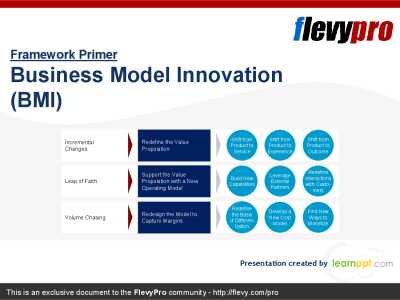
Business Model Innovation (BMI) is a powerful, [read more]
This toolkit contains a series of templates that are designed to capture the key elements of a innovative idea.
It is intended to a be a live document that is updated as you go through the discovery journey from idea to a revenue generating concept.
Each framework has key concepts that need [read more]
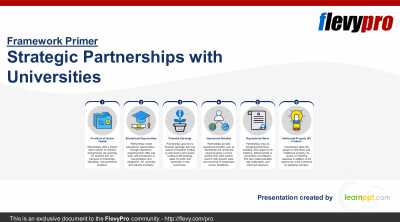
Partnerships among companies and universities are important drivers of the Innovation economy. Fruitful partnering with universities comprises of having the appropriate people, processes, and organizational backing to guarantee success and to detect and manage sources of conflict.
This [read more]
This PowerPoint compilation offers a comprehensive overview of 20 leading innovation management frameworks and methodologies, selected for their broad applicability across various industries and organizational contexts. These frameworks are valuable resources for a wide range of users, including [read more]
 When new technologies and competitors disrupt markets