Editor's Note: Take a look at our featured best practice, Hofstede's 6 Dimensions of National Cultures (35-slide PowerPoint presentation). Cultural differences can act as a barrier to communication. This could affect our organization's ability to build connections and motivate people. While we may be excited with the opportunities that global connectedness has brought forth, yet we are cautious of making cross-cultural faux [read more]
* * * *
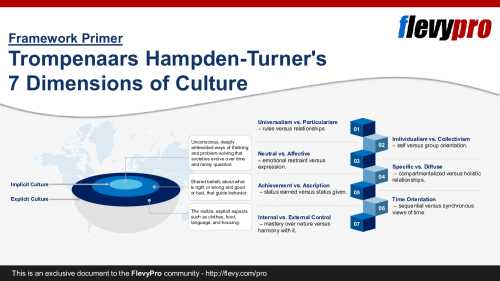
Culture does not sit quietly in the background of Strategy Development. It shapes how decisions are made, how risks are interpreted, and how Leadership signals intent. Trompenaars and Hampden Turner’s 7 Dimensions of Culture framework offers executives a structured lens to decode these dynamics across geographies. This is not theory for academic debate. It is a practical consulting template to prevent misalignment, reduce friction, and accelerate execution in global organizations.
Digital Transformation provides a sharp modern test case. Organizations scaling AI capabilities across regions often assume uniform adoption. Reality disagrees. Teams in rule-oriented cultures demand governance frameworks and compliance clarity before deploying AI tools. Relationship oriented environments prioritize trust building and informal validation before embracing automation. Leaders who ignore these differences end up with stalled initiatives and fragmented adoption.
The framework distills culture into 7 critical dimensions that influence behavior:
Universalism versus Particularism
Individualism versus Collectivism
Neutral versus Affective
Specific versus Diffuse
Achievement versus Ascription
Sequential versus Synchronous Time
Internal versus External Control
Each dimension represents a tension, not a binary choice. Strategy fails when executives treat these as fixed categories rather than dynamic levers.
At its core, the model highlights that culture operates in layers. Visible behaviors sit on top. Norms guide day to day actions. Deep assumptions drive unconscious decisions. Many organizations attempt Culture Change at the surface level. They introduce new processes, new KPIs, new messaging. Results disappoint because the underlying assumptions remain untouched.
Why this Framework Matter
Global Strategy Execution depends on behavioral alignment across diverse cultural contexts. Misinterpretations are not minor inconveniences; they derail deals, slow integration, and erode trust. A standardized global policy may appear efficient in theory but often collapses in practice when applied to markets that prioritize relationships over rigid rules. Conversely, excessive localization can fragment operations and weaken Organizational Design, undermining a company’s identity and cohesion.
The GLOBE framework matters because it equips leaders with a disciplined lens to balance global consistency with local adaptation. By embedding Cultural Intelligence into leadership practice, organizations can anticipate cultural expectations, reduce execution risks, and strengthen trust across markets. This alignment supports effective Change Management and enables sustainable Business Transformation. In essence, the framework transforms cultural complexity from a source of friction into a strategic advantage, ensuring that global ambitions translate into successful local execution.
The framework also forces Leadership teams to confront uncomfortable tradeoffs. Efficiency versus flexibility. Autonomy versus cohesion. Control versus adaptation. These are not problems to eliminate. They are tensions to manage.
Universalism versus Particularism
This dimension defines whether rules or relationships dominate decision-making. In Universalist environments, consistency is paramount. Contracts are binding, policies are enforced uniformly, and fairness is measured by equal application of standards. Predictability and transparency are valued, with leaders expected to uphold rules as the foundation of trust. In contrast, Particularist environments adapt decisions based on context. Relationships carry significant weight, exceptions are expected, and flexibility is seen as a sign of respect and responsiveness. Trust is built through personal bonds rather than strict adherence to rules, and leaders are judged by their ability to navigate unique circumstances with sensitivity.
Leaders often default to one side, but this is a mistake. A rigid universalist approach can alienate local teams and customers who expect relational nuance. An overly particularist approach risks inconsistency and governance challenges. High-performing organizations design hybrid models where global standards define boundaries while local discretion enables responsiveness, ensuring effective Strategy Execution and cultural alignment.
Individualism versus Collectivism
This dimension shapes how performance is measured and rewarded, directly influencing Performance Management systems. In individualist cultures, personal achievement is celebrated, and success is tied to individual contribution. Recognition, promotions, and incentives often highlight the accomplishments of high performers, reinforcing competition and self-driven outcomes. In collectivist cultures, however, group success is emphasized. Collaboration, harmony, and shared responsibility define performance, and rewards are structured to strengthen team cohesion rather than spotlight individuals.
Misalignment between these orientations shows up quickly. An organization that rewards individual sales performance may demotivate teams in collectivist environments where collaboration drives outcomes. Conversely, in individualist settings, tying rewards solely to group results risks disengaging top performers who expect recognition for their distinct contributions. The solution lies in dual metrics—systems that recognize individual excellence while linking incentives to team outcomes. Achieving this balance is complex, but when executed well, it enhances motivation, strengthens trust, and ensures effective Strategy Execution across diverse cultural contexts.
Case Study
A multinational technology organization launched an enterprise-wide AI initiative. Headquarters designed a centralized governance model with strict protocols. Rollout in North America progressed quickly. European teams complied but raised concerns around regulatory interpretation. Asian markets showed resistance, not due to technical limitations but due to trust gaps and unclear relational alignment.
Leadership initially interpreted this as execution failure. They pushed harder. Adoption stalled further. A consulting intervention applied the 7 Dimensions framework. The diagnosis revealed multiple cultural tensions. Universalist bias in headquarters clashed with particularist expectations in regional markets. Individual performance metrics conflicted with collectivist norms. Neutral communication styles from central teams were perceived as cold and directive in affective cultures.
The organization redesigned its approach. Governance remained centralized but allowed local adaptation. Regional leaders were empowered to contextualize AI use cases. Communication shifted to include storytelling and relationship building. Incentives balanced individual and team metrics. Adoption accelerated within months. Not because the technology changed. Because the cultural strategy did.
FAQs
How can Leadership teams operationalize cultural dimensions in Strategy Development?
Embed cultural diagnostics into planning cycles. Treat culture as a variable, not a constant. Use structured assessments to identify dominant orientations across regions and adjust execution models accordingly.
Can organizations shift cultural orientation intentionally?
Yes, but slowly. Culture evolves through consistent signals, incentives, and Leadership behavior. Forced shifts without alignment create resistance.
How does this framework support Risk Management?
It identifies hidden risks in decision making and communication. Cultural misalignment often leads to compliance gaps, stakeholder conflict, and execution delays.
Is this framework relevant for remote and hybrid work environments?
More than ever. Virtual collaboration amplifies cultural differences. Without physical cues, misinterpretation increases. Structured cultural awareness becomes critical.
Closing Remarks
Strategy without cultural alignment is theater. It looks convincing in boardrooms and fails in execution. Leaders who treat culture as a soft variable underestimate its impact on performance. Global organizations operate in a constant state of tension. Standardization drives scale. Localization drives relevance. The 7 Dimensions framework does not resolve this tension. It equips leaders to navigate it with intent.
Execution excellence now depends on cultural intelligence as much as operational discipline. Organizations that master both will not just expand globally. They will operate as truly integrated systems.
You can download in-depth presentations on this and hundreds of similar business frameworks from the FlevyPro Library. FlevyPro is trusted and utilized by 1000s of management consultants and corporate executives.
For even more best practices available on Flevy, have a look at our top 100 lists:
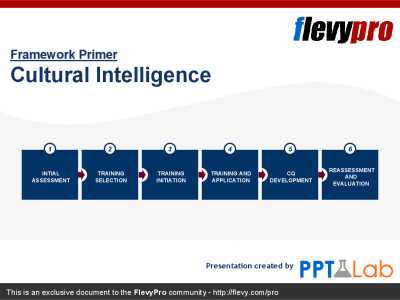
Cultural Intelligence (CQ) is a model that ability to cope with national, corporate, and vocational cultures. It was developed by Christopher Earley and Elaine Mosakowski, based on a study of 2,000 managers across 60 countries. CQ is the ability to understand unfamiliar contexts, and then to [read more]
Readers of This Article Are Interested in These Resources
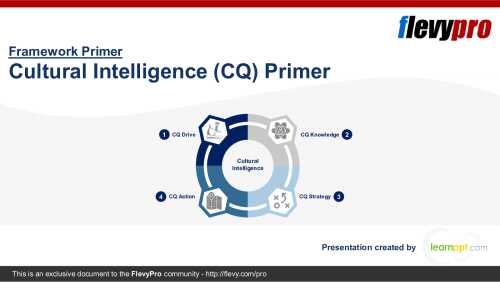
Today's business environment demands more than just market knowledge and technical expertise. It calls for Cultural Intelligence (CQ)--the ability to cross boundaries and thrive in multiple cultures.
In this PowerPoint presentation, we will explore the essence of CQ, focusing on its 4 core [read more]
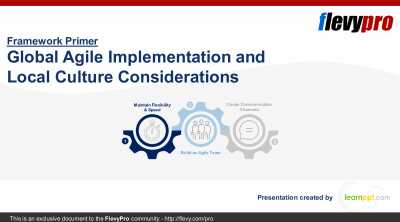
In today's modern era driven by Technology and Innovation, organizations can only survive if they are swift and agile; and have the capability of learning and adjusting rapidly.
Organizations have become cognizant of this and have introduced Agile methodologies in their Operations to allow them [read more]
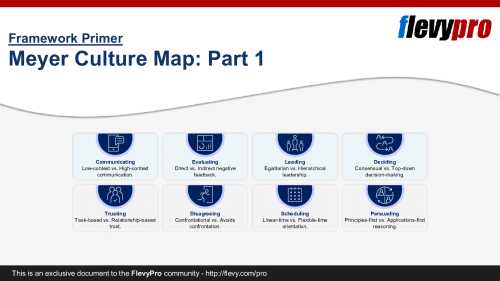
As organizations operate across increasingly complex international environments, cultural friction remains a persistent leadership challenge to navigate. Cultural differences weaken collaboration, disrupt trust, and create hidden operational drag.
This PPT presentation discusses the Meyer [read more]
Societal Culture shapes how organizations and societies define problems, make decisions, and pursue goals. It evolves over time through internal innovation and external influences. Differences in culture across geographies often lead to miscommunications, misalignment, and conflict.
This PPT [read more]
 Culture does not sit quietly in the