 Corporate legal teams often inherit entity records that have grown across jurisdictions, business units, and years of transactions without a truly centralized system. In the early stages, spreadsheets, shared folders, calendar reminders, and email chains may look manageable enough. Once the company expands, however, manual tracking starts creating risk around filing deadlines, ownership records, director changes, and audit readiness.
The real shift happens when a legal department moves from scattered administration to a dedicated legal entity management software environment that can support governance at scale. Better organization matters because entity information affects compliance, board activity, tax coordination, financing, due diligence, and internal reporting all at once.
Where Manual Tracking Starts to Break Down
Manual tracking often survives longer than it should because legal teams become skilled at compensating for weak systems. A spreadsheet may still produce results for a while, but the amount of checking, updating, and cross-referencing grows quietly until routine work becomes harder to control.
Deadlines Become Harder to Trust
Filing calendars and renewal dates are among the first areas where manual systems begin to weaken. One missed update, one outdated spreadsheet version, or one handoff between team members can create a compliance gap that stays invisible until the deadline is already close.
Risk rises faster when the group manages multiple entities across states or countries. Calendar discipline matters, but it becomes much harder to trust when the underlying data lives in too many places.
Entity Records Drift out of Sync
A corporate structure changes over time through director appointments, officer updates, address changes, ownership shifts, and new subsidiary formation. Manual methods often fail because one document is updated while another remains unchanged, leaving the team uncertain about which record is actually current.
The weak points below usually become visible first in manual systems:
- Duplicate spreadsheets with conflicting updates
- Entity charts that no longer reflect current ownership
- Filing deadlines tracked in separate calendars
- Supporting documents stored across different folders.
Knowledge Stays with Individuals
Manual tracking often depends too heavily on the memory of one or two experienced team members. When that happens, continuity suffers every time someone is absent, changes roles, or leaves the company. A department that relies on personal memory becomes harder to scale and more exposed during transitions.
What Legal Teams Gain from Software
Dedicated entity management systems are valuable because they reduce fragmentation rather than simply digitizing existing paperwork. The teams get a structure where records, deadlines, documents, and responsibility can stay connected instead of being managed through separate workarounds.
Centralized Visibility
A software platform gives the team one reference point for entity records, organizational charts, officers, filings, and key documents. Centralization improves daily work because legal staff spend less time confirming whether they are looking at the latest version. Visibility matters during ordinary administration, but it becomes even more important during transactions, audits, financing rounds, and governance reviews.
Better Governance Support
Entity management software supports governance because it helps legal teams maintain records in a way that is easier to review and defend. Board minutes, resolutions, director data, and subsidiary information are easier to connect when the system is built around legal structure rather than general document storage.
A stronger setup can also support a broader business strategy framework because executives and leadership can see how entity structure aligns with expansion, investment, and risk management decisions.
The operational benefits below often make the biggest difference after implementation:
- One source for entity and governance records
- Clearer ownership of filing responsibilities
- Faster document retrieval during reviews
- Better audit and diligence preparation
- More reliable reporting across jurisdictions.
Less Administrative Rework
A legal team using dedicated software usually spends less time hunting for signatures, confirming effective dates, rebuilding charts, or checking whether a filing already happened. Rework drops because the process becomes more structured and repeatable.
Why the Difference Matters More as Companies Grow
Growth makes manual systems weaker because each new subsidiary, market entry, or financing event adds more records and more deadlines. Complexity does not increase in a straight line. It compounds. A structure that felt acceptable with ten entities may feel fragile at forty.
Legal teams often notice the problem most clearly when a diligence request arrives or when leadership asks for a current structure map and the answer takes too long to assemble. Growth raises expectations around speed, accuracy, and audit readiness, so entity management becomes a bigger legal operations issue. A faster starting point is running a business entity search to pull current registration status and ownership records directly from state filings, before the internal records reconciliation begins.
A Stronger Operating Model
Choosing software instead of manual tracking is a governance decision. Legal entity management software helps corporate legal teams reduce deadline risk, improve record accuracy, and create a more dependable system for supporting the business as it expands.
Manual tracking can work for a limited period, but it rarely scales cleanly. A department that wants better control over compliance, board records, and structural visibility usually gains more from a centralized system than from trying to keep increasingly complex entity work inside spreadsheets and folders.
Do You Want to Implement Business Best Practices?
You can download in-depth presentations on Governance and 100s of management topics from the FlevyPro Library. FlevyPro is trusted and utilized by 1000s of management consultants and corporate executives.
For even more best practices available on Flevy, have a look at our top 100 lists:
These best practices are of the same as those leveraged by top-tier management consulting firms, like McKinsey, BCG, Bain, and Accenture. Improve the growth and efficiency of your organization by utilizing these best practice frameworks, templates, and tools. Most were developed by seasoned executives and consultants with over 20+ years of experience.
Readers of This Article Are Interested in These Resources
113-slide PowerPoint presentation
This presentation is a collection of PowerPoint diagrams and templates used to convey 20 different governance, risks and compliance frameworks and models. (Please note that these are diagrams and charts that are to be used in your own business or classroom presentations. These are not
[read more]

23-slide PowerPoint presentation
All organisations have to have a framework to maintain, adapt and grow their IT applications, software and hardware alike, they have to manage vendors and they have to create scale-able platforms.Without a governance framework these efforts can not be orchestrated in a methodical way. This
[read more]

165-slide PowerPoint presentation
Curated by former McKinsey Consultants
Are you looking to elevate your business strategy and take your company to the next level? Do you want to gain a competitive edge in your industry and drive growth? Look no further than our Strategy Consulting Toolkit.
Our toolkit is a comprehensive
[read more]
22-slide PowerPoint presentation
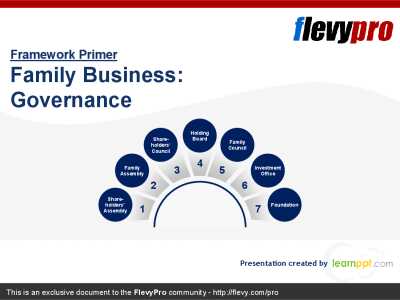
Governance of Family Businesses must include the concerns of the numerous and diverse third generation. Establishing a set of councils and boards is essential in addressing critical transition issues. With a Governance Model, Family Businesses can address acute short-term challenges and prepare
[read more]