Editor's Note: Take a look at our featured best practice, GenAI Roadmap Design (30-slide PowerPoint presentation). Organizations worldwide are embracing GenAI for its ability to generate actionable insights, predict outcomes, personalize at scale, and process natural language with human-like fluency.
Leading organizations already deploy GenAI in AI-assisted software development, workflow automation, [read more]
* * * *
Generative AI (GenAI) has moved past the novelty phase. Most executives know what the technology can do. They have already seen draft reports written in seconds, code generated on command, customer interactions summarized instantly, and policy documents turned into searchable knowledge. However, many leadership teams are still treating GenAI like a clever side project when it should be handled like a full-scale strategy decision tied to value, risk, operating model, and governance.
That is where many programs stall out. An organization runs a chatbot pilot, buys a few licenses, launches a small proof of concept, then wonders why enterprise results never show up on the P&L. The pattern is familiar: excitement is high, discipline is thin, and nobody has answered the hard questions around process redesign, talent implications, or control points. A serious roadmap fixes that and turns scattered experimentation into an executable sequence of decisions. The GenAI Roadmap Design framework does exactly that by linking AI ambition to initiative selection, experimentation, prioritization, process redesign, organizational change, and governance.
The GenAI Roadmap Design Framework Structure
The framework is a structured model that helps an organization move from isolated AI pilots to measurable enterprise impact. It is a Strategic Planning framework for deciding where GenAI should play, how it should create value, what should be tested first, and which controls must be built before scale.
This framework earns its keep in 3 ways. First, it reduces waste by stopping random experimentation that burns money and management attention. Second, it improves speed by clarifying which use cases deserve investment and which ones should be killed early. Third, it increases the odds of durable value because it forces leadership to connect GenAI to workflow redesign, role clarity, and governance rather than shiny demos.
The 7 elements of the GenAI Roadmap Design framework are:
Develop a Progressive AI Vision
Identify AI Initiatives
Undertake Calculated AI Experiments
Prioritize High Impact AI Initiatives
Redesign End to End Processes
Reimagine Structure, Processes, and Roles
Set Up an AI Governance Framework
Let’s discuss the first 3 elements of the framework in detail, for now.
Develop a Progressive AI Vision
Without a clear AI vision, GenAI is not more than disconnected pilots. One team wants a writing assistant, another wants automated research, another wants a customer service bot. Everyone is busy. Nobody is aligned. A progressive AI vision forces leadership to answer a sharper set of questions. Which functions matter most. What decisions need human control. What risks are unacceptable. Where will GenAI create measurable value.
The vision should not freeze the organization in a rigid target state. It should set direction, principles, funding logic, and boundaries while allowing the roadmap to evolve as capabilities improve. It also has to distinguish GenAI from predictive AI. GenAI is useful for synthesis, content creation, summarization, reasoning support, and interaction. It is not a replacement for every forecasting engine or rule-based control system.
A good vision creates accountability. It defines what responsible deployment looks like, where validation is mandatory, and what success means in practical terms such as cycle time reduction, quality improvement, or faster onboarding.
Identify AI Initiatives
Once the vision is in place, the next task is use case selection. The strongest initiatives are tied to actual workflow pain points. An organization should look for areas where GenAI can remove repetitive cognitive work, speed document heavy processes, improve knowledge retrieval, support Decision making, or enhance customer and employee interactions.
The screening criteria should be blunt. Does the initiative solve a meaningful problem. Does it save time or improve output quality. Does it fit the risk appetite. Is the required data available and usable. Is human oversight clear. Could the solution scale beyond a single team. If the answer is vague on most of those questions, park it.
Undertake Calculated AI Experiments
Experimentation is the bridge between concept and scaled execution. Smart organizations do not roll GenAI into the enterprise just because a demo looked slick in a steering committee. They test a small number of prioritized use cases in controlled settings with defined objectives, success metrics, and clear exit criteria.
Calculated experiments should be time bounded, data controlled, and tied to real workflows. End users need to be involved early because polished vendor demos tell you almost nothing about messy day to day execution. The right pilot measures time saved, error reduction, quality uplift, user adoption, failure modes, and control gaps. Teams learn prompt design, workflow orchestration, evaluation methods, exception handling, and governance requirements before scale.
Case Study
Consider a mid-sized retail and commercial bank facing rising service costs, slow credit file preparation, and inconsistent compliance documentation. Leadership had already run several disconnected AI pilots. None had moved the needle. The organization then adopted the GenAI Roadmap Design framework to reset the effort.
The first move was vision. Executives defined 3 enterprise priorities for AI deployment: improve frontline productivity, shorten credit and onboarding cycle times, and strengthen control quality in regulated workflows. Next, teams identified initiatives in relationship management, underwriting support, policy summarization, and contact center assistance. Ideas that looked interesting but carried poor data readiness or unclear controls were shelved.
The bank then ran a small set of calculated experiments. One pilot used GenAI to prepare first draft credit memos from structured and unstructured inputs. Another supported service agents by summarizing prior interactions and suggesting compliant next best responses. A third tested policy monitoring and document summarization for compliance teams. Results were measured against handling time, documentation quality, exception rates, and user adoption. Credit teams cut preparation time sharply. Service teams improved response consistency. Compliance teams reduced manual review hours. Leadership then prioritized the initiatives with the best mix of value, feasibility, and control readiness, setting up the next stages of process redesign and governance.
FAQs
What makes GenAI different from predictive AI in a roadmap discussion?
Predictive AI estimates likely outcomes. GenAI creates, synthesizes, explains, and interacts in natural language. An effective roadmap treats them as complementary capabilities, not substitutes. One informs decisions, the other accelerates the work around those decisions.
How many GenAI pilots should an organization run at once?
Very few. A small portfolio of well-chosen pilots beats a crowded backlog of half-managed experiments. Too many pilots create noise, stretch control functions, and make learning harder to capture.
What types of initiatives usually create the fastest returns?
Document intensive, knowledge heavy, repetitive workflows often move first. Examples include drafting, summarization, onboarding support, case preparation, agent assistance, and code review. These tend to offer visible productivity gains without requiring a full operating model rebuild on day one.
Who should own the roadmap?
Senior leadership must own the direction, risk appetite, funding logic, and success metrics. Functional leaders, technology teams, control functions, and end users should shape execution. If ownership sits only in IT, only in innovation, or only with a vendor, expect drift.
When should governance be introduced?
Immediately. Governance is not the clean-up crew after deployment. It should be embedded from the start through policy guardrails, use case approval criteria, risk assessment, human validation rules, and monitoring standards. Waiting until scale arrives is how an organization earns an avoidable headache.
Closing Thoughts
The real promise of GenAI is not faster content generation. The larger opportunity is management leverage. When an organization redesigns work around AI-enabled judgment, it changes how decisions are prepared, how knowledge travels, how teams coordinate, and how leaders allocate scarce talent. That is a much bigger prize than a handful of productivity wins.
A disciplined framework signals that AI is part of the core operating agenda. That changes behavior. Managers get more serious about use case quality. Control teams engage earlier. Talent discussions become more practical. Investment choices improve. Culture shifts, slowly at first, then all at once.
You can download in-depth presentations on this and hundreds of similar business frameworks from the FlevyPro Library. FlevyPro is trusted and utilized by 1000s of management consultants and corporate executives.
For even more best practices available on Flevy, have a look at our top 100 lists:
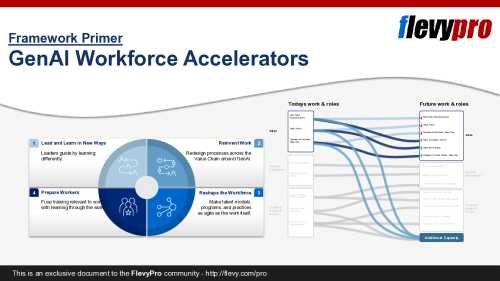
Generative AI (GenAI) is the most significant shift to work since the industrial revolution--and the Trifecta of Opportunities it unlocks (the economic, business, and people upsides) is the strategic objective. This presentation moves from the opportunity to the path: how leaders capture [read more]
Readers of This Article Are Interested in These Resources
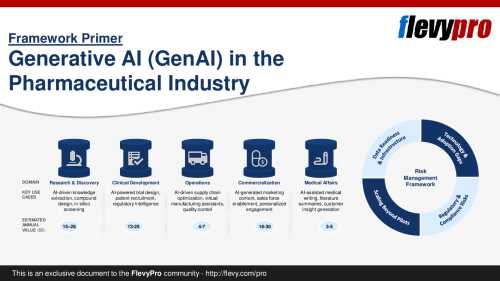
Pharmaceutical companies recognize the immense potential of Generative AI (GenAI) to accelerate drug discovery, improve clinical trials, and optimize commercial operations. Yet, capturing real value requires moving beyond hype to structured implementation strategies.
The McKinsey Global [read more]
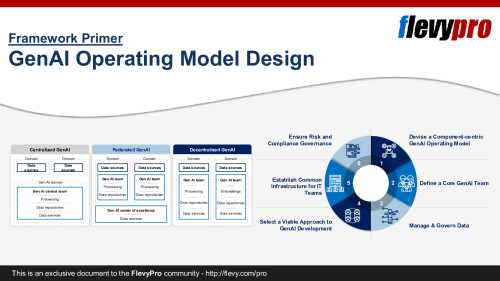
GenAI use is rising globally. Many organizations set GenAI strategies and launch pilots across functions. Yet most stall at the proof-of-concept stage and never show measurable financial or operational results.
This PPT presentation outlines the missing piece: an effective GenAI Operating [read more]
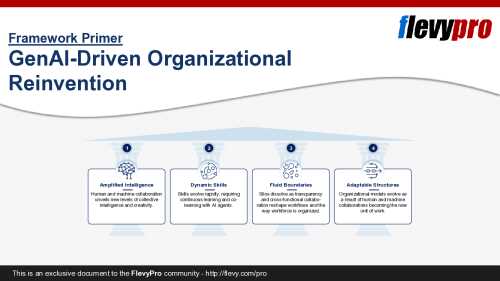
Generative AI (GenAI) marks a turning point in how organizations function and compete today. Similar to how the industrial revolution reshaped production, this wave of GenAI forces leaders to reimagine operating models, workforce design, and decision‑making at unprecedented speed.
This [read more]
A fast-growing share of buyers now open an AI answer engine--ChatGPT, Perplexity, Google's AI answers, Claude, or Copilot--instead of a search engine, asking for an answer rather than a page of links. The engine names a few options, recommends one, and passes judgment on price and trust. [read more]